"Dad, did dinosaurs eat fish too?" Your child might ask this on a day when there is fish on the table. Baryonyx is a good dinosaur to talk about then.
Baryonyx was a meat-eating dinosaur that lived in the Early Cretaceous, in what is now England. It ate mostly fish, using a long snout like a crocodile's and pointed, cone-shaped teeth, and it had a claw on its thumb that was longer than a 30 cm (12 inch) ruler. Fossil fish scales were found in its belly, which made it the first meat-eating dinosaur with proof that it ate fish. Below are the questions children ask most, with answers at a child's level. You can read them out loud.
Fact cardBaryonyx
- Name means
- heavy claw
- Lived
- Early Cretaceous (about 130 to 125 million years ago)
- Length
- about 9 m (30 ft)
- Weight
- about 1.2 to 2 tonnes
- Food
- Meat-eater that ate mostly fish
- Found in
- Europe (England)
- Group
- Big meat-eating dinosaurs
- A very big claw on its thumb
- A long snout like a crocodile's
- Pointed, cone-shaped teeth
How big was Baryonyx? Measure it with your own height
When your child asks, answer like this
 What does Baryonyx mean?

How big was it?
What did it eat?
How did it hunt?
Who lived with it?
- Scheenstia (an ancient fish) preyfossil evidence
The scales and teeth of Scheenstia were found in the belly of Baryonyx. This is clear proof that Baryonyx caught and ate this fish. - A young dinosaur from the Iguanodon group preyfossil evidence
The bones of a young plant-eating dinosaur were found in the belly of Baryonyx too. Nobody knows yet if Baryonyx hunted it or ate one that was already dead. - Mantellisaurus neighboursame time and place
A fossil of the plant-eating dinosaur Mantellisaurus was found in the same clay pit as Baryonyx. The two probably lived by the same water.
When and where did it live?
What was it like as a baby? Did it live with friends?
Are there dinosaurs that look like it?
Who found it first?
Baryonyx facts that make kids say “Wow!”
- Fossil fish scales were found in the belly of Baryonyx. That is how we learned that it caught and ate fish.
- Baryonyx was the first meat-eating dinosaur with proof that it ate fish.
- To get the skeleton out, about 2 tonnes of rock and clay were moved in 54 blocks.
- The skeleton of Baryonyx is now in the Natural History Museum in London, England.
From head to tail
- Its thumb claw was about 31 cm (12 inches) long measured along the curve, longer than a 30 cm ruler.
- Its skull was probably about 95 cm (3 ft) long.
- It had 32 teeth in a row on just one side of its lower jaw.
- Its nostrils were set a long way back from the tip of its snout.
A Baryonyx story to read aloud
Mist rises over the lake where the ferns grow thick. Baryonyx stands in the shallow water and looks down into it. Its long, crocodile-like snout holds a row of pointed teeth. A Scheenstia fish swims by, and its scales sparkle. Baryonyx darts its snout forward and snaps up the fish. The big claw on its thumb shines in the sunlight. Far along the shore, a Mantellisaurus is eating plants.
A quiz to do together
Tap an answer.
What does the name Baryonyx mean?
What was found in the belly of Baryonyx?
Which finger has the big claw of Baryonyx?
You finished the quiz! Well done.
Colouring page
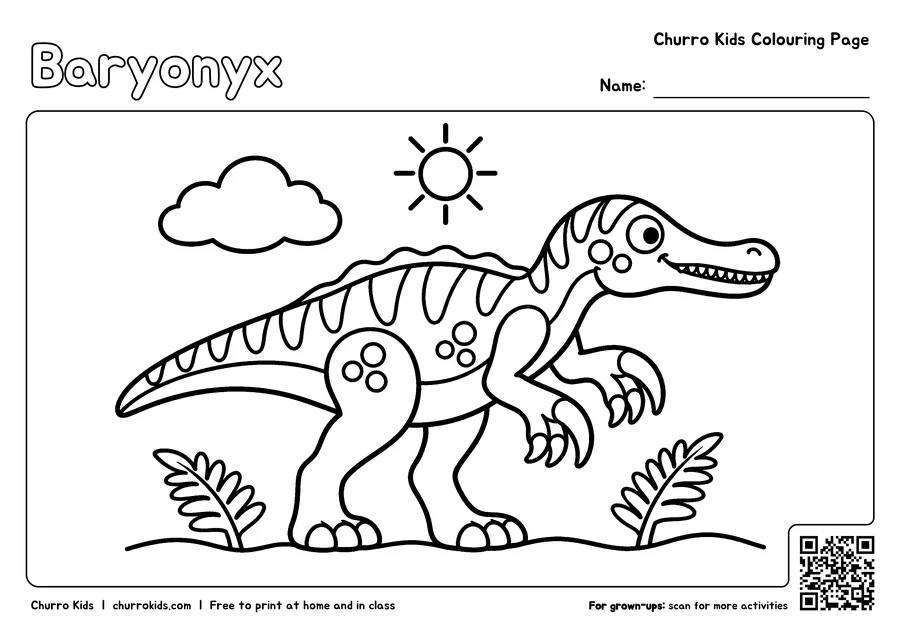
One A4 page, and it is free. Print it freely at home or in class.
Good for parents to know
- Its length differs from study to study, from 7.5 to 10 metres. The only good skeleton may be from an animal that was not fully grown.
- It did not eat only fish. The bones of a young dinosaur from the Iguanodon group were found in its belly together with the fish scales. Nobody knows yet if it hunted that dinosaur or ate one that was already dead.
- The idea that it scooped up fish with its big thumb claw is a guess. You can say "It may have used it that way." Most of the fossils from Spain and Portugal that were once called Baryonyx have been moved to other dinosaurs.