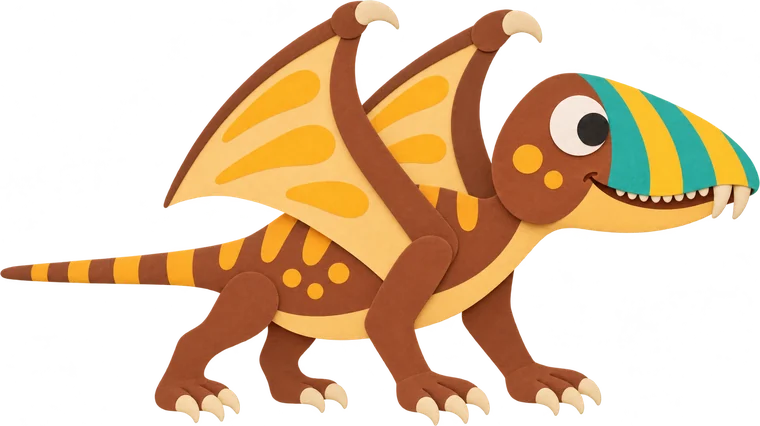
"What is that thing on the end of its tail?" Your child is copying a picture of a pterosaur and wonders about the diamond shape at the tip of the long tail.
Rhamphorhynchus was not a dinosaur, but it lived in the age of dinosaurs. It was a pterosaur, a flying reptile. In the Late Jurassic it caught fish and squid-like animals in a shallow sea in what is now Solnhofen in Germany. It had something like a little sail at the tip of its very long tail, and its needle-like teeth pointed forward and held slippery fish tight. Below are the questions children ask most, with answers at a child's level. You can read them out loud as they are.
Fact cardRhamphorhynchus
- Name means
- beak snout
- Lived
- Late Jurassic (about 151 to 148 million years ago)
- Length
- about 1.8 m (6 ft) wingspan
- Weight
- not known exactly (it was probably light)
- Food
- Fish-eater (it ate fish and squid-like animals)
- Found in
- Europe (Solnhofen in Bavaria, Germany; the UK and other places)
- Group
- Friends from the age of dinosaurs (not dinosaurs)
- A very long tail
- A diamond-shaped sail at the tip of the tail
- Pointed teeth that stick out forward
How big was Rhamphorhynchus? Measure it with your own height
When your child asks, answer like this
 What does Rhamphorhynchus mean?

How big was it?
What did it eat?
How did it hunt?
Who lived with it?
- Aspidorhynchus (a big fish with a pointed snout) neighbourfossil evidence
A fossil has been found with this fish's pointed snout caught in the wing skin of a Rhamphorhynchus, and the two were preserved together. The scientists who studied this fossil think the fish was not trying to eat Rhamphorhynchus. It probably grabbed it by mistake and its snout got stuck. - Leptolepides (a small fish) preyfossil evidence
In that very same fossil, a small fish that the Rhamphorhynchus had just swallowed was still in its throat. - Pterodactylus neighboursame time and place
A short-tailed pterosaur that lived on the same seashore. Pterodactylus was probably active in the day and Rhamphorhynchus at night.
When and where did it live?
What was it like as a baby? Did it live with friends?
Are there dinosaurs that look like it?
Who found it first?
Rhamphorhynchus facts that make kids say “Wow!”
- Rhamphorhynchus had something like a little sail at the tip of its long tail.
- The sail on its tail changed shape as it grew: a long leaf shape when it was young, a diamond when it was a bit bigger, and a triangle when it was fully grown.
- The biggest fossil has a wingspan about six times as long as the smallest one.
- There is a fossil with three animals together on one slab of stone: a big fish, a Rhamphorhynchus and a small fish.
From head to tail
- It had 34 teeth in all: 20 in the upper jaw and 14 in the lower jaw.
- The biggest fossil has a wingspan of 1.8 m (6 ft), as wide as a grown-up is tall.
- The smallest fossil has a wingspan of 29 cm (about 11 inches), shorter than a 30 cm (12 inch) ruler.
- The very tip of its beak had no teeth and was pointed.
A Rhamphorhynchus story to read aloud
The sun goes down and night comes to the island. Rhamphorhynchus holds its long tail out straight and flies low over the sea. The little sail at the tip of its tail cuts through the wind. A small fish glints in the water, and Rhamphorhynchus snaps it up with its needle-like teeth. Even a slippery fish cannot get away. But there are big fish with pointed snouts in the water too, so it has to be careful. Rhamphorhynchus gulps down the fish and flies up again.
A quiz to do together
Tap an answer.
What was on the tip of the tail of Rhamphorhynchus?
What did Rhamphorhynchus mostly eat?
Was the tail of Rhamphorhynchus long or short?
You finished the quiz! Well done.
Colouring page
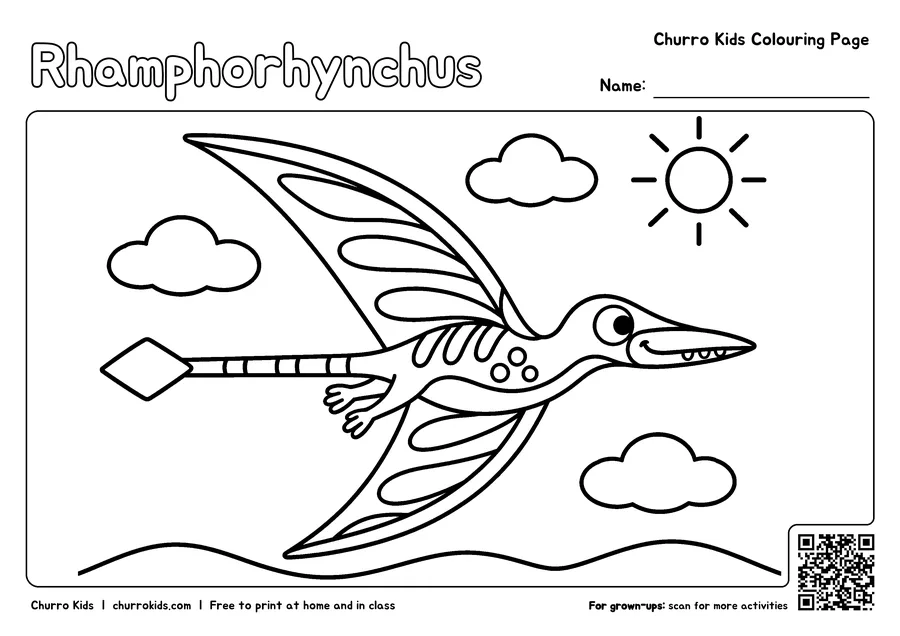
One A4 page, and it is free. Print it freely at home or in class.
Good for parents to know
- The 1.8 metre wingspan is the size of the biggest fossil. Most of the fossils found are smaller, younger animals, and its weight is not known exactly.
- There is a fossil in which the pointed snout of a big fish is caught in the wing skin of a Rhamphorhynchus. The scientists who studied this fossil think the fish was not trying to eat Rhamphorhynchus and got caught by mistake. It is safest to say "there are signs that the two bumped into each other."
- Rhamphorhynchus was a pterosaur and not a dinosaur. The idea that it was active at night comes from studying the bones around its eyes, so say something like "it probably flew around at night."