You are reading a picture book of prehistoric animals at bedtime, and your child's hand stops on one page. "Why is its head so big?"
Dimorphodon was not a dinosaur, but it lived in the age of dinosaurs. It was a pterosaur, a flying reptile. It lived in the Early Jurassic, and its fossils come from the coast at Lyme Regis in England. Its body was about 1 metre (3.3 feet) long, but its skull was about 23 cm (9 inches) long, and it had long teeth at the front of its mouth and small teeth at the back. The person who first found its fossil was the fossil hunter Mary Anning. Below are the questions children ask most, with answers at a child's level. You can read them out loud as they are.
Fact cardDimorphodon
- Name means
- two shapes of teeth
- Lived
- Early Jurassic (about 201 to 190 million years ago)
- Length
- about 1.45 m (4.8 ft) wingspan
- Weight
- not known exactly (it was probably light)
- Food
- Meat-eater (it ate small animals and bugs)
- Found in
- Europe (Lyme Regis, Dorset, England)
- Group
- Friends from the age of dinosaurs (not dinosaurs)
- A very big head for its body
- Two kinds of teeth: long ones and small ones
- A long, straight tail
How big was Dimorphodon? Measure it with your own height
When your child asks, answer like this
 What does Dimorphodon mean?

How big was it?
What did it eat?
How did it hunt?
Who lived with it?
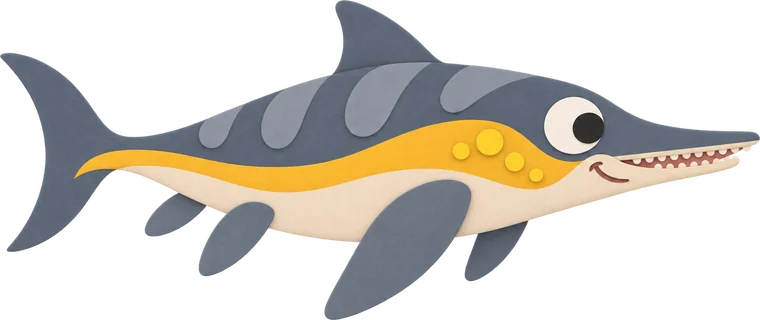
- Ichthyosaurus neighboursame time and place
A sea reptile whose fossils come from the same rocks at Lyme Regis in England. Nobody knows yet who Dimorphodon competed with, but while it flew along the seashore, Ichthyosaurus was probably swimming in the sea.
When and where did it live?
What was it like as a baby? Did it live with friends?
Are there dinosaurs that look like it?
Who found it first?
Dimorphodon facts that make kids say “Wow!”
- Dimorphodon had two kinds of teeth: long teeth at the front of its mouth and small teeth at the back.
- It was the first pterosaur skeleton ever found outside Germany.
- Dimorphodon was not a very good flier, but it was probably good at climbing.
- It could shut its mouth very fast, but its bite was fairly weak.
From head to tail
- Its skull was about 23 cm (9 inches) long, which is very big for a body 1 m (3.3 ft) long.
- Its wingspan was about 1.45 m (4.8 ft).
- Its tail had 30 bones joined in a row.
- In the lower jaw, behind the long front teeth, there was a row of 30 to 40 very tiny teeth.
A Dimorphodon story to read aloud
On a rock by the sea, Dimorphodon opens its eyes. It grips the rock tight with its big, curved claws and climbs up. It turns its head, which is very big for its body, this way and that, looking for food. A small animal goes by, and Dimorphodon snaps its mouth shut and grabs it. The long teeth at the front and the small teeth at the back hold the food. It spreads its short wings and flutters over to the next rock. Out in the sea, Ichthyosaurus is swimming.
A quiz to do together
Tap an answer.
How many shapes of teeth did Dimorphodon have?
Who first found a Dimorphodon fossil?
Was the head of Dimorphodon big or small for its body?
You finished the quiz! Well done.
Colouring page
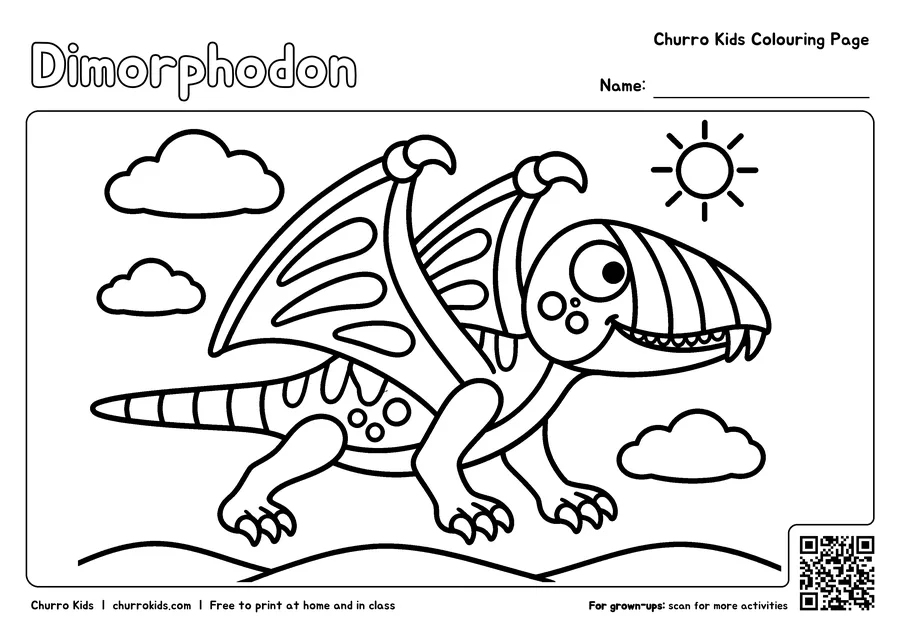
One A4 page, and it is free. Print it freely at home or in class.
Good for parents to know
- What it mostly ate is still not settled. Scientists are still discussing bugs, fish and small animals, so say something like "it probably caught small animals to eat."
- The 1.45 metres is its wingspan, and its body was about 1 metre long. Its weight is not known exactly, and nobody knows if it had a sail at the tip of its tail.
- Dimorphodon was a pterosaur and not a dinosaur. It can be mixed up with the long-tailed Rhamphorhynchus, but Dimorphodon has a much bigger head and lived much earlier.