"Isn't this a dolphin?" Your child sees an Ichthyosaurus in a picture book and tilts their head.
Ichthyosaurus was not a dinosaur, but it lived in the age of dinosaurs. It was a sea reptile that lived in the sea in the Early Jurassic, and many of its fossils come from England. Its body was shaped like a dolphin's, and it had a long, pointed snout and very big eyes. It did not lay eggs and gave birth to its babies in the sea, and fossils of mothers with babies inside the belly have been found. Below are the questions children ask most, with answers at a child's level. You can read them out loud as they are.
Fact cardIchthyosaurus
- Name means
- fish lizard
- Lived
- Early Jurassic (about 200 to 193 million years ago)
- Length
- about 2 m (6.6 ft)
- Weight
- not known exactly
- Food
- Fish-eater (it ate fish and squid-like animals)
- Found in
- Europe (the UK, Germany, Belgium and more)
- Group
- Friends from the age of dinosaurs (not dinosaurs)
- A body shaped like a dolphin's
- A long, pointed snout
- Very big eyes
How big was Ichthyosaurus? Measure it with your own height
When your child asks, answer like this
 What does Ichthyosaurus mean?

How big was it?
What did it eat?
How did it hunt?
Who lived with it?
- Belemnites (animals that looked like squid) preyfossil evidence
Traces of fish and of squid-like animals that seem to be belemnites have been found in the fossil belly of Ichthyosaurus. - Temnodontosaurus (a very big ichthyosaur) predatorsame time and place
A much bigger relative that lived in the same sea. If Ichthyosaurus met this big relative, it probably swam away fast. - Plesiosaurus neighboursame time and place
A long-necked sea reptile whose fossils come from the same rocks. The two probably caught fish in the same sea.
When and where did it live?
What was it like as a baby? Did it live with friends?
Are there dinosaurs that look like it?
Who found it first?
Ichthyosaurus facts that make kids say “Wow!”
- Ichthyosaurus did not lay eggs. It gave birth to its babies in the sea.
- Mary Anning broke open stones that came from the belly area of ichthyosaurs like this one and worked out that they were fossil droppings with fish bones and scales inside.
- The ichthyosaurs, the group that Ichthyosaurus belongs to, have the biggest eye sockets of any animals with backbones.
- It lived in the water but had no gills, so it had to come up to the surface to breathe.
From head to tail
- Most were about 2 m (6.6 ft) long, and the biggest species grew to 3.3 m (11 ft).
- Inside its broad front flippers there were more than five rows of finger bones.
- Inside each eye there was a ring of bone that protected the big eye.
- Unlike a dolphin's, its tail fin stood upright like a fish's.
A Ichthyosaurus story to read aloud
Ichthyosaurus zooms through the blue sea. It swings its tail fin from side to side, and its body shoots forward. It looks for a school of fish with its very big eyes. It snaps up a fish with its long, pointed snout. It enjoys eating belemnites too, which look like squid. Inside the belly of a mother Ichthyosaurus, a baby is growing. When it runs out of breath, it swims up to the surface to breathe.
A quiz to do together
Tap an answer.
Which animal does Ichthyosaurus look like?
Did Ichthyosaurus lay eggs or give birth to babies?
What does the name Ichthyosaurus mean?
You finished the quiz! Well done.
Colouring page
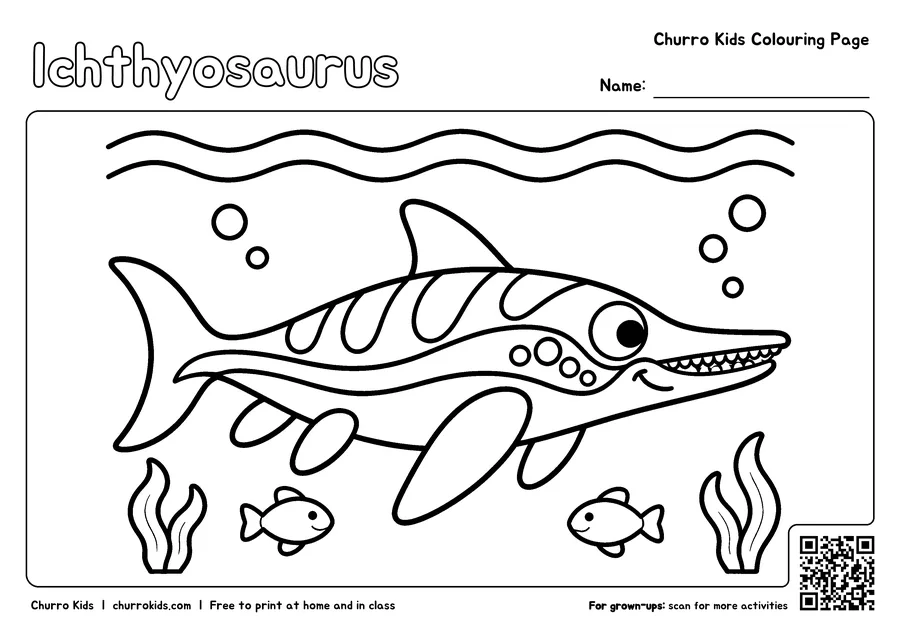
One A4 page, and it is free. Print it freely at home or in class.
Good for parents to know
- It looks a lot like a dolphin, but a dolphin is a mammal and Ichthyosaurus is a reptile. It is not a dinosaur either. Look at the picture together and find the tail fin that stands upright and the four flippers.
- Most were about 2 metres long, but the biggest species grew to 3.3 metres. Its weight is not known exactly.
- The ideas that the babies were born tail first and that it swam away when it met a big ichthyosaur are guesses. With your child, say "it probably did."