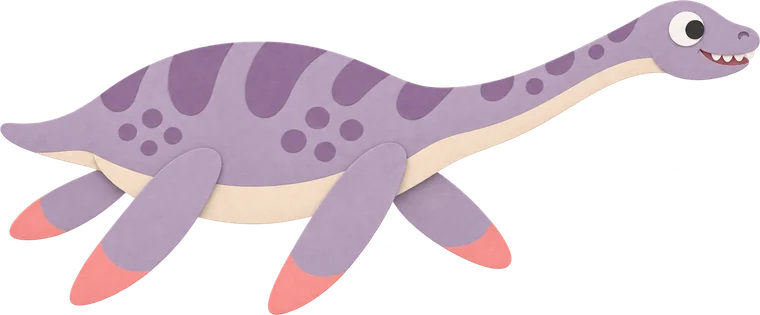
On the evening after a trip to the aquarium, your child finds a sea animal with a very long neck in a book. "Why is its neck so long?"
Elasmosaurus was not a dinosaur, but it lived in the age of dinosaurs. It was a sea reptile, and in the Late Cretaceous it lived in the wide sea that cut through the middle of North America. Of its body length of about 10.3 metres (34 feet), about 7.1 metres (23 feet) was neck, and it had 72 neck bones. It swam with four flippers shaped like oars and probably ate small fish and other sea animals. Below are the questions children ask most, with answers at a child's level. You can read them out loud as they are.
Fact cardElasmosaurus
- Name means
- thin-plate lizard
- Lived
- Late Cretaceous (about 80 to 77 million years ago)
- Length
- about 10.3 m (34 ft)
- Weight
- about 2 tonnes (an estimate)
- Food
- Fish-eater
- Found in
- North America (Kansas, USA)
- Group
- Friends from the age of dinosaurs (not dinosaurs)
- A neck much longer than its body
- A small head with pointed teeth
- Four flippers shaped like oars
How big was Elasmosaurus? Measure it with your own height
When your child asks, answer like this
 What does Elasmosaurus mean?

How big was it?
What did it eat?
How did it hunt?
Who lived with it?
- Enchodus (a fish with fangs) preysame time and place
A fish that was very common in the same sea. Elasmosaurus probably caught and ate fish like this. - Tylosaurus predatorsame time and place
A huge sea lizard that lived in the same sea. If Elasmosaurus met a Tylosaurus, it probably kept carefully out of its way. - Pteranodon neighboursame time and place
The pterosaur Pteranodon probably flew in the sky above the sea where Elasmosaurus swam.
When and where did it live?
What was it like as a baby? Did it live with friends?
Are there dinosaurs that look like it?
Who found it first?
Elasmosaurus facts that make kids say “Wow!”
- The neck of Elasmosaurus was about 7 metres (23 feet) long and had 72 neck bones.
- Cope, who named it, made a mistake at first and put the skull on the tip of the tail instead of on the neck.
- The bones dug up in Kansas weighed about 360 kg (about 790 lb), and they travelled by wagon and train all the way to Philadelphia.
- The only animal known to have more neck bones than Elasmosaurus is its relative Albertonectes.
From head to tail
- Of its body length of about 10.3 m (34 ft), about 7.1 m (23 ft) was neck.
- People have 7 neck bones, and Elasmosaurus had more than ten times as many.
- Its neck was fairly stiff, so it could not lift it high above the water like a swan.
- It swam by paddling with its four flippers. Scientists do not all agree on how it shared the work between the front and back flippers.
A Elasmosaurus story to read aloud
In the wide sea, Elasmosaurus slowly paddles its four flippers. It swims with its long neck stretched out in front. Ahead, a school of small fish sparkles. Elasmosaurus moves its small head closer, very quietly. It snaps up a fish with its pointed teeth and gulps it down whole. In the sky above the water, Pteranodon is flying. Elasmosaurus comes gently up to the surface to breathe.
A quiz to do together
Tap an answer.
What is the longest part of the body of Elasmosaurus?
What did Elasmosaurus swim with?
Could Elasmosaurus lift its neck up high like a swan?
You finished the quiz! Well done.
Colouring page
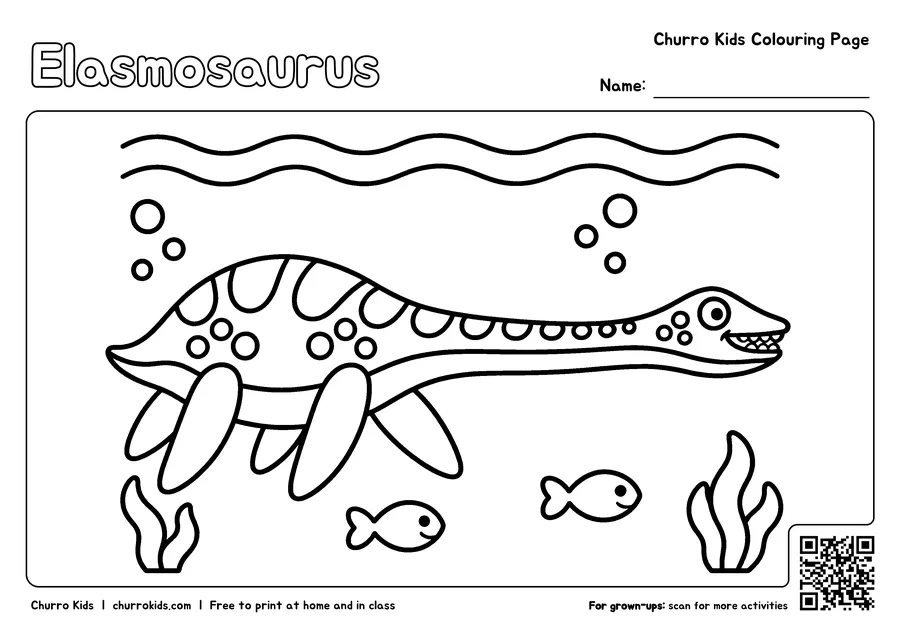
One A4 page, and it is free. Print it freely at home or in class.
Good for parents to know
- The only fossil that is certain is one skeleton, and it is not complete. So the length of 10.3 metres is an estimate, and the weight of about 2 tonnes is a rough figure too.
- If you see a picture with the neck lifted high above the water like a swan, tell your child that the neck was stiff and could not be lifted like that. It swam with its neck stretched out in front.
- It is often mixed up with Plesiosaurus. Elasmosaurus is about three times as long and lived much later. Both are sea reptiles, and neither is a dinosaur.