Your child is colouring in a dinosaur, stops, and asks, "Dad, how do we know what colour dinosaurs really were?" Psittacosaurus is a good dinosaur to talk about at a moment like this.
Psittacosaurus was a small dinosaur that lived in Asia in the Early Cretaceous. It belongs with the horned dinosaurs, but it had no frill. It had a beak like a parrot's and walked on two legs when it was fully grown. Thanks to a fossil, we even know that it was dark on its back and light on its belly. Below are the questions children ask most, with answers at a child's level. You can read them out loud as they are.
Fact cardPsittacosaurus
- Name means
- parrot lizard
- Lived
- Early Cretaceous (about 125 to 105 million years ago)
- Length
- about 2 m (6.5 ft)
- Weight
- about 20 to 50 kg
- Food
- Plant-eater
- Found in
- Asia (China, Mongolia, Russia)
- Group
- Horned dinosaurs
- A beak like a parrot's
- It walks on two legs
- Stiff bristles on top of its tail
How big was Psittacosaurus? Measure it with your own height
When your child asks, answer like this
 What does Psittacosaurus mean?

How big was it?
What did it eat?
What did it do when a scary dinosaur came?
Who lived with it?
- Repenomamus predatorfossil evidence
The bones of a baby Psittacosaurus were found inside the belly of Repenomamus, an early mammal about the size of a cat. There is also a fossil that shows a Repenomamus just as it was when it jumped at a Psittacosaurus. - Dilong predatorsame time and place
Dilong, a small feathered meat-eating dinosaur that lived in the same place, probably hunted young Psittacosaurus.
When and where did it live?
What was it like as a baby? Did it live with friends?
Are there dinosaurs that look like it?
Who found it first?
Psittacosaurus facts that make kids say “Wow!”
- Thanks to a fossil, we even know that Psittacosaurus was dark on its back and light on its belly.
- The first mark of a dinosaur's belly button ever found was on a Psittacosaurus fossil.
- As a baby it probably walked on four legs, and then came to walk on two legs as it grew.
- Hundreds of fossils have been found, so it is one of the best-known dinosaurs.
From head to tail
- It was about 2 m (6.5 ft) long, about the size of a big dog.
- The stiff bristles on top of its tail were about 16 cm (6 inches) long, about as long as a pencil.
- A newly hatched baby was 11 to 13 cm (about 4 to 5 inches) long, about the size of a grown-up's palm.
- Other horned dinosaurs have five toes on each front foot, but Psittacosaurus has four.
A Psittacosaurus story to read aloud
Morning sunlight slips into the forest by the lake. Psittacosaurus trots out on two legs. It nips off seeds and tough leaves with its parrot-like beak. The small stones it has swallowed break the food into small bits inside its belly. The young Psittacosaurus go around huddled close together. It sniffs the air, and when it smells something strange, it slips into the dark shade of the forest to hide.
A quiz to do together
Tap an answer.
Which animal has a beak like the beak of Psittacosaurus?
Why did Psittacosaurus swallow small stones?
How many legs did a grown-up Psittacosaurus walk on?
You finished the quiz! Well done.
Colouring page
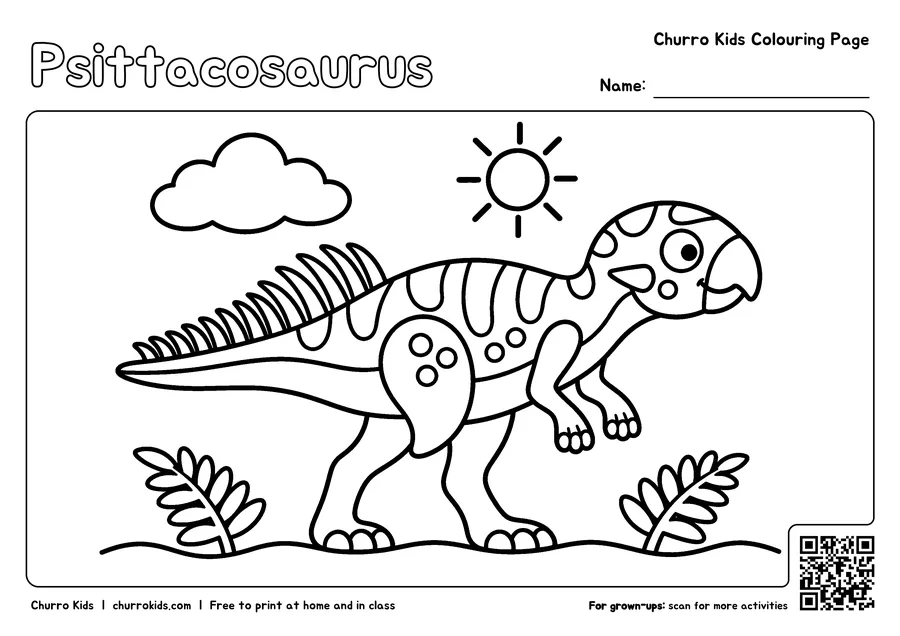
One A4 page, and it is free. Print it freely at home or in class.
Good for parents to know
- The stiff bristles on the tail and the 'dark back, light belly' colour are known from one fossil. There are several kinds of Psittacosaurus, and nobody knows if all of them looked like that.
- Grown-up Psittacosaurus walked on two legs, but newly hatched babies probably walked on four. Pictures may show it walking in different ways.
- It is easy to mix up with Protoceratops, but Psittacosaurus has no frill and walks on two legs. Also, there is a fossil of the early mammal Repenomamus with the bones of a baby Psittacosaurus inside its belly. For a child it is enough to say "small mammals sometimes ate baby dinosaurs."