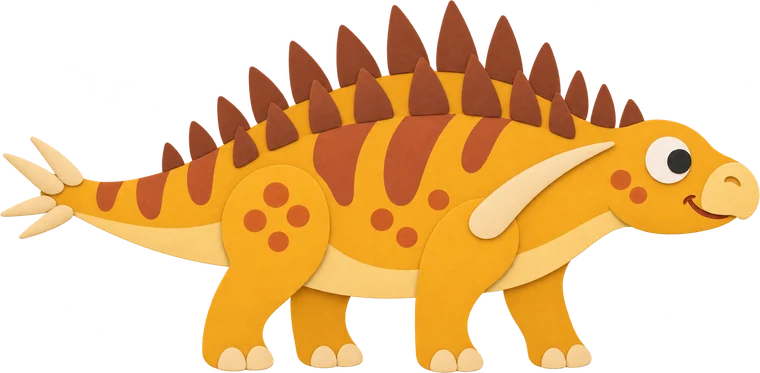
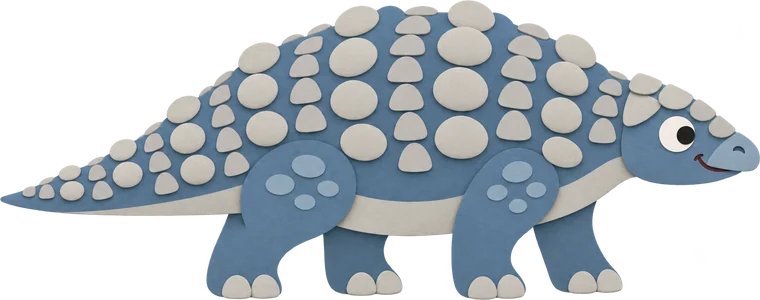
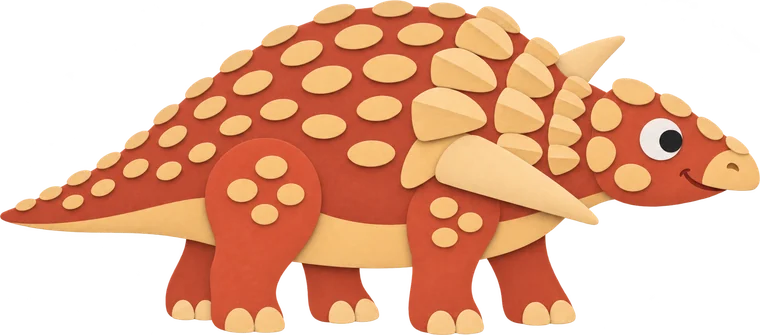
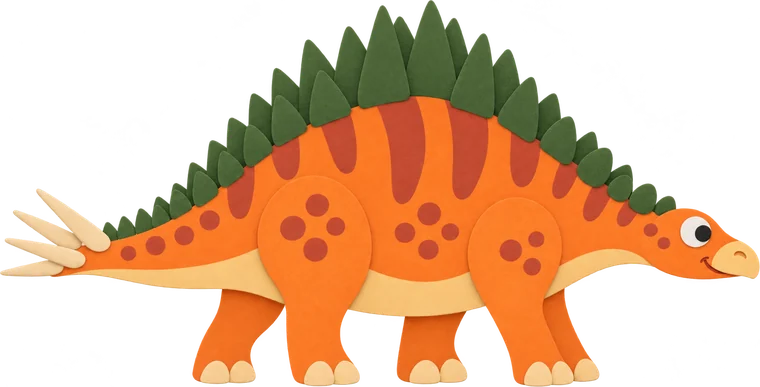
In front of a picture at the museum, your child tugs at your hand. "What is this dinosaur carrying on its bottom?"
Polacanthus was an armoured dinosaur that lived in the Early Cretaceous on what is now the Isle of Wight in England. It was about as big as a car, with rows of pointed spikes along its sides and a bony shield over its hips as wide as a small dining table. It had no club at the end of its tail. Below are the questions children ask most, with answers at a child's level. You can read them just as they are.
Fact cardPolacanthus
- Name means
- many spikes
- Lived
- Early Cretaceous (about 130 to 125 million years ago)
- Length
- about 4.5 m (15 ft)
- Weight
- about 0.2 to 2 tonnes
- Food
- Plant-eater
- Found in
- Europe (the Isle of Wight, UK)
- Group
- Armoured and plated dinosaurs
- A wide, flat bony shield over its hips
- Spikes in rows along the sides of its body
- A tail with no club
How big was Polacanthus? Measure it with your own height
When your child asks, answer like this
 What does Polacanthus mean?

How big was it?
What did it eat?
What did it do when a scary dinosaur came?
Who lived with it?
- Neovenator predatorsame time and place
Neovenator was a big meat-eating dinosaur that lived in the same place at the same time. Polacanthus probably protected itself with its spikes and its hip shield. - Mantellisaurus neighboursame time and place
Mantellisaurus, a plant-eating relative of Iguanodon, lived on the same plains. The two probably ate plants together by the river. - Hypsilophodon neighboursame time and place
Hypsilophodon, a small and fast plant-eating dinosaur, lived in the same place too. It probably darted about near Polacanthus.
When and where did it live?
What was it like as a baby? Did it live with friends?
Are there dinosaurs that look like it?
Who found it first?
Polacanthus facts that make kids say “Wow!”
- Polacanthus had a wide, hard plate of bone over its hips, like a shield.
- The famous English poet Tennyson tried to give this dinosaur a different name, but the name was not accepted.
- Fossils of burnt plants show that wildfires often broke out where Polacanthus lived.
- Scientists who looked at the fossils again in 2020 said the only one that is surely Polacanthus is the very first one that was found.
From head to tail
- The hip shield was about 108 cm (43 in) wide and 90 cm (35 in) long, as wide as a small dining table.
- The first fossil was found with 22 spikes.
- Its thigh bone was about 55 cm (22 in) long, and for an armoured dinosaur its back legs were quite long.
- It was about 4 to 5 m (13 to 16 ft) long, about as big as a car.
A Polacanthus story to read aloud
A river runs across the dry plain. Polacanthus comes down to the bank and nibbles ferns. Mantellisaurus is eating plants close by, and little Hypsilophodon darts about beside them. Then the meat-eating dinosaur Neovenator appears. Polacanthus crouches low and protects itself with its pointed spikes and its hip shield. When Neovenator moves away, Polacanthus goes back to eating ferns by the river.
A quiz to do together
Tap an answer.
What is on top of the hips of Polacanthus?
Does Polacanthus have a club at the end of its tail?
In which country was Polacanthus found?
You finished the quiz! Well done.
Colouring page
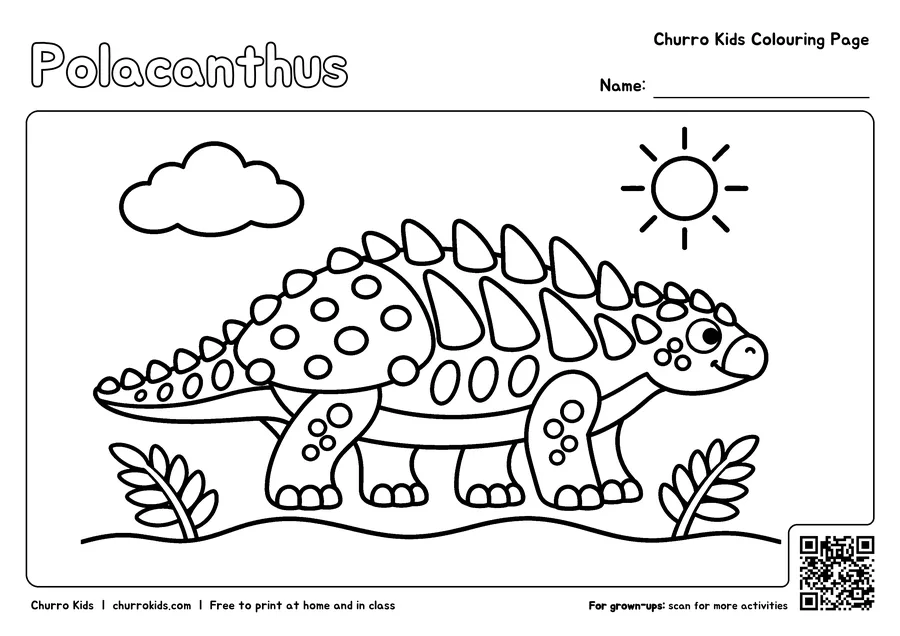
One A4 page, and it is free. Print it freely at home or in class.
Good for parents to know
- Sources give its length as 4 to 5 metres. The weight varies much more, from a few hundred kilograms to about 2 tonnes. So this guide gives a wide range, about 0.2 to 2 tonnes.
- Almost none of the skull has been found. So the face and the exact places of the spikes are drawn from what scientists think is likely. You can tell your child that pictures may differ a little from book to book.
- There is no fossil evidence that it met Neovenator. We only know that they lived in the same place at the same time. Its food is also a guess, so it is best to say "it probably ate low plants such as ferns."