At bedtime your child is looking at a dinosaur book and starts counting horns with a finger. "One, two, three, four. Mum, why does this dinosaur have so many horns?" This often happens at the picture of Kosmoceratops.
Kosmoceratops was a horned dinosaur that lived in the Late Cretaceous in what is now Utah, USA. It had fifteen horns and horn-shaped decorations on its head in all, and the hooks on top of its frill were folded down like a fringe of hair. It was about 4.5 m (15 ft) long, about as long as a car. Below are the questions children ask most, with answers at a child's level. You can read them out loud as they are.
Fact cardKosmoceratops
- Name means
- richly decorated horned face
- Lived
- Late Cretaceous (about 76 million years ago)
- Length
- about 4.5 m (15 ft)
- Weight
- about 1.2 tonnes
- Food
- Plant-eater
- Found in
- North America (Utah, USA)
- Group
- Horned dinosaurs
- Frill hooks folded down like a fringe of hair
- Horns above the eyes that point out sideways
- Fifteen horns and decorations
How big was Kosmoceratops? Measure it with your own height
When your child asks, answer like this
 What does Kosmoceratops mean?

How big was it?
What did it eat?
What did it do when a scary dinosaur came?
Who lived with it?
- Teratophoneus predatorsame time and place
Teratophoneus, a relative of Tyrannosaurus that lived in the same place, probably hunted Kosmoceratops. - Utahceratops neighboursame time and place
It probably ate plants in the same swamps as the horned dinosaur Utahceratops. - Parasaurolophus neighboursame time and place
Parasaurolophus, which had a long crest on its head, lived in the same place too.
When and where did it live?
What was it like as a baby? Did it live with friends?
Are there dinosaurs that look like it?
Who found it first?
Kosmoceratops facts that make kids say “Wow!”
- Kosmoceratops had fifteen horns and horn-shaped decorations on its head in all.
- Of all the dinosaurs we know so far, Kosmoceratops has one of the fanciest heads.
- The land where Kosmoceratops lived was a long, narrow island continent called Laramidia.
- The full scientific name of Kosmoceratops includes the name of Richardson, the volunteer who found the fossil.
From head to tail
- It was about 4.5 m (15 ft) long, about as long as a car.
- It weighed about 1.2 tonnes, about the same as a small car.
- It had one horn on its nose, two above its eyes, two on its cheeks, and ten horns and decorations on its frill.
- The horns above its eyes point out sideways, like the horns of a bison.
A Kosmoceratops story to read aloud
Morning breaks over the damp swampland. Kosmoceratops walks out, swinging its fancy head. It nips off tough plants by the river with its beak. Its hundreds of teeth cut the leaves into small pieces. Nearby, Utahceratops and Parasaurolophus are eating plants too. The frill decorations, folded down like a fringe of hair, shine in the sunlight.
A quiz to do together
Tap an answer.
How many horns and decorations are on the head of Kosmoceratops in all?
Which way do the horns above the eyes of Kosmoceratops point?
In which country was the Kosmoceratops fossil found?
You finished the quiz! Well done.
Colouring page
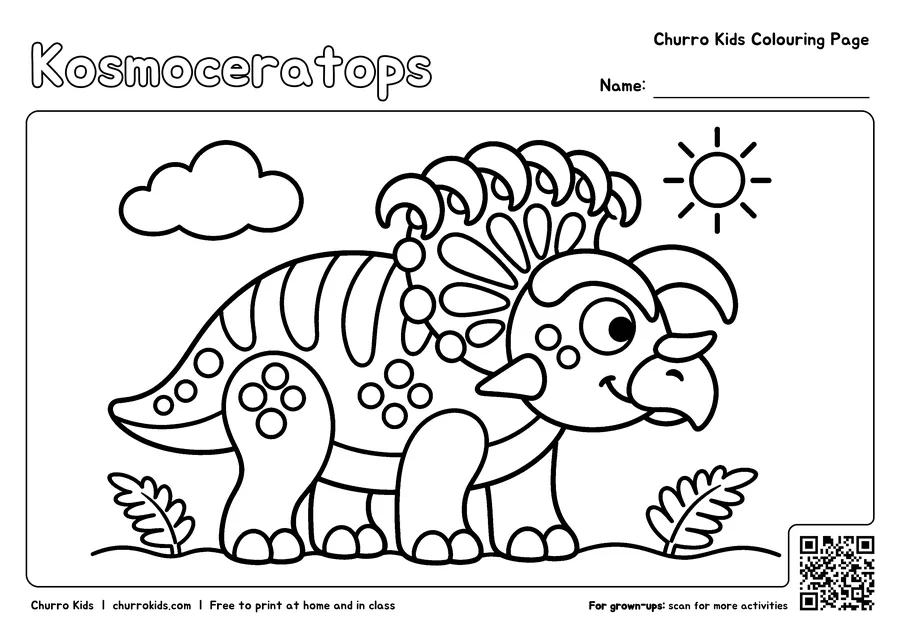
One A4 page, and it is free. Print it freely at home or in class.
Good for parents to know
- Fifteen is the total of one on the nose, two above the eyes, two on the cheeks and ten on the frill. Tell your child that it counts horns and horn-shaped decorations together.
- This dinosaur is known from only a few fossils from Utah. So the length of about 4.5 metres (15 ft) and the weight of about 1.2 tonnes are rough estimates, and we still do not know much about how it lived.
- There is no fossil evidence that Teratophoneus hunted Kosmoceratops. Scientists think the showy horns and decorations were mainly used to show off to other Kosmoceratops.