"Were there dinosaurs in Antarctica, where the penguins live?" your child asks, spinning the globe and pointing at the white land at the very bottom.
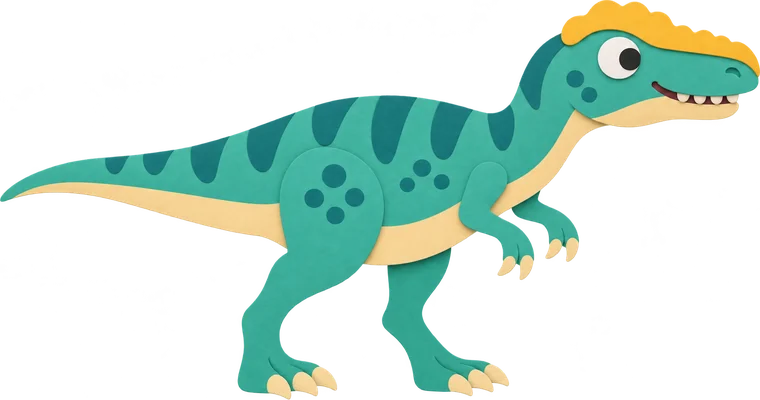
Cryolophosaurus was a meat-eating dinosaur that lived in the Early Jurassic in what is now Antarctica. Antarctica was much warmer then than it is now, and cool, damp forests covered the land. It had one crest above its eyes that spread out sideways like a fan, and it was the first dinosaur from Antarctica to get an official name. Below are the questions children ask most, with answers at a child's level. You can read them out loud.
Fact cardCryolophosaurus
- Name means
- cold crest lizard
- Lived
- Early Jurassic (about 196 to 188 million years ago)
- Length
- about 6.5 m (21 ft)
- Weight
- about 350 to 465 kg
- Food
- Meat-eater
- Found in
- Antarctica
- Group
- Very early dinosaurs (Triassic and Jurassic)
- A head crest spread out like a fan
- Sharp teeth
- Walking on two legs
How big was Cryolophosaurus? Measure it with your own height
When your child asks, answer like this
 What does Cryolophosaurus mean?

How big was it?
What did it eat?
How did it hunt?
Who lived with it?
- Glacialisaurus preysame time and place
Glacialisaurus was a long-necked plant-eating dinosaur whose fossils came from the same land in Antarctica. Cryolophosaurus probably hunted it. - Tritylodonts (distant relatives of mammals) preysame time and place
A tooth of one of these small animals was found beside the bones of Cryolophosaurus. Scientists say Cryolophosaurus may have caught and eaten it.
When and where did it live?
What was it like as a baby? Did it live with friends?
Are there dinosaurs that look like it?
Who found it first?
Cryolophosaurus facts that make kids say “Wow!”
- The fossil of Cryolophosaurus was found in cold Antarctica, but Antarctica was much warmer than it is now when dinosaurs lived there.
- Its crest looks like the hairstyle of the singer Elvis Presley, so it has the nickname "Elvisaurus".
- The fossil was found on a high mountain in Antarctica, about 4,000 m (13,000 ft) up.
- In three weeks the scientists dug out 2,300 kg (about 5,000 pounds) of rock with bones inside.
From head to tail
- The one that was found was 6 to 7 m (20 to 23 ft) long, and a fully grown one was probably about 8 m (26 ft).
- Its skull was about 65 cm (26 inches) long.
- The crest spread out sideways above the eyes and had many ridges, like a comb.
- It weighed about 350 to 465 kg (about 770 to 1,025 pounds), close to the weight of one big horse.
A Cryolophosaurus story to read aloud
It is the Early Jurassic in the land of Antarctica, and morning comes to the cool, damp forest. Cryolophosaurus walks through the trees on its two long back legs. Above its eyes, a crest with ridges like a comb spreads out wide to the sides. When it meets another of its kind, it shows off its crest. A long-necked Glacialisaurus appears between the trees, and Cryolophosaurus creeps closer. Sharp teeth are the hunting tools of Cryolophosaurus.
A quiz to do together
Tap an answer.
Where was the fossil of Cryolophosaurus found?
What shape is the crest of Cryolophosaurus?
What was Antarctica like when Cryolophosaurus lived?
You finished the quiz! Well done.
Colouring page
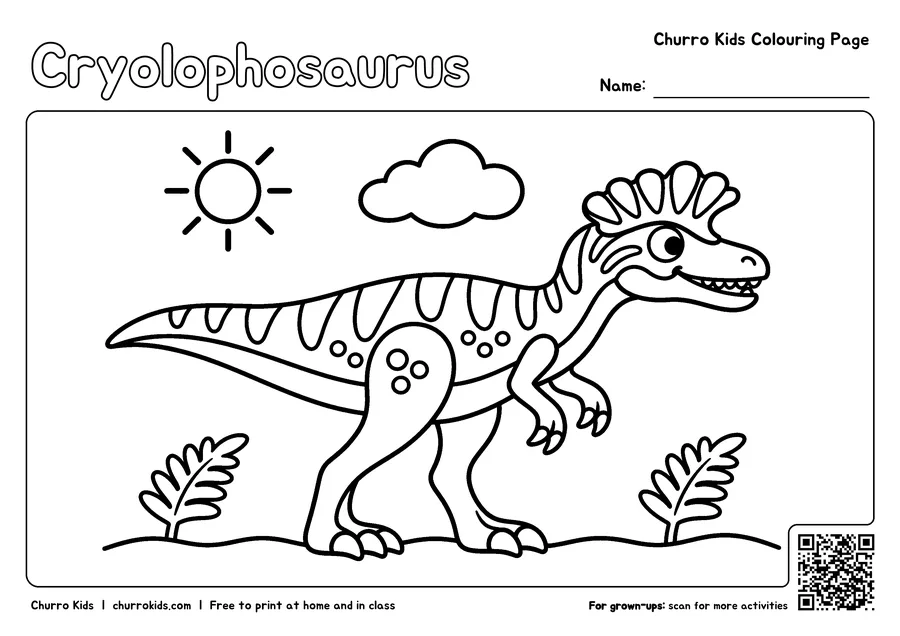
One A4 page, and it is free. Print it freely at home or in class.
Good for parents to know
- The skeleton that was found seems to be not fully grown, so the adult size is uncertain. The one that was found is 6 to 7 metres long, and a fully grown one is guessed at about 8 metres.
- The dates differ a little between sources. Older works give about 196 to 188 million years ago, and newer ones about 194 to 182 million years ago. Either way it is the Early Jurassic.
- What the crest was for is still debated, and showing off to friends or a mate is a guess. Older books tell a story that it choked on the rib of a plant-eating dinosaur, but the ribs were its own. The small animal's tooth found beside it is also not firm evidence that it ate that animal.