Your child is tidying the box of dinosaur toys and pulls out one with a sail on its back. "This one is a dinosaur too, right?"
Dimetrodon was not a dinosaur. It lived in the Early Permian, long before the dinosaurs appeared, and its fossils come from places such as Texas and Oklahoma in the USA. It had a big sail standing up on its back, walked on four legs around rivers and swamps, and was the strongest hunter of its time and place. It is also a closer relative of mammals like us than of dinosaurs. Below are the questions children ask most, with answers at a child's level. You can read them out loud as they are.
Fact cardDimetrodon
- Name means
- two sizes of teeth
- Lived
- Early Permian (about 294 to 271 million years ago)
- Length
- about 3 m (10 ft)
- Weight
- about 28 to 250 kg (it depends on the species)
- Food
- Meat-eater
- Found in
- North America (Texas, Oklahoma and other parts of the USA, and Canada), Europe (Germany)
- Group
- Friends from the age of dinosaurs (not dinosaurs)
- A big sail standing up on its back
- A body that walked on four legs held out to the sides
- Sharp teeth, big and small
How big was Dimetrodon? Measure it with your own height
When your child asks, answer like this
 What does Dimetrodon mean?

How big was it?
What did it eat?
How did it hunt?
Who lived with it?
- Diplocaulus (an amphibian with a boomerang-shaped head) preyfossil evidence
A fossil has been found of eight Diplocaulus gathered together in a burrow, and three young ones among them have Dimetrodon tooth marks on them. - Xenacanthus (a river shark) preysame time and place
A shark that lived in the same rivers and swamps. Dimetrodon probably hunted this shark at the water's edge. - Edaphosaurus neighboursame time and place
A neighbour that also had a sail on its back but ate plants. It probably lived around the same swamps as Dimetrodon.
When and where did it live?
What was it like as a baby? Did it live with friends?
Are there dinosaurs that look like it?
Who found it first?
Dimetrodon facts that make kids say “Wow!”
- Dimetrodon lived long before the dinosaurs, and it is a closer relative of mammals like us than of dinosaurs.
- The first dinosaurs did not appear until about 40 million years after Dimetrodon had died out.
- About 13 species of Dimetrodon are known so far.
- The sail grew very quickly as the body grew, so many scientists think it was probably used for showing off to a mate.
From head to tail
- A big species was about 3.2 m (10.5 ft) long and weighed about 250 kg (550 lb).
- The smallest species was 60 cm (2 ft) long and weighed 14 kg (31 lb), about the size of a small dog.
- The sail on its back was held up by long, spine-like bones that rose from its backbone.
- It had one opening in the skull behind each eye, and this is a sign that it belongs on the mammal side of the family tree.
A Dimetrodon story to read aloud
Long, long ago, before there were any dinosaurs, morning comes to a swamp. Dimetrodon holds up the big sail on its back and walks slowly on four legs. In the river, the shark Xenacanthus is swimming. Dimetrodon looks along the water's edge and then snaps up its food. Its sharp teeth, big and small, hold the food tight. Over there, its neighbour Edaphosaurus, which has a sail too, is munching on plants.
A quiz to do together
Tap an answer.
Is Dimetrodon a dinosaur?
What did Dimetrodon have on its back?
Which lived first, Dimetrodon or the dinosaurs?
You finished the quiz! Well done.
Colouring page
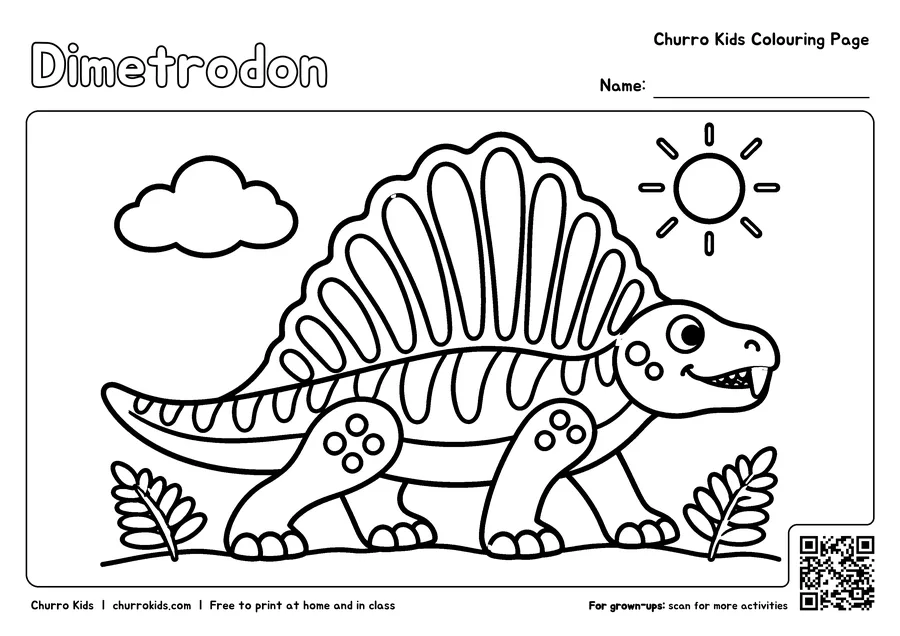
One A4 page, and it is free. Print it freely at home or in class.
Good for parents to know
- Dimetrodon was not a dinosaur, and it did not live in the age of dinosaurs either. The first dinosaurs did not appear until about 40 million years after Dimetrodon had died out. You can tell your child, "It was not a dinosaur. It lived long before the dinosaurs."
- Its size was very different from species to species, so books give different numbers. A big species was about 3.2 metres long and weighed about 250 kg.
- What the sail on its back was for is still not settled. One idea is that it helped to control body temperature, and another is that it was for showing off to a mate, so say "scientists are still working it out."