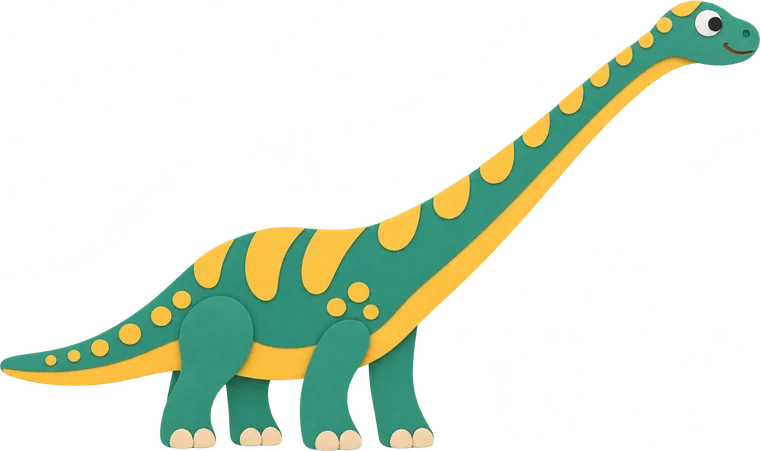
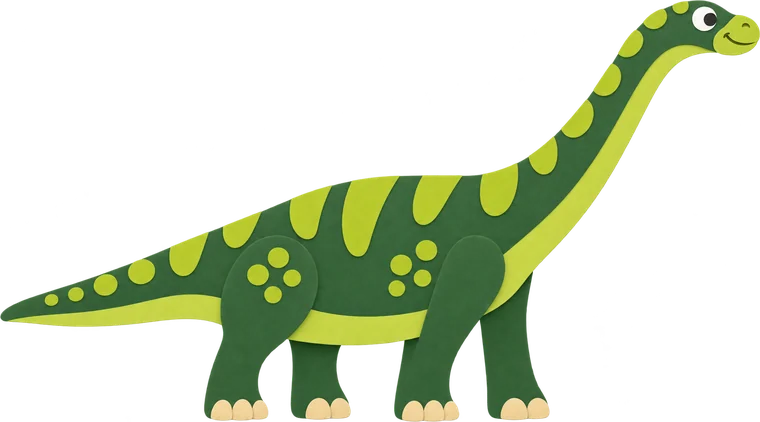
"Who was the biggest dinosaur in the whole world?" Every child who loves dinosaurs asks this at least once. The first name that comes up is Argentinosaurus.
Argentinosaurus was a long-necked dinosaur that lived in Argentina, in South America, in the middle of the Cretaceous. A single backbone was as big as a grown-up is tall, and it was probably one of the biggest animals that ever lived on land. Even though it is so famous, only a few bones have been found, such as backbones, ribs and a leg bone. Below are the questions children ask most, with easy answers. You can read them out loud.
Fact cardArgentinosaurus
- Name means
- lizard of Argentina
- Lived
- Middle Cretaceous (about 106 to 92 million years ago)
- Length
- about 35 m (115 ft)
- Weight
- about 65 to 80 tonnes
- Food
- Plant-eater
- Found in
- South America (Argentina)
- Group
- Long-necked dinosaurs
- An enormously big body
- A long, thick neck
- Legs like tree trunks
How big was Argentinosaurus? Measure it with your own height
When your child asks, answer like this
 What does Argentinosaurus mean?

How big was it?
What did it eat?
What did it do when a scary dinosaur came?
Who lived with it?
- Mapusaurus predatorsame time and place
Mapusaurus was a big meat-eating dinosaur that lived on the same land. Several were found together, so they probably went after young or weak Argentinosaurus as a group. - Skorpiovenator neighboursame time and place
Skorpiovenator was a middle-sized meat-eating dinosaur found in the same land. Even if the two met, it probably could not take on a fully grown Argentinosaurus.
When and where did it live?
What was it like as a baby? Did it live with friends?
Are there dinosaurs that look like it?
Who found it first?
Argentinosaurus facts that make kids say “Wow!”
- A single backbone of Argentinosaurus was as big as a grown-up is tall, and it was probably one of the biggest animals that ever lived on land.
- Even though it is so famous, only a few bones have been found, such as backbones, ribs and a leg bone.
- Its huge backbones had many empty chambers for air inside, which made the bones lighter.
- Even Argentinosaurus was lighter than the blue whale that lives in the sea.
From head to tail
- A thigh bone thought to belong to Argentinosaurus is about 2.5 m (8 ft) long, long enough to reach the ceiling of a room.
- A single shin bone was about 1.55 m (5 ft) long, taller than a big brother or sister in elementary school.
- It probably walked at about 5 to 7 km (3 to 4 miles) an hour, about as fast as a grown-up walking quickly.
- It weighed about 65 to 80 tonnes, more than ten elephants.
A Argentinosaurus story to read aloud
Argentinosaurus walks slowly onto the plains where many rivers branch and flow. Each step is slow, but its legs are as thick and strong as tree trunks. It stretches out its long neck, pulls off conifer leaves and gulps them down without chewing. Its body is so big that it eats all day long, and then eats some more. Across the river there are some Mapusaurus, but they cannot easily come near a fully grown Argentinosaurus. Argentinosaurus plods on toward the next forest.
A quiz to do together
Tap an answer.
In which country was Argentinosaurus found?
What did the farmer first think the dinosaur bone was?
Which is heavier, Argentinosaurus or a blue whale?
You finished the quiz! Well done.
Colouring page
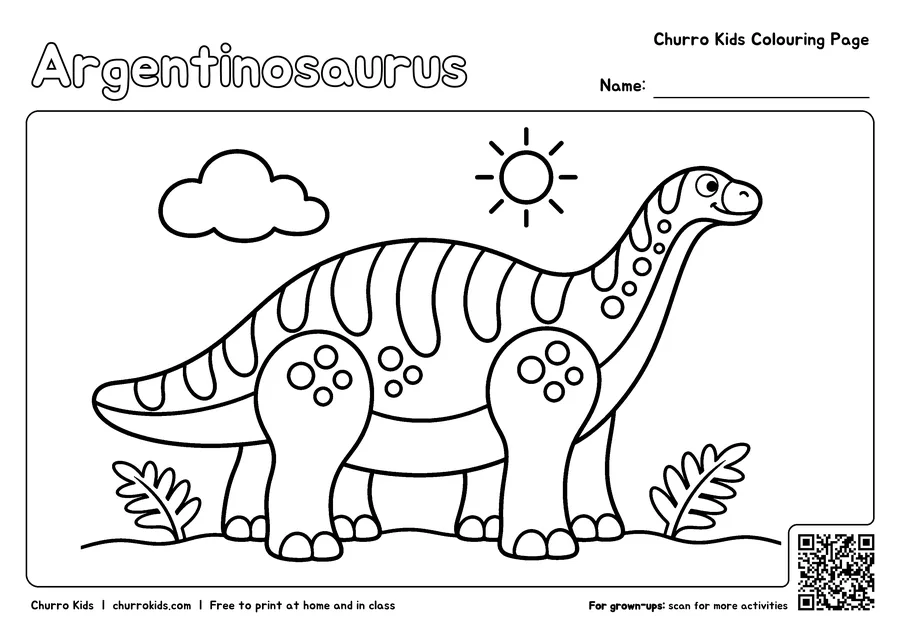
One A4 page, and it is free. Print it freely at home or in class.
Good for parents to know
- Only a few bones have been found, so every size figure is an estimate. Sources give 30 to 35 metres or more for the length, and anywhere from about 50 to 96 tonnes for the weight. It is safer to say "it was probably one of the biggest" than "it was the biggest dinosaur."
- For a long time its age was given as Late Cretaceous, about 96 to 92 million years ago. A dating study published in 2026 says it is older, from the end of the Early Cretaceous, about 106 million years ago or a little later. So this page covers both views: Middle Cretaceous, about 106 to 92 million years ago.
- The idea that Mapusaurus went after it in a group comes from the fact that they lived on the same land and that several Mapusaurus were found together. The skull has not been found either, so the way it ate is worked out from other long-necked dinosaurs.