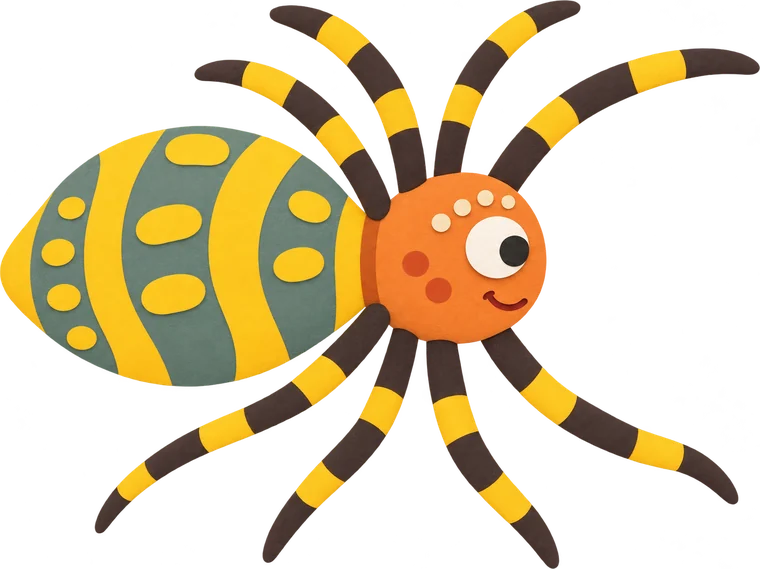
In an autumn park, your child stops in front of a huge golden web strung between two trees and asks, "Is a spider an insect? Why doesn't it get stuck?"
With eight legs and a body in two parts, a spider is not an insect but an arachnid. It spins silk from spinnerets at the tip of its abdomen and mostly walks on the non-sticky threads of its web, touching them only with its leg tips. The big spider in the middle of a golden autumn web in Korea is usually a female Joro spider. Below are the questions children ask most, with answers you can read aloud.
Fact cardSpider Arachnid · not an insect
- Legs
- 8
- Body
- 2 parts (head-and-chest, abdomen)
- Antennae and wings
- none
- Eyes
- usually 8
- Kinds
- more than 50,000 species
- Joro spider size
- female body about 1.7-3 cm
- An eight-legged builder that spins its own thread
Spider in a child's words
- A spider is not an insect. Insects have six legs; spiders have eight.
- A spider's body has two parts, the head-and-chest and the abdomen, rather than an insect's three, and it has no antennae and no wings.
- Spiders spin silk from little spinnerets at the tip of the abdomen. The silk is very fine but strong and stretchy.
- Not every spider builds a web: many walk about hunting on the ground.
- Most spiders have eight eyes, yet web-building spiders learn more from the vibrations they feel through their legs.
- To grow, a spider sheds its old skin and steps out in a bigger one. This is called moulting.
- The big spider often seen in the middle of a yellow web in Korean autumns is the Joro spider; females are about 1.7-3 cm long.
Spider: measure it with your own height
When your child asks, answer like this
 Is a spider an insect?

How does a spider make silk?
Why doesn't a spider stick to its own web?
What is a web for?
How do baby spiders travel?
Do spiders bite people?
Why are Joro spiders so big?
Spider facts that make kids say “Wow!”
- There are more than 50,000 kinds of spider, and scientists find new ones every year.
- The silk of a Joro spider shines golden yellow in the sun.
- Spiders have tiny hook-like claws at the tips of their feet, which let them grip thin threads as they walk.
A quiz to do together
Tap an answer.
How many legs does a spider have?
Is a spider an insect?
Where does a spider's silk come out?
You finished the quiz! Well done.
Colouring page
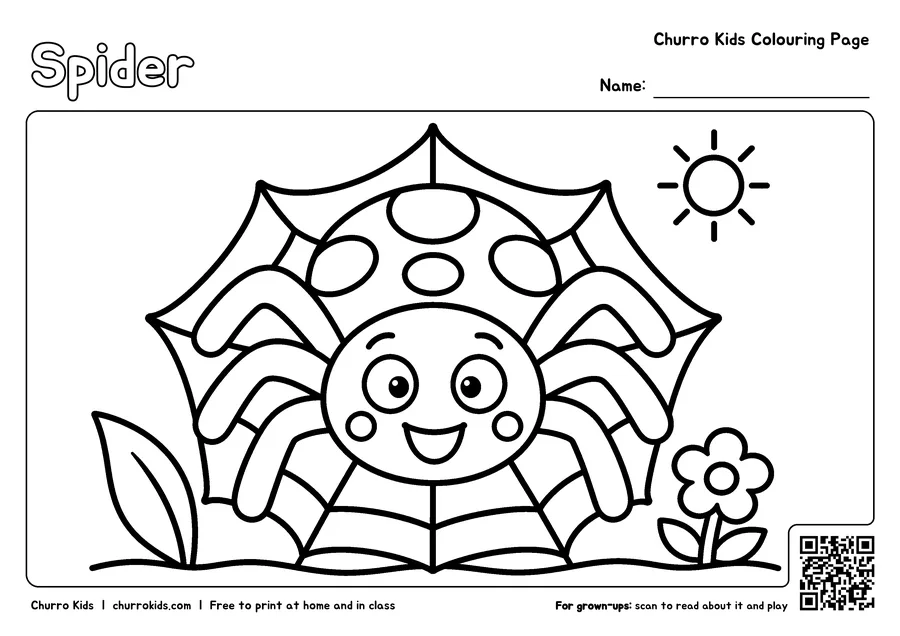
One A4 page, and it is free. Print it freely at home or in class.
Good for parents to know
- The World Spider Catalog listed about 54,000 species in 2026 and the number keeps rising, so the page says 'more than 50,000'. Joro spider females are about 17-30 mm long; males are far smaller, given as about 4-8 mm or 6-13 mm depending on the source.
- If your child is scared of spiders, try 'spiders catch the mosquitoes and flies that come into our home'. Rather than breaking webs, look together at a web covered in morning dew.
- Most spiders around us are not seriously harmful to people, but even a Joro spider can bite if handled, and the bite may swell and hurt. Do not let your child pick spiders up; seek medical help if a bite swells badly or breathing becomes difficult.
Things to try together
- On a dewy morning or in an autumn park, find a round web and count its spokes.
- Draw a spider from two circles (head-and-chest and abdomen) with eight legs on the front circle. Put it next to an ant drawing (three circles, six legs) and spot the differences.
- Make a little web with yarn: tie a few chopsticks together in the middle and wind the yarn round and round outwards.
Sources
- australian.museum/learn/animals/spiders/
- australian.museum/learn/animals/spiders/spider-facts/
- biokids.umich.edu/critters/Arachnida
- wsc.nmbe.ch/
- site.extension.uga.edu/forsyth/here-to-stay-joro-spiders/
- fieldreport.caes.uga.edu/publications/C1271/joro-spider-trichonephila-clavata/
- ko.wikipedia.org/wiki/무당거미
- en.wikipedia.org/wiki/Spider
- en.wikipedia.org/wiki/Spider_web