Stories · Bug Friends · Insect
Grasshopper Facts for Kids: Where Are a Grasshopper's Ears?
· Churro Kids
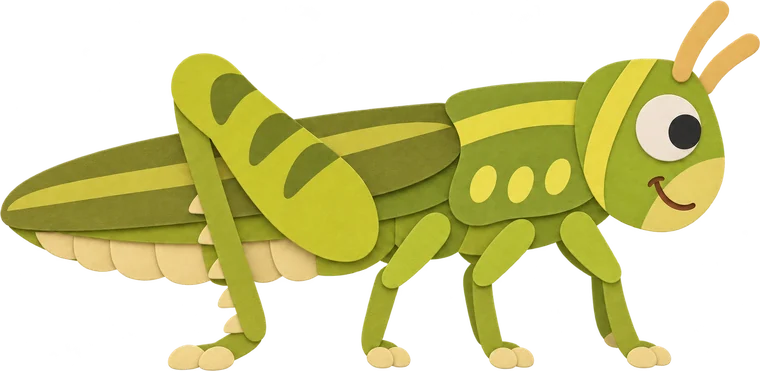
Walking along a rice-field path in autumn, your child watches a grasshopper spring up underfoot and asks, "How does it jump so far? Where are its ears?"
A grasshopper's big back legs launch it 10 to 20 times its own length. Its ears sit on the sides of its abdomen, and males sing by rubbing a back leg against a wing. It grows by moulting, with no pupa, and its short antennae tell it apart from a cricket. Below are the questions children ask most, with answers you can read aloud.
Fact cardGrasshopper Insect · grasshopper family
- Length
- about 2-4 cm (Korean rice grasshopper)
- Jump
- 10-20 times its body length
- Legs
- 6, with big back legs
- Ears
- on the sides of the abdomen
- Food
- grass and leaves
- Kinds
- more than 10,000 species
- A meadow friend that springs away on strong back legs
Grasshopper in a child's words
- A grasshopper is an insect with six legs and four wings. Its thick, long back legs make it a great jumper.
- It can jump 10 to 20 times its own body length in one go.
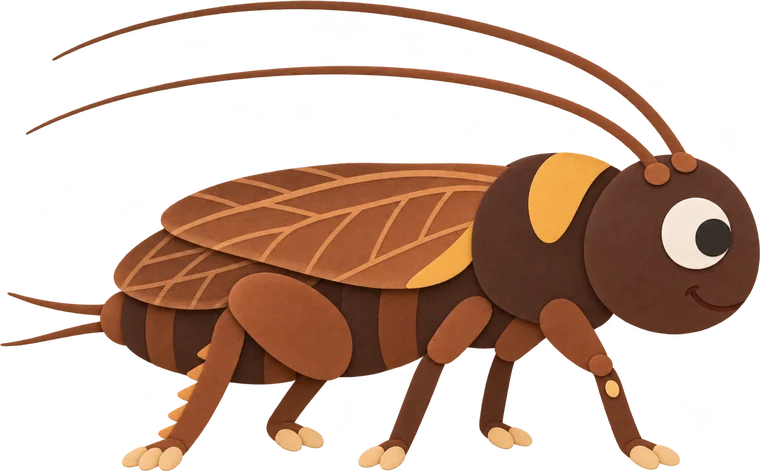
- Its antennae are short and thick, unlike a cricket's, which are longer than its body.
- Its ears are not on its head but on the sides of its abdomen, under the wings.
- Male grasshoppers make sound by rubbing a back leg against a wing, and each kind has its own song.
- Grasshoppers mostly eat grass and leaves. The rice grasshopper common in Korean paddies in autumn eats the leaves of rice and other grasses.
- Grasshoppers grow without a pupa stage: a hatchling looks like a small wingless grasshopper and becomes a winged adult after moulting five or six times.
Grasshopper: measure it with your own height
When your child asks, answer like this
 How can a grasshopper jump so far?

Where are a grasshopper's ears?
How does a grasshopper make its sound?
How is a grasshopper different from a cricket?
Does a grasshopper become a pupa?
Where are grasshoppers in winter?
Grasshopper facts that make kids say “Wow!”
- A grasshopper's ears are on its belly: a round, thin membrane hidden under the wings on each side of the abdomen.
- A female grasshopper digs a hole in the ground with the tip of her abdomen and lays her eggs inside.
- There are more than 10,000 kinds of grasshopper in the world.
A quiz to do together
Tap an answer.
Where are a grasshopper's ears?
Compared with a cricket's, a grasshopper's antennae are...
Does a grasshopper become a pupa?
You finished the quiz! Well done.
Colouring page
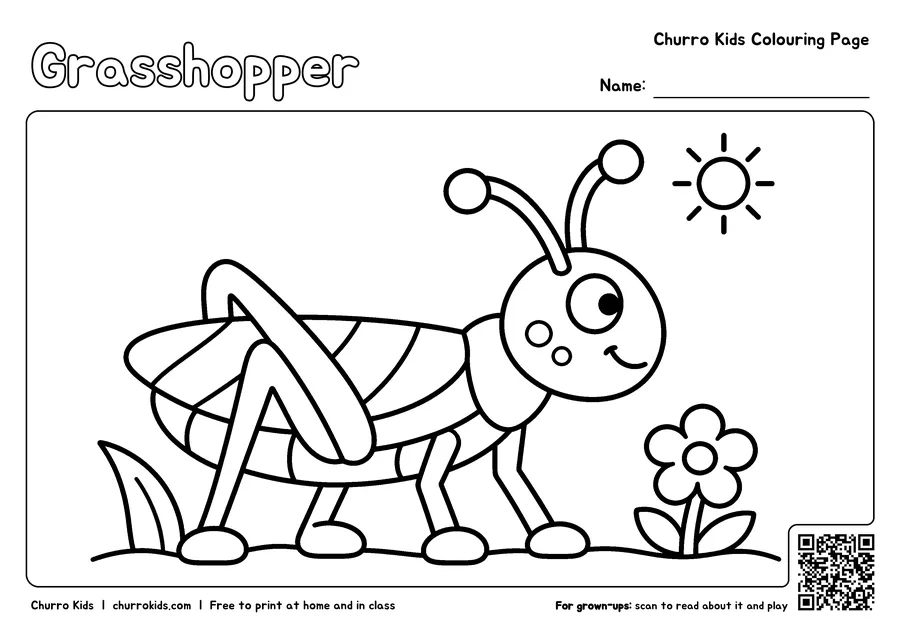
One A4 page, and it is free. Print it freely at home or in class.
Good for parents to know
- '메뚜기' is a group name for short-horned grasshoppers, not one species. This page uses the rice grasshopper of Korean paddies as its example; its length is given as about 21-35 mm, and 30-40 mm for a close relative, so 'about 2-4 cm' is used.
- Jump distance is quoted as '20 times its length' or '10-20 times', depending on the species and size, so a range is used. Grasshoppers make their songs in slightly different ways from kind to kind.
- If you catch one to look at, cup it gently in two hands rather than pinching a leg or wing; they are easily hurt. Let it go in the grass after a short look.
Things to try together
- Estimate how far a grasshopper jumps, then have your child do a standing long jump and work out how many of their own heights they covered.
- Whenever you find a hopping insect, check the antennae: short means grasshopper, long means cricket.
- Draw three boxes, egg, wingless young, winged adult, and join them in order. Unlike a butterfly, there is no pupa box.