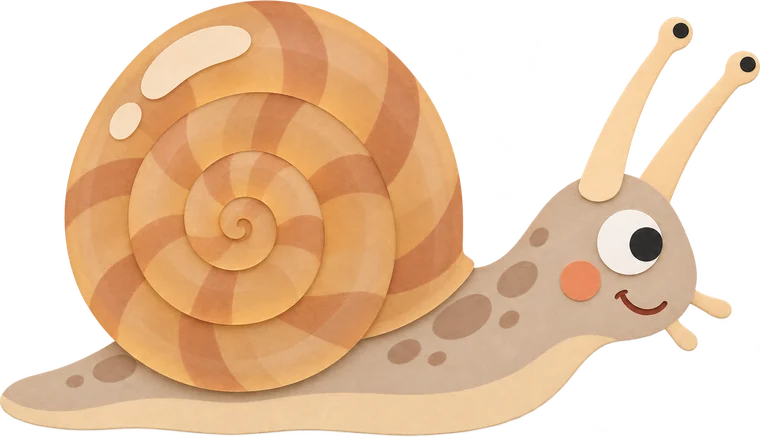
The morning after the rain, your child crouches by the flower bed, points and asks, "Is a snail an insect too? Where are its legs?"
A snail is not an insect but a mollusc, like an octopus or a clam. It glides on a single broad foot, carries its eyes on the tips of its long tentacles, rasps food with thousands of tiny teeth, and comes out on damp days so it does not dry out. Below are the questions children ask most, with answers you can read aloud.
Fact cardSnail Mollusc · not an insect
- Group
- mollusc (not an insect)
- Legs
- none: it glides on one muscly foot
- Tentacles
- 2 pairs, eyes on the tips of the long pair
- Speed
- about 1 m (3 ft) an hour at best
- Teeth
- thousands of tiny teeth
- Favourite weather
- damp days after rain
- A slowpoke that carries its house on its back
Snail in a child's words
- A snail is not an insect. Insects have six legs; a snail has none and is a soft-bodied mollusc, in the same big group as octopuses and clams.
- It moves by sending waves along the broad, muscly foot under its body.
- The foot oozes sticky slime that helps it glide and keeps it from drying out, leaving a shiny trail behind.
- Its head has two pairs of tentacles: eyes on the tips of the long pair, and the short pair for smelling.
- The shell is part of the snail's body and grows as the snail grows.
- A snail rasps up leaves with thousands of tiny teeth on a ribbon in its mouth.
- When it is very hot or very cold, it seals the opening of its shell with dried slime and rests.
When your child asks, answer like this
 Is a snail an insect?

Where are a snail's eyes?
How slow is a snail?
Do snails have teeth?
Why do snails come out when it rains?
Can a snail leave its shell?
Where do snails lay eggs?
Snail facts that make kids say “Wow!”
- Each snail has both mother and father parts, but two snails still need to meet before eggs are laid.
- Sticky slime lets a snail creep up walls and even upside down under leaves.
- Many kinds of land snail live about a year and some two or three, while a few big kinds live for more than ten years.
A quiz to do together
Tap an answer.
Is a snail an insect?
Where are a snail's eyes?
What weather do snails like?
You finished the quiz! Well done.
Colouring page
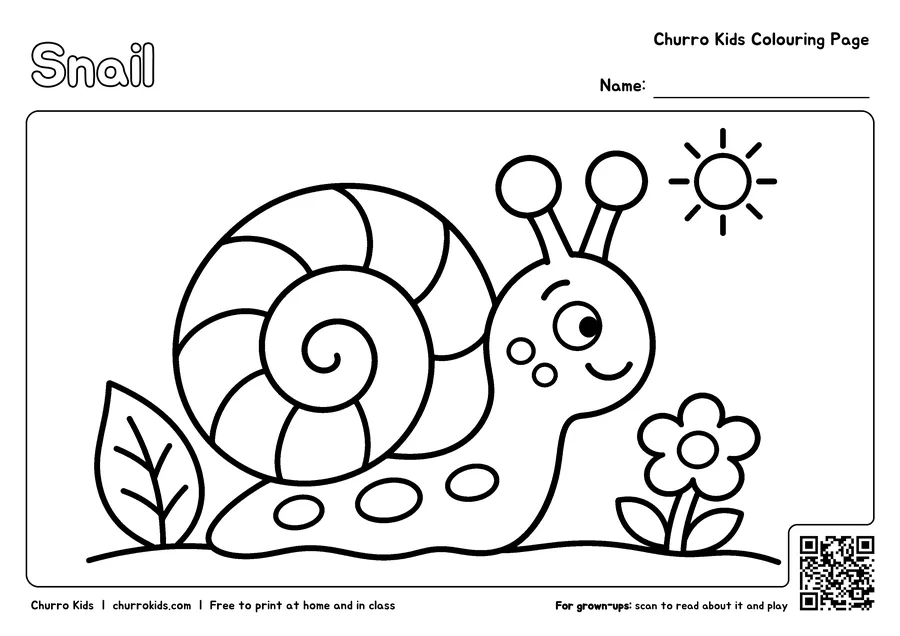
One A4 page, and it is free. Print it freely at home or in class.
Good for parents to know
- The snail Korean children usually find is a species of Acusta (명주달팽이 and its relatives), with a shell about 2-2.5 cm across; its scientific name is still being revised, so the page just says 'snail'. The speed of about 1 m an hour is the top speed in a UK garden-snail tracking study; other sources quote about 1 mm a second.
- Salt draws the water out of a snail's body and causes it real distress, so please make it clear this is never a game. When you are done watching, put the snail back on a leaf or plant.
- Have your child wash their hands with soap after touching a snail. Snails do not bite or sting, but soil and slime stay on the hands, and snails must never go in the mouth or be eaten raw.
Things to try together
- The day after rain, look for snails in a flower bed and, without poking, count the long and short tentacles.
- Let a snail crawl briefly on a clear sheet or window and watch the waves ripple along its foot from below, then return it to the grass.
- Trace the spiral on a snail's shell with a finger and count how many times it goes round.
Sources
- mdc.mo.gov/discover-nature/field-guide/land-snails-slugs
- nhm.org/stories/microscopic-look-snail-jaws
- news-archive.exeter.ac.uk/2013/august/title_315519_en.html
- sbs.com.au/news/article/uk-scientists-track-snails-pace/us77g465n
- fieldofmar-e.schools.nsw.gov.au/fact-sheets/invertebrates/snail-fact-sheet
- sciencefocus.com/nature/why-does-salt-kill-slugs
- accesson.kr/malacol/v.39/3/73/32883
- ko.wikipedia.org/wiki/달팽이
- en.wikipedia.org/wiki/Snail
- en.wikipedia.org/wiki/Land_snail
- ja.wikipedia.org/wiki/ウスカワマイマイ