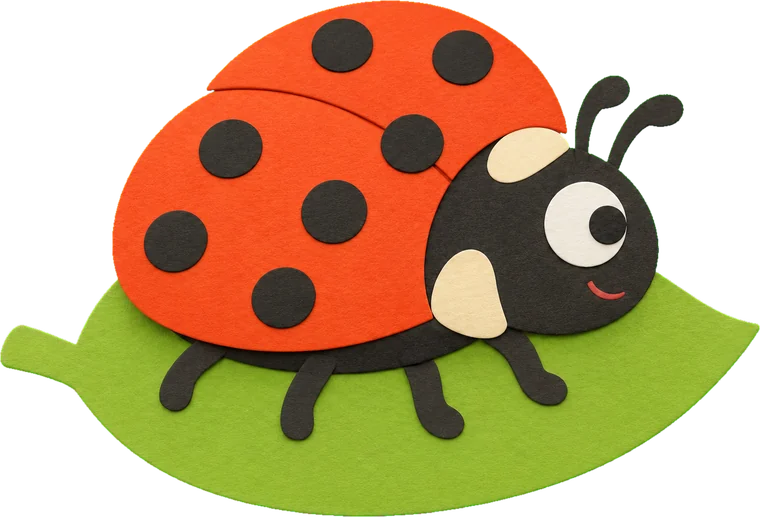
A ladybug walks across your child's hand. Counting the spots, your child asks, "One, two, three... is it seven years old?"
A ladybug's spots tell you its kind, not its age. The seven-spot ladybug has seven and is about 5-8 mm long (the size of a pea). It eats the aphids that feed on plants, and defends itself with a bitter yellow fluid. Below are the questions children ask most, with answers you can read aloud.
Fact cardLadybug Insect · beetle
- Length
- about 5-8 mm (seven-spot ladybug)
- Food
- aphids
- Spots
- 7 on a seven-spot ladybug
- Defence
- a bitter yellow fluid
- Winter
- sleeps in clusters
- Kinds
- more than 5,000 species
- The red spotted friend that eats up aphids
Ladybug in a child's words
- A seven-spot ladybug has seven black spots on its red wing covers and is about 5-8 mm long, the size of a pea.
- Ladybugs eat aphids, tiny bugs that suck the juice out of plants.
- Both adults and young eat aphids: one ladybug is said to eat about 5,000 in its lifetime.
- A ladybug larva looks nothing like the adult. It is long and dark.
- When it feels in danger, a ladybug lets out a bitter yellow fluid from its leg joints.
- The bright red colour is a sign to birds that says, 'I taste bad.'
- When winter comes, ladybugs gather under leaves or in cracks in bark and sleep in groups.
Ladybug: measure it with your own height
When your child asks, answer like this
 How many spots does a ladybug have?

Do more spots mean the ladybug is older?
What do ladybugs eat?
What is the yellow fluid that comes out when you touch a ladybug?
Why are ladybugs red?
Can ladybugs fly?
Where do ladybugs go in winter?
Ladybug facts that make kids say “Wow!”
- There are more than 5,000 kinds of ladybug, and they come in yellow, orange and black as well as red.
- Thousands of ladybugs may spend the winter huddled in one place.
- Not every ladybug eats aphids: some kinds eat the leaves of potato and aubergine plants.
A quiz to do together
Tap an answer.
How many spots does a seven-spot ladybug have?
What is a ladybug's favourite food?
Do more spots mean an older ladybug?
You finished the quiz! Well done.
Colouring page
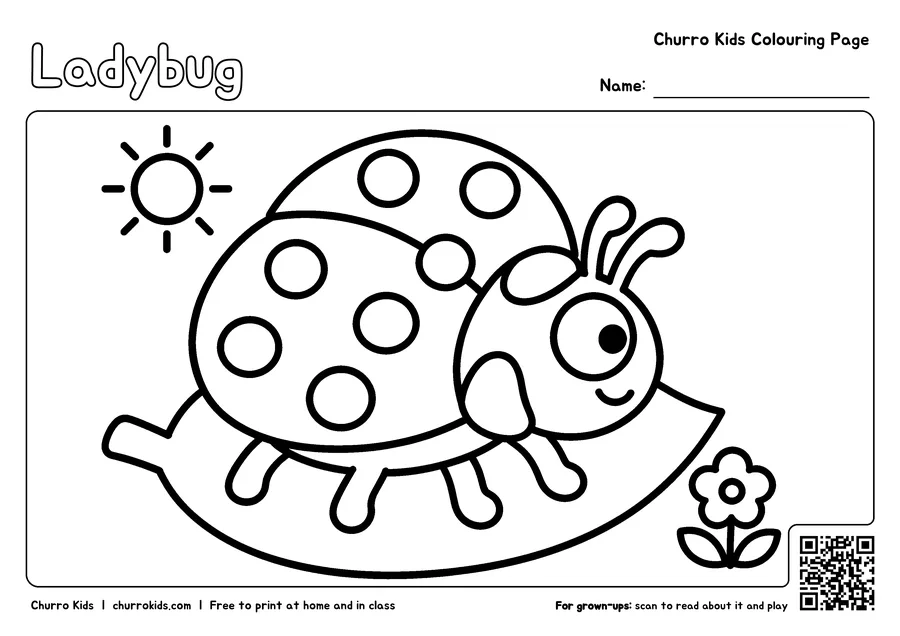
One A4 page, and it is free. Print it freely at home or in class.
Good for parents to know
- '5,000 in a lifetime' is a popular round figure. Daily numbers range from a few dozen to 150 depending on the source, and lifespan is usually given as about a year, though some pages say two to three.
- The two commonest ladybugs in Korea are the seven-spot and the harlequin (Asian) ladybug. Harlequins come in many colours and spot counts, so the one your child finds may not have seven.
- The yellow fluid is harmless to people but smelly, and it can stain clothes. Wash hands afterwards and keep fingers away from eyes.
Things to try together
- In spring, look for clusters of aphids on rose stems or weeds: a ladybug or its larva is often close by.
- When you meet a ladybug, count its spots and draw it just as it is.
- Let a ladybug walk up your hand to a fingertip and watch it open its wings and take off.
Sources
- en.wikipedia.org/wiki/Coccinella_septempunctata
- en.wikipedia.org/wiki/Coccinellidae
- kids.nationalgeographic.com/animals/invertebrates/facts/ladybug
- woodlandtrust.org.uk/trees-woods-and-wildlife/animals/beetles/7-spot-ladybird/
- plantura.garden/uk/beneficial-insects/seven-spot-ladybird
- ko.wikipedia.org/wiki/칠성무당벌레
- coleoptera.org.uk/node/23848