Stories · Bug Friends · Insect
Praying Mantis Facts for Kids: Why Does a Mantis Turn Its Head to Look at You?
· Churro Kids
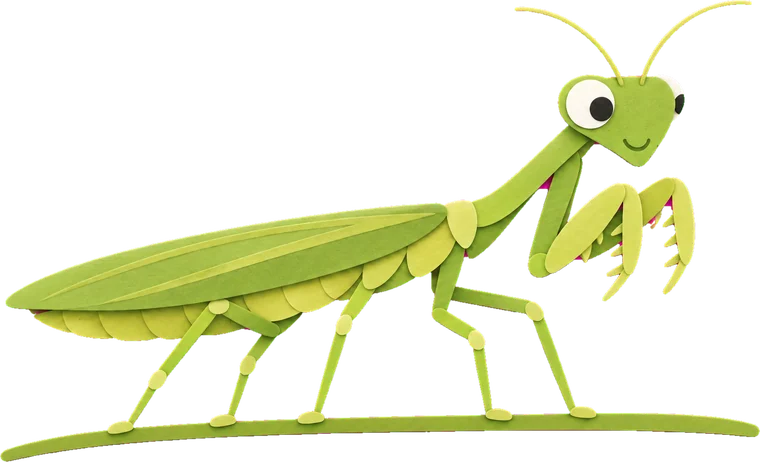
In the long grass your child comes eye to eye with a mantis and gasps, "It turned its head and looked at me! Why did it do that?"
A mantis can swivel its triangular head almost half a circle, and with five eyes it is very good at spotting movement. It catches insects with its folding, spiny front legs, and in autumn the female lays her eggs in a foam case. The Chinese mantis, the largest in Korea, is about 7-10 cm (3-4 in) long. Below are the questions children ask most, with answers you can read aloud.
Fact cardPraying Mantis Insect · mantis
- Length
- about 7-10 cm (Chinese mantis)
- Food
- insects such as grasshoppers and butterflies
- Eyes
- 5 (2 compound, 3 simple)
- Head
- turns almost half a circle
- Legs
- 6 (the front two are folding grabbers)
- Lifespan
- about 1 year
- The hunter in the grass that can look over its shoulder
Praying Mantis in a child's words
- A mantis can turn its triangular head almost half a circle, so it can look behind without moving its body.
- The Chinese mantis, the biggest in Korea, is about 7-10 cm (3-4 in) long.
- Its front legs fold like a pocket knife and have spines for holding food tight.
- Mantises are green or brown like the grass and twigs around them, so they are hard to see.
- A mantis waits very still, then quickly catches insects such as grasshoppers and butterflies that come close.
- In autumn the female makes a foamy egg case and lays her eggs inside, where they spend the winter.
- In spring as many as 200-300 baby mantises can come out of one egg case.
Praying Mantis: measure it with your own height
When your child asks, answer like this
 Why does a mantis hold its hands together?

The mantis turned its head to look at me. Is it really looking?
What do mantises eat?
Do mantises bite people?
Is the black dot in a mantis's eye a pupil?
Where do baby mantises come from?
How long does a mantis live?
Praying Mantis facts that make kids say “Wow!”
- A mantis can judge distance with its two big eyes, as people do, so it knows exactly how close its food is.
- There are around 2,000 kinds of mantis, and some look just like flowers or dead leaves.
- A baby mantis looks like a tiny adult without wings. There is no pupa stage.
A quiz to do together
Tap an answer.
How many eyes does a mantis have in all?
What does a mantis eat?
Where do mantis eggs spend the winter?
You finished the quiz! Well done.
Colouring page
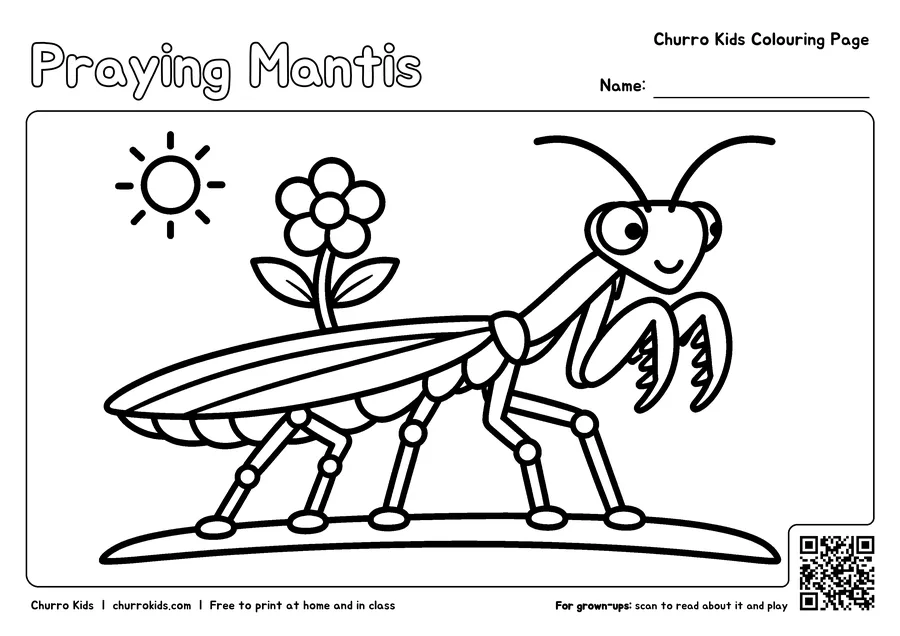
One A4 page, and it is free. Print it freely at home or in class.
Good for parents to know
- Chinese mantis length is given as 7.5-9.5 cm on average and up to about 11 cm; hatchlings per egg case as 150-300. World species counts range from about 1,800 to more than 2,400.
- Your child may have heard that the female eats the male. It happens sometimes, not always, and in the wild most males get away. 'It can happen when she is very hungry' is enough.
- In Korean the insect shares its name with the skin wart (사마귀); touching a mantis does not give you warts. If you catch one, look and then return it to the grass where you found it.
Things to try together
- If you meet a mantis in autumn, stand a step away and move slowly sideways. Does its head follow you?
- On a winter walk, look for brown egg cases on twigs and dry stems. Leave them where they are.
- Cut a mantis out of green paper, hide it among the leaves of a houseplant and take turns finding it.
Sources
- en.wikipedia.org/wiki/Mantis
- en.wikipedia.org/wiki/Chinese_mantis
- ko.wikipedia.org/wiki/왕사마귀
- kids.nationalgeographic.com/animals/invertebrates/facts/praying-mantis
- australian.museum/learn/animals/insects/praying-mantises-order-mantodea/
- ncl.ac.uk/press/articles/archive/2018/02/newformof3dvisiondiscoveredinprayingmantis/
- minibeastwildlife.com.au/are-you-looking-at-me-how-insects-see-the-world/4/