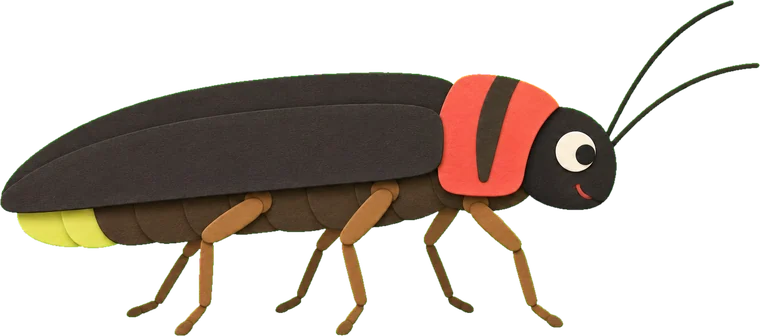
On a country lane one summer night your child sees a firefly for the first time and asks, wide-eyed, "Is that light hot? Will it burn me?"
A firefly's glow is 'cold light': almost no heat at all. It is made at the tip of the abdomen when a glowing substance meets oxygen, and the flashes are signals for finding a mate. The firefly most often seen in Korea in early summer is 7-10 mm long, and its larvae grow up under water eating snails. Fireflies need clean water and dark nights. Below are the questions children ask most, with answers you can read aloud.
Fact cardFirefly Insect · beetle
- Length
- about 7-10 mm (Aquatica lateralis)
- Light
- from the tail end, and not hot
- Why it glows
- to find a mate
- Larva's food
- water snails and land snails
- When to see
- early summer nights (June-August)
- Adult life
- about 2 weeks
- A tiny star of summer nights, with light that is not hot
Firefly in a child's words
- A firefly is an insect that makes light at the end of its abdomen.
- The light appears when a glowing substance in its body meets oxygen. Unlike a light bulb, it is hardly warm at all.
- Flashing is a signal for finding a mate, and each kind of firefly has its own pattern.
- The firefly seen in Korea in early summer, Aquatica lateralis, is about 7-10 mm long.
- Its larvae live under water in rice fields and streams and eat water snails.
- Fireflies glow even when they are larvae.
- An adult firefly lives for about two weeks; growing from egg to adult takes about a year.
Firefly: measure it with your own height
When your child asks, answer like this
 How does a firefly make light?

Is a firefly's light hot?
Why do fireflies blink?
Is a firefly a kind of fly?
Why are there no fireflies where we live?
What do firefly larvae eat?
Can I catch a firefly?
Firefly facts that make kids say “Wow!”
- Even firefly eggs are said to glow faintly.
- There are about 2,000 kinds of firefly, and their light can be yellow, green or orange depending on the kind.
- In Muju, South Korea, the fireflies and the places where they live are protected as a Natural Monument.
A quiz to do together
Tap an answer.
Is a firefly's light hot?
Why does a firefly flash its light?
What kind of insect is a firefly?
You finished the quiz! Well done.
Colouring page
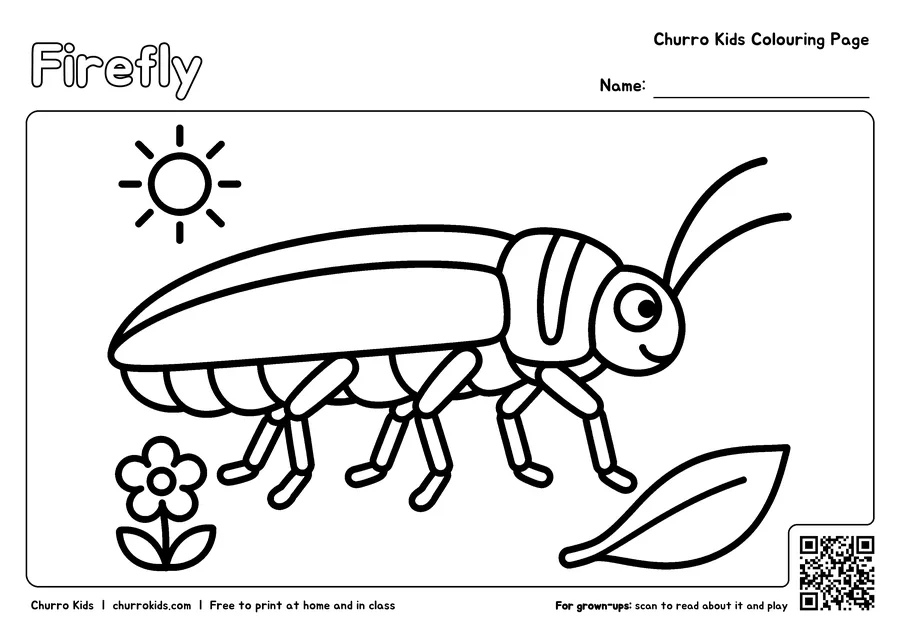
One A4 page, and it is free. Print it freely at home or in class.
Good for parents to know
- Three fireflies are commonly seen in Korea: Aquatica lateralis (flashing, June-August, aquatic larvae), Luciola unmunsana, and Pyrocoelia rufa, which flies in late summer with a steady glow. Some sources record six species in all.
- Adult lifespan is given as anything from about 15 days to three weeks depending on the source and rearing conditions (three to four weeks for some American species). World species counts range from about 2,000 to more than 2,400. 'Nearly 100% light' simply means very little energy is lost as heat.
- When you go firefly watching, switch off torches and phone screens and stay on the path: females sit in the grass and are easily trodden on.
Things to try together
- In a dark room, play a signal game with a torch: agree that two short flashes mean 'hello' and one long flash means 'over here'.
- Find a firefly-watching spot or festival for June, mark it on the calendar and go together.
- On black paper, paint a night scene with yellow dots of firefly light.