Stories · Bug Friends · Not an insect
Earthworm Facts for Kids: Why Do Worms Come Out When It Rains?
· Churro Kids
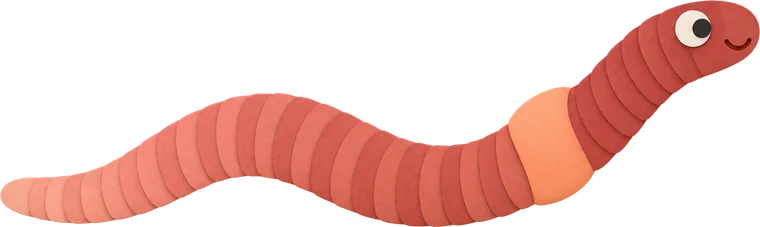
On a wet morning on the way to nursery, your child stops at a worm on the pavement: "Why is it outside? Did it lose its home?"
Earthworms have no legs and no eyes. They crawl by gripping the soil with tiny bristles on each segment and breathe through their moist skin. They eat dead leaves, leave rich droppings and dig tunnels that let air and water into the soil, which makes them the garden's underground farmers. Why they come up after rain is still being studied. With no legs, they are not insects. Below are the questions children ask most, with answers you can read aloud.
Fact cardEarthworm Not an insect · annelid (segmented worm)
- Length
- commonly about 7-10 cm (3-4 in)
- Legs
- none; tiny bristles on each segment
- Breathing
- through its moist skin
- Eyes
- none; its skin senses light
- 'Hearts'
- 5 pairs of pumping vessels
- Food
- dead leaves and bits in the soil
- The underground farmer that breathes through its skin
Earthworm in a child's words
- An earthworm is not an insect. It has no legs, and its body is a chain of ring-like segments: it is an annelid, a segmented worm.
- An earthworm has a great many segments, more than 100 in a big worm, each with tiny stiff bristles that grip the soil as it crawls.
- Earthworms have no nose or lungs. They breathe through their moist skin, so drying out makes breathing hard.
- They have no eyes, but their skin senses light and dark, so they move away from sunlight into the soil.
- In the common nightcrawler, five pairs of thick blood vessels pump blood like hearts, which is why people say a worm has five hearts.
- They eat dead leaves and soil, and their droppings make the soil richer. Their burrows let air and water into the ground.
- A thick band near the front end makes a small cocoon with eggs inside, and baby worms hatch from it.
Earthworm: measure it with your own height
When your child asks, answer like this
 Is an earthworm an insect?

How does an earthworm move without legs?
Why do earthworms come out after rain?
Do earthworms have eyes?
If you cut an earthworm in half, do you get two worms?
Why are earthworms good for us?
What should we do with an earthworm on the pavement?
Earthworm facts that make kids say “Wow!”
- Every earthworm is both male and female. Two worms swap sperm, and then both lay eggs.
- There are thousands of kinds of earthworm, and one Australian earthworm is said to grow to more than 2 m (6.5 ft) long.
- An earthworm cocoon is smaller than a grain of rice, yet several baby worms can hatch from one.
A quiz to do together
Tap an answer.
How does an earthworm breathe?
Is an earthworm an insect?
How do earthworms help the soil?
You finished the quiz! Well done.
Colouring page
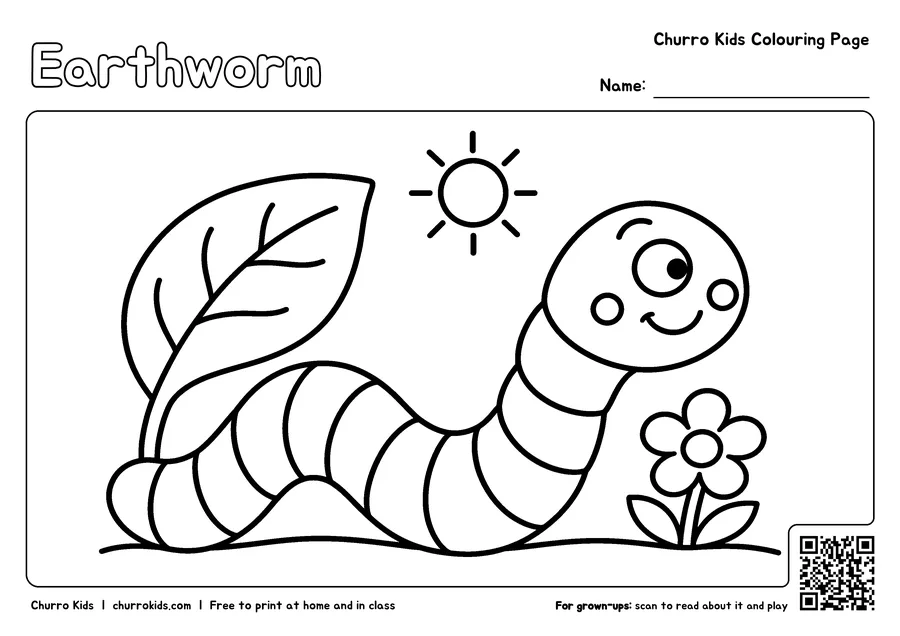
One A4 page, and it is free. Print it freely at home or in class.
Good for parents to know
- Earthworms are annelids, not insects. They appear in this insect book, which makes them a handy chance to practise spotting insects: six legs and a three-part body. The 120-170 segments and four pairs of bristles per segment are for the common nightcrawler, Lumbricus terrestris; many worms common in Korea carry a whole ring of bristles on each segment, so species differ.
- Why worms surface after rain is not settled. The 'burrows flood and they drown' idea is popular, but nightcrawlers have survived weeks in oxygenated water, and migration and finding mates are also suggested. The 'five hearts' are five pairs of aortic arches. World species counts range from about 2,700 to more than 6,000 depending on the source.
- Cutting a worm in half does not make two worms. When handling worms, wet your hands first and be gentle, then return the worm to the soil and wash hands.
Things to try together
- The day after rain, find a worm in a flowerbed, rest it on damp paper for a moment and look with a magnifying glass for its segments and the thick band. Then put it back in the soil.
- Do 'worm exercises': stretch long, squeeze short and creep across the floor.
- Fill a clear jar with layers of soil and sand, add dead leaves on top and watch a couple of worms for a few days as the layers mix. Then return the worms to where you found them.
Sources
- ko.wikipedia.org/wiki/지렁이
- en.wikipedia.org/wiki/Earthworm
- en.wikipedia.org/wiki/Lumbricus_terrestris
- mdc.mo.gov/discover-nature/field-guide/earthworms
- kids.nationalgeographic.com/animals/invertebrates/facts/earthworm
- web.extension.illinois.edu/worms/facts/
- web.extension.illinois.edu/worms/anatomy/anatomy3.html
- web.extension.illinois.edu/worms/anatomy/anatomy6.html
- web.extension.illinois.edu/worms/anatomy/anatomy10.html