Stories · Bug Friends · Insect
Rhinoceros Beetle Facts for Kids: Why Do Only Males Have a Horn?
· Churro Kids
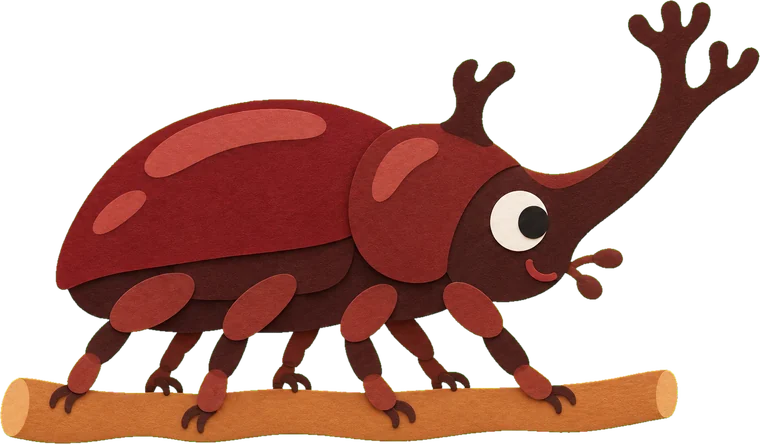
Your child stops in front of a beetle tank and asks, "Why does this one have a horn, and that one doesn't?"
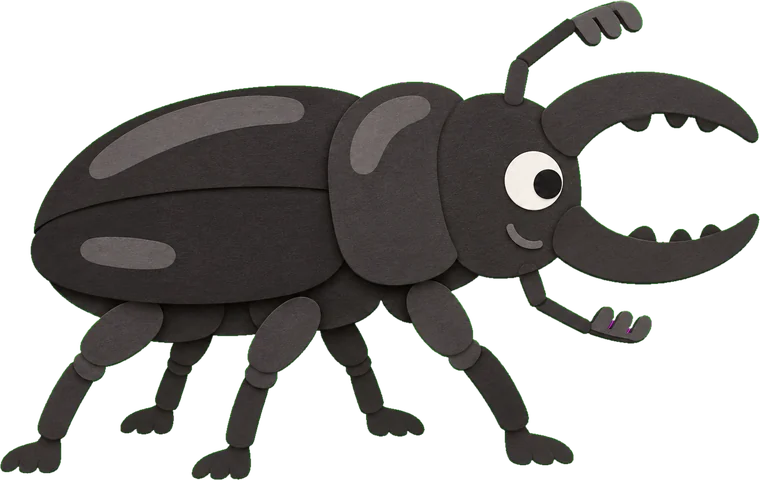
The Japanese rhinoceros beetle (Trypoxylus dichotomus) is the largest scarab beetle in Korea and a much-loved summer pet across East Asia. Only males carry the long forked horn. Adults gather on oak trees at night to feed on sap, after spending most of a year underground as grubs. Below are the questions children ask most, with answers you can read aloud as they are.
Fact cardRhinoceros Beetle Insect · beetle
- Length
- about 3-8 cm with the horn
- Food
- oak tree sap
- When to see
- summer nights (June-September)
- Legs
- 6
- Life cycle
- about 1 year from egg to adult
- Home
- oak woods in East Asia
- The strongman of the forest, with a horn to guard its tree sap
Rhinoceros Beetle in a child's words
- The Japanese rhinoceros beetle is the biggest scarab beetle in Korea: about 3-8 cm (1.2-3.3 in) long with the horn.
- Only males have the long horn. Females have none and look rounder.
- Adults feed on the sweet sap that runs from oak trees.
- They rest under leaf litter or in the soil by day and come out at night.
- The grubs live in the soil and grow fat on rotting leaves and wood.
- It takes about a year to go from egg to grub to pupa to adult.
- The adult lives for just one summer, around one to three months.
Rhinoceros Beetle: measure it with your own height
When your child asks, answer like this
 Why does a rhinoceros beetle have a horn?

What do rhinoceros beetles eat?
How strong is a rhinoceros beetle?
Why don't females have a horn?
How long does a rhinoceros beetle live?
Can a rhinoceros beetle fly?
Will a small beetle grow bigger?
Rhinoceros Beetle facts that make kids say “Wow!”
- A male's horn can be up to a third of his body length, and the better he ate as a grub, the longer it grows.
- The grub sheds its skin twice and passes through three stages; a full-grown grub is as thick as an adult's finger.
- A male already shows the shape of his horn while he is still a pupa.
A quiz to do together
Tap an answer.
Which rhinoceros beetle has the long horn?
What do adult rhinoceros beetles like to eat?
When are rhinoceros beetles mostly active?
You finished the quiz! Well done.
Colouring page
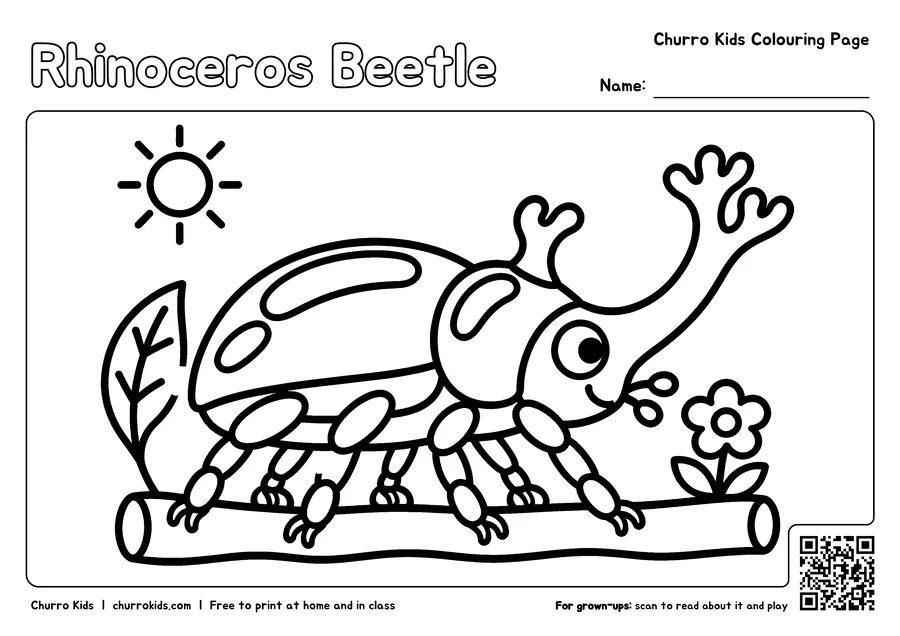
One A4 page, and it is free. Print it freely at home or in class.
Good for parents to know
- Published sizes differ because of how the beetle is measured: about 3-5.5 cm without the horn and about 3-8.5 cm with it.
- The popular line that a rhinoceros beetle lifts 850 times its own weight has not been confirmed by experiment. In a laboratory test on another rhinoceros beetle species, the beetles walked for a long time carrying about 30 times their weight and could barely move under about 100 times. 'Dozens of times its own weight' is a safe way to put it.
- If you keep one at home, do not let children lift it by the horn or hold it for long. Its claws are sharp and can prick. Wash hands afterwards.
Things to try together
- Draw a 5 cm line with a ruler and compare it with your child's finger.
- In summer, look for sap runs on oak trees along a woodland path; butterflies and beetles gather there in the daytime.
- Draw the four stages in order: egg, grub, pupa, adult.