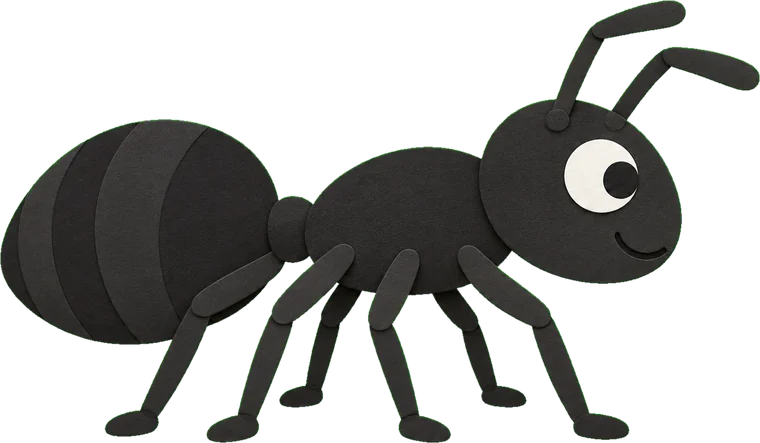
Crouched on the playground, your child watches for a long while and then asks, "Why do the ants all walk in a line?"
Ants lay down a smell trail and follow it nose to tail, or rather antenna to antenna. A nest holds an egg-laying queen and her worker daughters, and a single ant can carry more than ten times its own weight. There are well over 10,000 kinds. Below are the questions children ask most, with answers you can read aloud.
Fact cardAnt Insect · relative of bees and wasps
- Length
- about 1 cm (Japanese carpenter ant worker)
- Kinds
- more than 10,000 species
- Legs
- 6
- How they live
- in a colony with a queen and workers
- How they talk
- by smell and antennae
- Strength
- carries over 10 times its own weight
- Tiny workers that march along a trail of smell
Ant in a child's words
- There are more than 10,000 kinds of ant, living almost everywhere except very cold places such as Antarctica.
- The big black ant Korean children see in playgrounds is the Japanese carpenter ant; a worker is about 1 cm (0.4 in) long.
- An ant's body has three parts, head, thorax and abdomen, and all six legs are attached to the thorax.
- A nest has a queen who lays eggs and workers who do the jobs. Every worker is female.
- Ants mark their path with a smell and follow it with their antennae, which is why they walk in a line.
- An ant can carry more than ten times its own weight.
- Ants grow in four steps: egg, larva, pupa, adult.
Ant: measure it with your own height
When your child asks, answer like this
 Why do ants walk in a line?

How strong is an ant?
What does the queen ant do?
How do ants talk to each other?
Are there ants with wings?
How long do ants live?
What if an ant bites me?
Ant facts that make kids say “Wow!”
- Scientists estimate there are about 20 quadrillion ants on Earth: a 2 followed by 16 zeros.
- Ants were already around in the age of dinosaurs; ant fossils more than 100 million years old have been found.
- A Japanese carpenter ant queen is about 1.7 cm long, much bigger than her workers.
A quiz to do together
Tap an answer.
What do ants follow when they walk in a line?
How many legs does an ant have?
Which ant lays the eggs in the nest?
You finished the quiz! Well done.
Colouring page
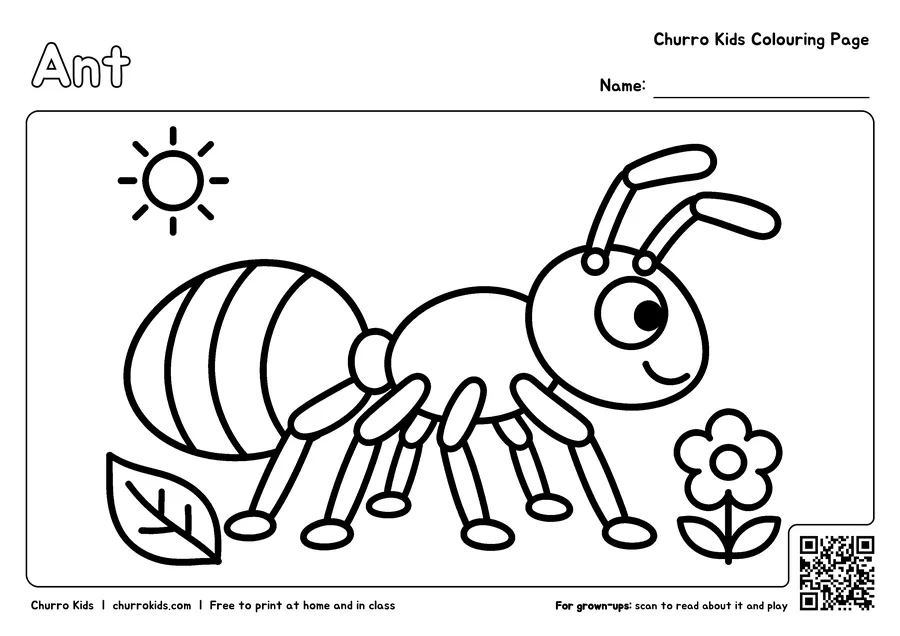
One A4 page, and it is free. Print it freely at home or in class.
Good for parents to know
- You will see '10 times', '20 times' and '50 times' for how much an ant can carry. It depends on the species and the method, so this page says 'more than ten times'.
- The figure of about 20 quadrillion ants is an estimate from a 2022 study. Queen lifespans vary by species; the record of more than 28 years belongs to a single captive black garden ant queen.
- If your child wants to stamp on ants or wreck a nest, try 'they are carrying food home'. Crouching down to watch is usually more fun anyway.
Things to try together
- Find a line of ants and follow it with your eyes: where does it start and where does it go?
- Put one biscuit crumb near an ant trail and count how many minutes it takes for the ants to find it.
- Draw an ant from three circles (head, thorax, abdomen) and add six legs to the middle one.
Sources
- en.wikipedia.org/wiki/Ant
- nwf.org/Educational-Resources/Wildlife-Guide/Invertebrates/Ants
- australian.museum/learn/animals/insects/ants-family-formicidae/
- en.wikipedia.org/wiki/Camponotus_japonicus
- ko.wikipedia.org/wiki/일본왕개미
- phys.org/news/2022-09-ants-earth-quadrillion.html
- askabiologist.asu.edu/content/ant-factoids