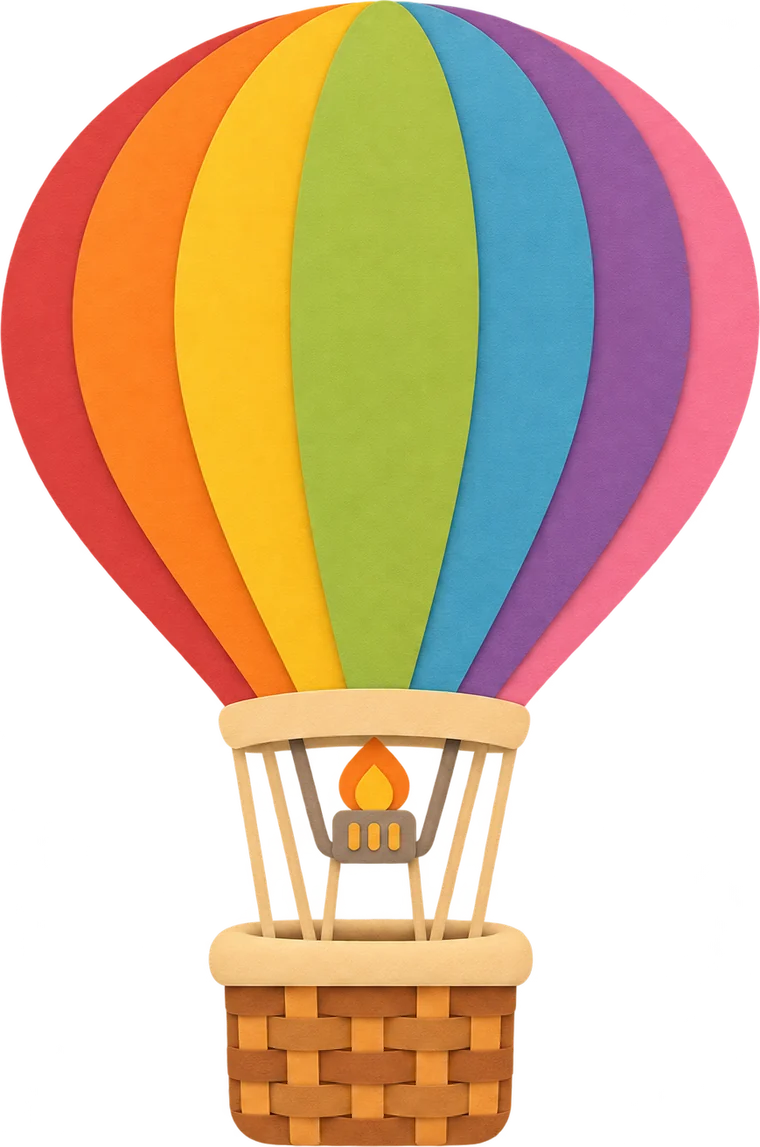
Spotting a colourful hot air balloon in a picture book, your child asks: "It has no wings and no engine - how does it go up?"
A burner heats the air inside the balloon, and hot air is lighter than the cooler air around it, so the balloon rises. With no steering wheel it travels with the wind, and to come down the pilot lets hot air out through a flap at the top. In 1783 a sheep, a duck and a rooster flew before any person did. Below are the questions children ask most, with answers you can read aloud as they are.
Fact cardHot Air Balloon Vehicle · flying vehicle
- Job
- carries people through the sky with the wind
- Why it rises
- heated air is lighter than the cooler air outside
- Air inside
- about 100-120 °C (210-250 °F)
- Burner fuel
- propane gas
- First people aboard
- 21 November 1783, about 25 minutes
- Height record
- about 21 km (69,000 ft), 2005
- Hot air carries it gently into the sky
Hot Air Balloon in a child's words
- A hot air balloon is a giant balloon filled with hot air. People ride in a basket hanging underneath.
- Heated air is lighter than cooler air. Because the hot air inside is lighter than the air outside, the balloon floats up.
- A burner above the basket burns propane gas and shoots a big flame up into the balloon. The air inside gets to about 100-120 °C (210-250 °F).
- To go down, the pilot opens a round flap at the top of the balloon to let hot air out.
- A balloon has no steering wheel. It drifts with the wind, and the pilot changes height to find winds blowing the right way.
- The basket is usually woven from wicker. It is light and cushions the landing.
- On 21 November 1783, in Paris, people made the first free flight in a hot air balloon, flying about 9 km (5.5 miles) in about 25 minutes.
When your child asks, answer like this
 How does a hot air balloon go up?

Why is there a big flame?
How does a balloon come down?
Can a balloon go wherever it wants?
Why is the basket woven?
Who rode in a balloon first?
Hot Air Balloon facts that make kids say “Wow!”
- The first balloon passengers were a sheep, a duck and a rooster. They flew about 3 km (2 miles) in eight minutes and landed safely.
- In 2005 a hot air balloon climbed to about 21 km (69,000 ft) - roughly twice as high as airliners fly.
- People first flew in a hot air balloon in 1783, 120 years before the first powered airplane flight in 1903.
A quiz to do together
Tap an answer.
Why does a hot air balloon rise?
Who were the very first balloon passengers?
What decides where a balloon goes?
You finished the quiz! Well done.
Colouring page
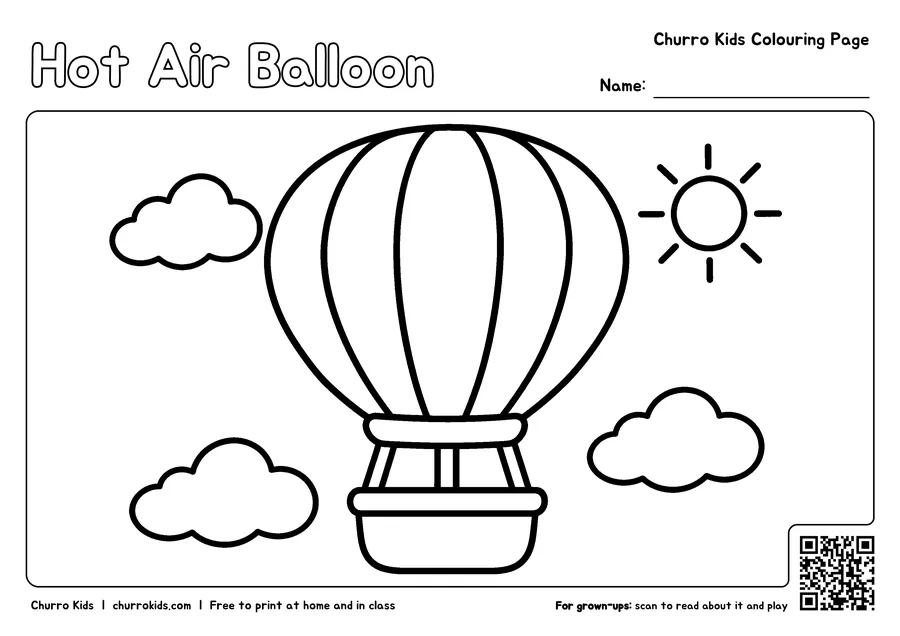
One A4 page, and it is free. Print it freely at home or in class.
Good for parents to know
- Figures for the air temperature inside vary: an encyclopedia calculation uses about 99 °C, and nylon envelopes are kept below about 120 °C to protect the fabric, so the page says 'about 100-120 °C'.
- Sources sometimes mix up the date of the first public demonstration (4 June 1783) with the animal flight at Versailles (19 September). The first free flight with people was on 21 November; a tethered ascent with a person is recorded in October, which is why the page says 'first free flight'.
- Balloons use fire. Make sure children know that launching balloons with candles or flames at home is dangerous and can start fires. On a real balloon ride, listen to the pilot and the grown-ups and keep still in the basket.
Things to try together
- Stretch a balloon over the neck of an empty plastic bottle and let a grown-up stand the bottle in a bowl of hot water. As the air inside warms and expands, the balloon stands up. Only grown-ups handle the hot water.
- Blow soap bubbles and watch them drift with the breeze - hot air balloons travel with the wind in the same way.
- Draw a hot air balloon, label the envelope, burner and basket, and colour the balloon with your favourite pattern.
Sources
- grc.nasa.gov/www/k-12/WindTunnel/Activities/buoy_Archimedes.html
- centennialofflight.net/essay/Lighter_than_air/Early_Balloon_Flight_in_Europe/LTA1.htm
- explainthatstuff.com/how-hot-air-balloons-work.html
- nasa.gov/feature/115-years-ago-wright-brothers-make-history-at-kitty-hawk
- en.wikipedia.org/wiki/Hot_air_balloon
- en.wikipedia.org/wiki/Montgolfier_brothers