Staring at the building site outside the window, your child asks: "That crane is lifting something so heavy - why doesn't it fall over?"
A crane lifts heavy loads with pulleys and a strong steel wire rope. It stays upright by spreading its outriggers wide and balancing the load with a counterweight, like a seesaw. A truck crane slides its boom out like a telescope, and a tower crane can grow taller along with the building. Below are the questions children ask most, with answers you can read aloud as they are.
Fact cardCrane Vehicle · construction vehicle
- Job
- lifts heavy loads high and moves them
- How it lifts
- pulleys and a strong steel wire rope
- Staying upright
- outriggers and a counterweight
- What truck cranes lift
- usually tens to hundreds of tonnes
- Strongest telescopic crane
- about 1,200 t, 100 m (330 ft) boom
- Also called
- a lifting machine; the truck version is a mobile crane
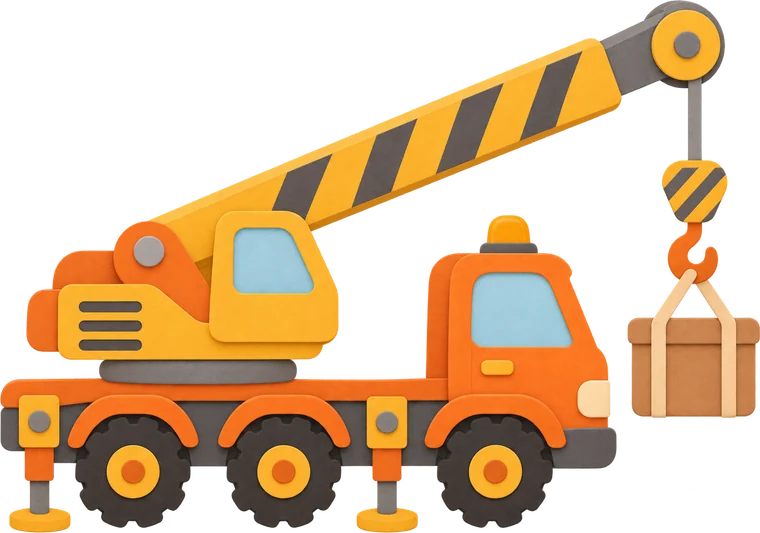
- A long arm and a hook that lift the heaviest loads
Crane in a child's words
- A crane is a machine that lifts loads far too heavy for people and moves them high in the air.
- A crane mounted on a truck is a mobile crane. It can drive along roads to work wherever it is needed.
- The crane's long arm is called the boom. On a truck crane it slides out section by section, like a telescope.
- A strong steel wire rope runs from the tip of the boom down to a hook. As the rope winds in and out over pulleys, the load goes up and down.
- Before it lifts, a truck crane stretches outriggers, sturdy legs, out to each side and plants them on the ground. Standing with its feet wide apart keeps it from tipping.
- At the back is a heavy counterweight that balances the load on the other side, like a seesaw.
- The further the boom reaches out, the less weight it can lift, so a crane parks as close to the load as it can.
When your child asks, answer like this
 Why doesn't a crane fall over when it lifts something heavy?

How does the crane's arm get longer?
How heavy a load can a crane lift?
How did the crane get to the top of that tall building?
Why is it called a crane?
Were there cranes long ago?
Can I go near a crane?
Crane facts that make kids say “Wow!”
- The strongest telescopic crane can lift about 1,200 tonnes, and its boom stretches to 100 m (330 ft).
- Even a small tower crane that lifts about 10 tonnes close to its tower can manage less than 2 tonnes at the tip of its arm: reaching further means less strength.
- The geojunggi used to build Suwon's Hwaseong Fortress about 230 years ago had several pulleys at the top and bottom, so a small pull could lift a heavy stone.
A quiz to do together
Tap an answer.
What are the legs a crane stretches out so it won't tip over?
When a crane reaches further out, the weight it can lift...
Which bird shares its name with the crane?
You finished the quiz! Well done.
Colouring page
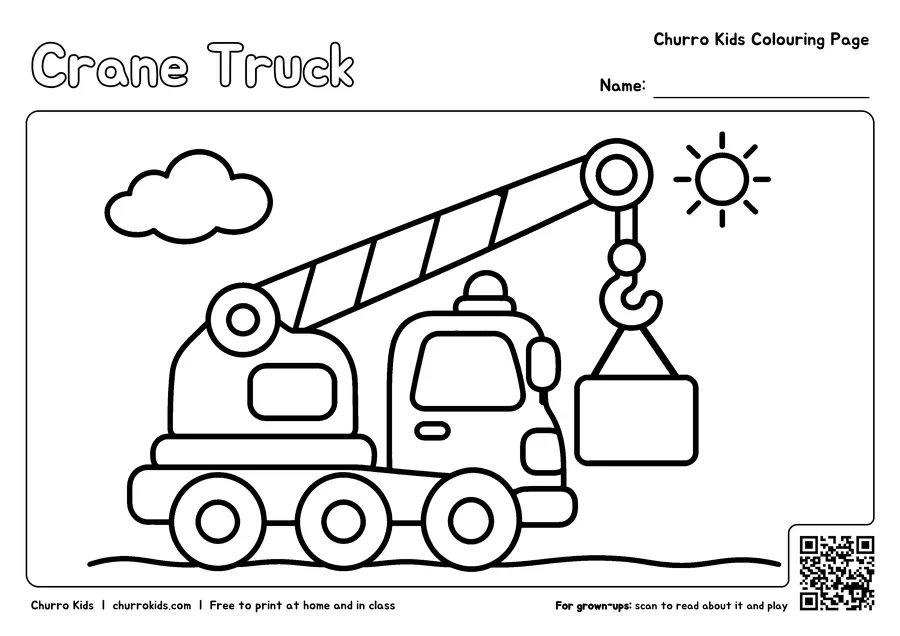
One A4 page, and it is free. Print it freely at home or in class.
Good for parents to know
- A crane's rated capacity is its maximum with a short boom close in; reaching out reduces it a lot. The 1,200-tonne figure is a 2007 Guinness record and a maker's claim; crawler cranes and shipyard gantry cranes can lift much heavier loads.
- The geojunggi is widely credited to Jeong Yak-yong, inspired by a book on Western machines, and was used on the Hwaseong Fortress (1794-1796). Some historians note that records mention only one geojunggi, so its overall contribution may have been modest.
- Teach the rule "never go under a hanging load" alongside the fun facts. Rather than making it scary, frame it as cheering the crane operator on from a safe distance.
Things to try together
- Wind thread around a pencil and tie a paper-clip hook to the end. Turn the pencil and a small toy rises: that is how a crane winds in its wire rope.
- Balance a ruler on an eraser and put a coin at one end. Find how many coins the other end needs to balance it, and you have discovered the counterweight.
- Photograph a tower crane at a nearby site from a distance and again a few weeks later. Has it grown taller?
Sources
- explainthatstuff.com/cranes.html
- superiorrigging.com/the-basic-parts-of-a-crane/
- open-exam-prep.com/study-guides/nccco-mobile-crane/technical-knowledge/stability-mechanics
- guinnessworldrecords.com/world-records/107410-most-powerful-telescopic-crane
- khl.com/news/ltm-1120091/8076.article
- v.daum.net/v/20231030004709607?f=p
- itwiki.kr/w/거중기
- en.wikipedia.org/wiki/Crane_(machine)
- en.wikipedia.org/wiki/Tower_crane
- ko.wikipedia.org/wiki/기중기
- ko.wikipedia.org/wiki/거중기
- en.wiktionary.org/wiki/crane