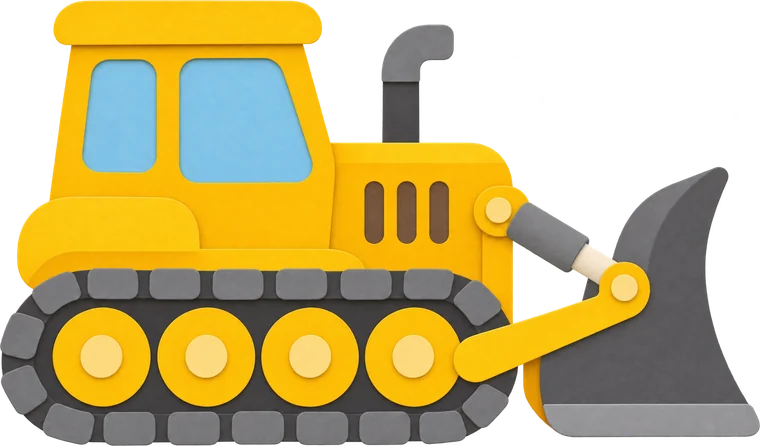
Turning the pages of a picture book, your child points at a bulldozer: "Why doesn't it have wheels? What's that belt?"
A bulldozer pushes soil and rock with the wide blade at its front to make the ground flat. Instead of tyres it runs on crawler tracks, which spread its weight so it does not sink into mud. It only moves at about jogging speed, but it is enormously strong. Below are the questions children ask most, with answers you can read aloud as they are.
Fact cardBulldozer Vehicle · construction vehicle
- Job
- pushes soil and rock to level the ground
- At the front
- a wide steel blade
- Instead of tyres
- crawler tracks (endless steel belts)
- Speed
- about 10 km/h (6 mph)
- Weight
- from about 3 t to over 100 t
- Largest bulldozer
- about 150 t, blade about 7.4 m (24 ft) wide
- The mighty pusher with a wide steel blade
Bulldozer in a child's words
- A bulldozer is a construction machine that pushes soil, sand and rock with a wide steel plate at its front.
- That plate is called the blade. Raising and lowering it lets the bulldozer scrape bumps away and level the ground.
- Instead of tyres it runs on crawler tracks: steel belts that wrap around its wheels and go round and round without end.
- Tracks touch the ground over a wide area, spreading the heavy machine's weight, so it does not sink into mud or sand.
- Some bulldozers have a big claw called a ripper at the back, for scratching up and breaking hard ground.
- A bulldozer is not fast: about 10 km/h (6 mph), roughly jogging speed. What it has is strength.
- The largest bulldozer, used in mines, weighs about 150 tonnes and has a blade about 7.4 m (24 ft) wide.
When your child asks, answer like this
 Why does a bulldozer have tracks instead of tyres?

What's the difference between a bulldozer and an excavator?
How heavy is a bulldozer?
How fast is a bulldozer?
What is the pointed hook at the back?
Where do bulldozers work?
Can I go near a bulldozer?
Bulldozer facts that make kids say “Wow!”
- The largest bulldozer's blade can push about 69 m³ of soil at once: enough to fill 69 boxes each 1 m wide, long and high.
- Bulldozers began as farm tractors with a steel plate fitted to the front.
- Swamp bulldozers have wider, longer tracks and press on the ground only about half as hard as a normal bulldozer, so they can work on soft, boggy land.
A quiz to do together
Tap an answer.
What is the wide steel plate at the front of a bulldozer called?
What is good about crawler tracks?
How fast is a bulldozer?
You finished the quiz! Well done.
Colouring page
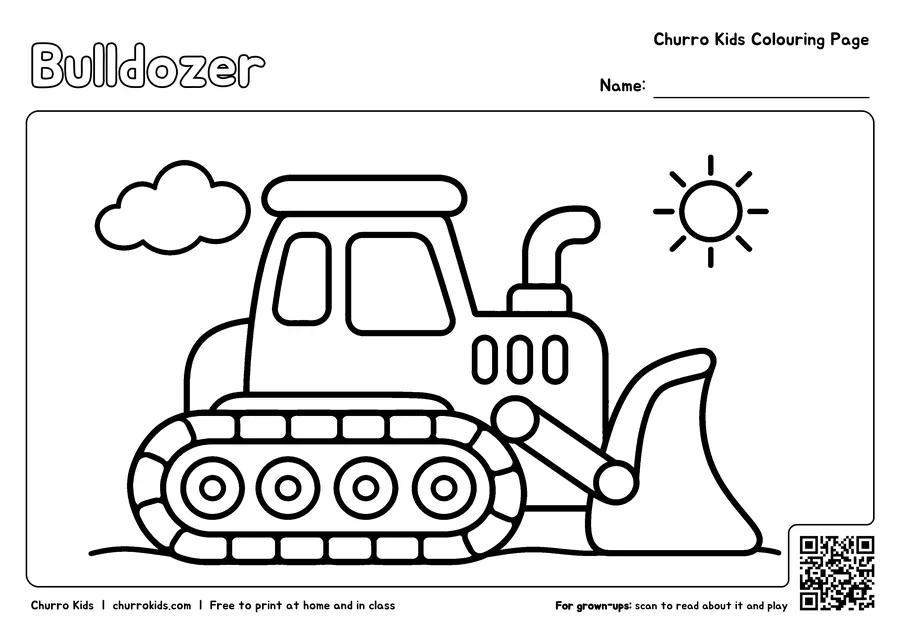
One A4 page, and it is free. Print it freely at home or in class.
Good for parents to know
- Children often mix up bulldozers and excavators. "The bulldozer pushes, the excavator digs" is an easy pairing. Where the word "bulldozer" comes from is disputed, so it is best not to tell a story about it.
- Weights and speeds vary a lot by size and model. "About 150 tonnes" is the largest bulldozer listed by Guinness World Records; a larger one-off prototype was built. Top speeds of crawler dozers mostly fall between about 6 and 12 km/h.
- Tracked machines can swing round sharply, so the space beside them is dangerous. Make watching from outside the fence the family rule.
Things to try together
- In the sandpit, hold a piece of stiff card or a plastic ruler upright like a blade and push the sand to make a bumpy patch flat.
- Spread flour or fine sand flat and press it with one finger, then with your whole open hand. The wider press sinks less: that is why tracks don't sink.
- Stretch a rubber band around two wheels of a toy car to make a simple track and roll it along.
Sources
- heavyquipmag.com/construction-equipment-encyclopedia/types-of-construction-equipment-machines/dozers/
- sankun.com/blog/detail/347_불도저__덤프트럭__지게차_등_중장비의_뜻과_종류_
- miltoncat.com/machinery-equipment/new/dozers/d1-dozer
- guinnessworldrecords.com/world-records/77555-largest-bulldozer
- thompsontractor.com/blog/bulldozer-types/
- en.wikipedia.org/wiki/Bulldozer
- en.wikipedia.org/wiki/Komatsu_D575