Stories · Sea Friends · Sea animal
Stingray Facts for Kids: Why Does a Stingray Look Like It's Smiling?
· Churro Kids
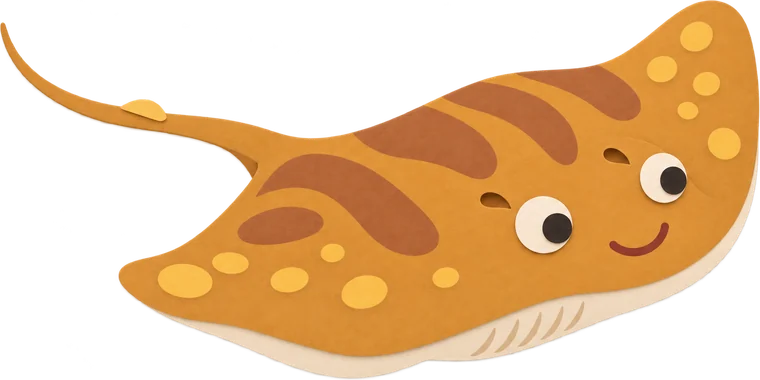
As a stingray glides up the aquarium glass, a child points: "It's smiling at me!"
A stingray is a flat fish related to sharks. The smiling face on the glass is really its nostrils and mouth on the underside; its eyes are on top. It flaps its wide fins like wings to swim and rests buried in sand, using its tail spine only to defend itself. Below are the questions children ask most, with answers at their level, ready to read aloud.
Fact cardStingray Sea animal · fish (a relative of sharks)
- Body
- flat and wide, with a long tail
- Size
- large ones about 2 m (6.5 ft) across
- Skeleton
- bendy cartilage, like a shark's
- Eyes and mouth
- eyes on top, mouth underneath
- Food
- clams, crabs, shrimp, small fish
- The flat fish that flies through the water on fin-wings
Stingray in a child's words
- A stingray is a fish and a relative of sharks. Like a shark, its skeleton is made of bendy cartilage, not hard bone.
- Its body is flat and wide. It swims by rippling or flapping its big side fins like wings.
- Its eyes are on top, while its mouth and gill slits are underneath, so it can watch what is above while lying on the bottom.
- It rests half-buried in sand, and its colour matches the sea floor, so it is hard to spot.
- Around its mouth are sense organs that feel the tiny electric signals of other animals, so it can find food hidden in sand.
- A stingray has a sharp spine on its tail, which it uses only to defend itself.
When your child asks, answer like this
 Is a stingray a fish?

How does a stingray swim?
Where is a stingray's face?
Is a stingray's tail spine dangerous?
How can I stay safe when I wade into the sea?
What do stingrays eat?
Do baby stingrays hatch from eggs?
Stingray facts that make kids say “Wow!”
- A stingray keeps growing new teeth to replace worn or lost ones, just like its shark relatives.
- Some rays dig pits in the sand while hunting, and pits up to 4 m (13 ft) long have been found.
- The spine on a stingray's tail is a greatly enlarged version of the tiny tooth-like scales that cover a shark's skin.
A quiz to do together
Tap an answer.
Which animal is a stingray's close relative?
Where is a stingray's mouth?
How should you walk in shallow water so stingrays move away?
You finished the quiz! Well done.
Colouring page
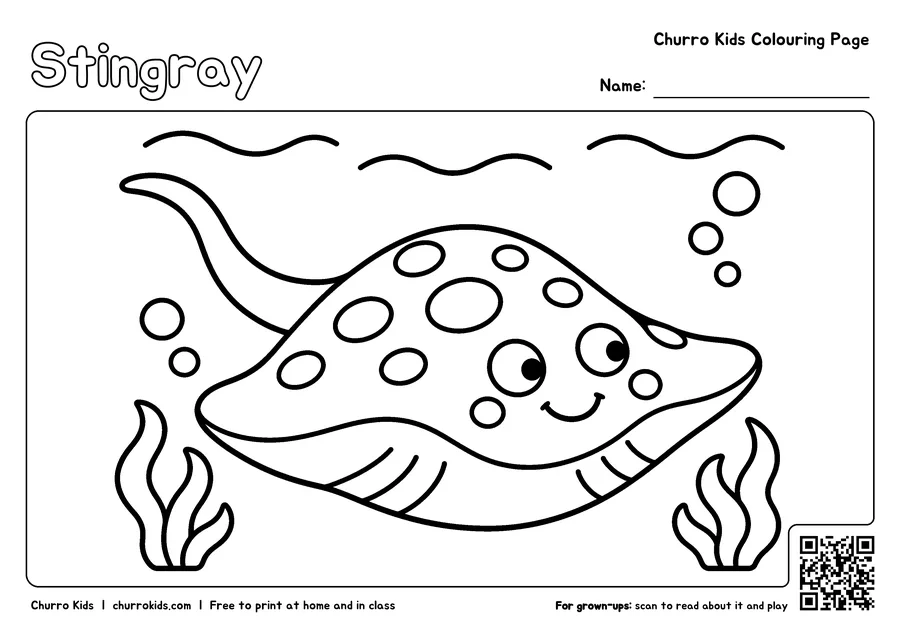
One A4 page, and it is free. Print it freely at home or in class.
Good for parents to know
- In Korean, garori covers many flat fish, from stingrays to skates (the hongeo eaten in Korea). This page uses stingrays, which carry a venomous tail spine, as the example. Skates have different tail spines and lay eggs in cases.
- Most stingray injuries happen when someone steps on a ray buried in sand. Teach the shuffle in shallow water, and if someone is stung, leave the water and tell the lifeguard. If a piece of spine is lodged deep, or there is breathing difficulty or dizziness, call emergency services (119 in Korea) and follow medical advice for the wound.
- The number of species (about 200) and sizes depend on which groups are counted. The huge manta rays are relatives too.
Things to try together
- Hold a scarf by its corners and ripple it like a wave. That is how a stingray swims.
- Hide a toy lightly in a sandpit and find it by shuffling your feet: practise the stingray shuffle.
- Cut a diamond from paper and add a long tail. Draw the eyes on the top side and the mouth on the underside, and compare.
Sources
- nationalgeographic.com/animals/fish/facts/stingrays
- en.wikipedia.org/wiki/Stingray
- montereybayaquarium.org/animals/animals-a-to-z/bat-ray
- montereybayaquarium.org/animals/animals-a-to-z/big-skate
- pacificsurf.com/stingray-shuffle/
- destinfire.gov/stingrays
- weekly.khan.co.kr/article/202404170600041
- msdmanuals.com/ko/home/부상-및-중독/물린-상처-및-쏘인-상처/노랑가오리-찔림
- wikitree.co.kr/articles/1096400
- pmc.ncbi.nlm.nih.gov/articles/PMC4593678