Stories · Sea Friends · Sea animal
Seahorse Facts for Kids: Why Does the Father Seahorse Give Birth?
· Churro Kids
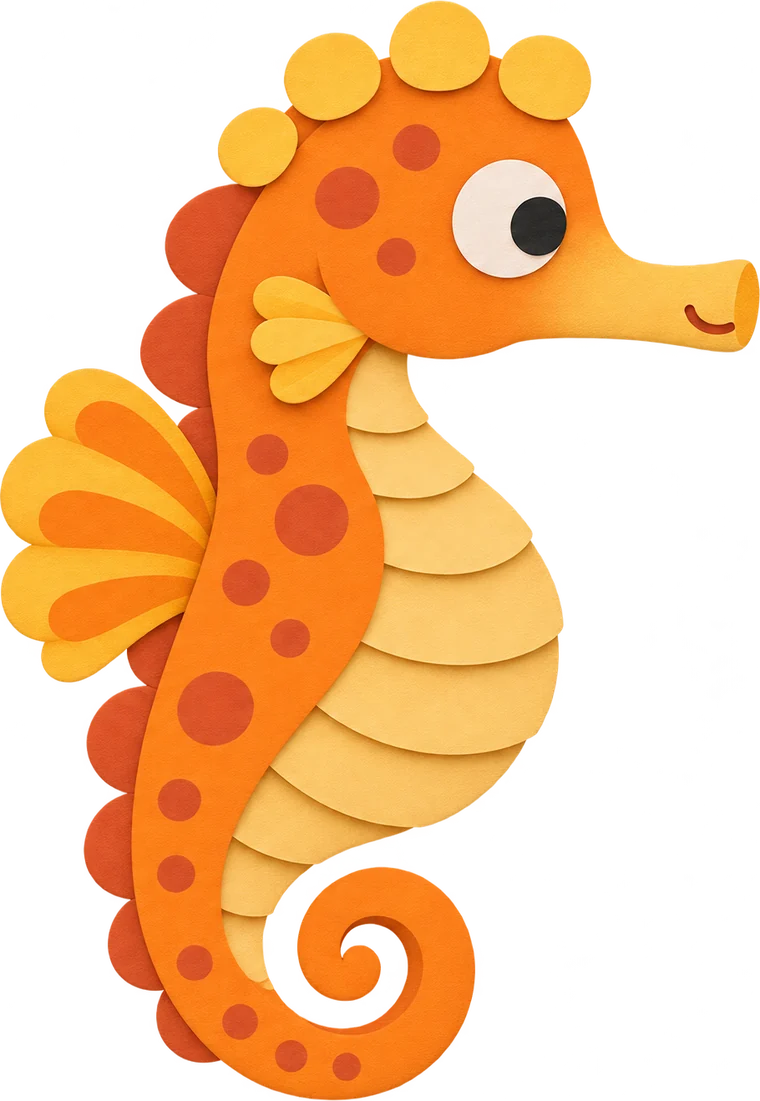
At the aquarium, a child watches a seahorse clinging to seagrass with its tail and asks, "Is that a fish? It looks like a horse!"
A seahorse really is a fish: it breathes with gills, even though its head looks like a horse's. The father carries the eggs in a belly pouch and gives birth, the tail grips like a hand, and each eye moves on its own. Below are the questions children ask most, with answers at their level, ready to read aloud.
Fact cardSeahorse Sea animal · fish
- Length
- about 2-35 cm (1-14 in), depending on the kind
- Kinds
- about 45-47 species
- Babies
- the father carries them in a belly pouch
- Babies per birth
- from a handful to over a thousand
- Food
- tiny shrimp-like plankton
- Lifespan
- about 1-5 years in the wild
- The horse-headed fish whose father has the babies
Seahorse in a child's words
- A seahorse's head looks like a horse's, but it is a real fish that breathes with gills and swims with fins.
- The father has the babies: the mother puts her eggs into a pouch on his belly, and he carries them until the young are ready to swim out.
- Depending on the kind, a single birth can be a handful of babies or more than a thousand.
- It swims by fluttering a small fin on its back very fast, yet it is still one of the slowest fish in the sea.
- It wraps its tail around seagrass to hold on, a tail that can grip like a monkey's.
- Its two eyes move separately, so one can look ahead while the other looks to the side.
- Instead of scales it has bony plates in rings under a thin skin, which gives its body those striped segments.
Seahorse: measure it with your own height
When your child asks, answer like this
 Is a seahorse a fish?

Does the daddy seahorse really have the babies?
How many babies are born?
Why does a seahorse curl its tail around things?
What does a seahorse eat?
Why do a seahorse's eyes move separately?
Do seahorses live in Korean seas?
Seahorse facts that make kids say “Wow!”
- Seahorses have no teeth and no stomach, so one can eat thousands of tiny shrimp in a day.
- Many seahorse pairs meet every day and greet each other by circling round together, as if dancing.
- A father seahorse often takes a new batch of eggs soon after giving birth.
A quiz to do together
Tap an answer.
In whose belly pouch do baby seahorses grow?
Is a seahorse a fish?
What does a seahorse use to hold on to seagrass when it rests?
You finished the quiz! Well done.
Colouring page
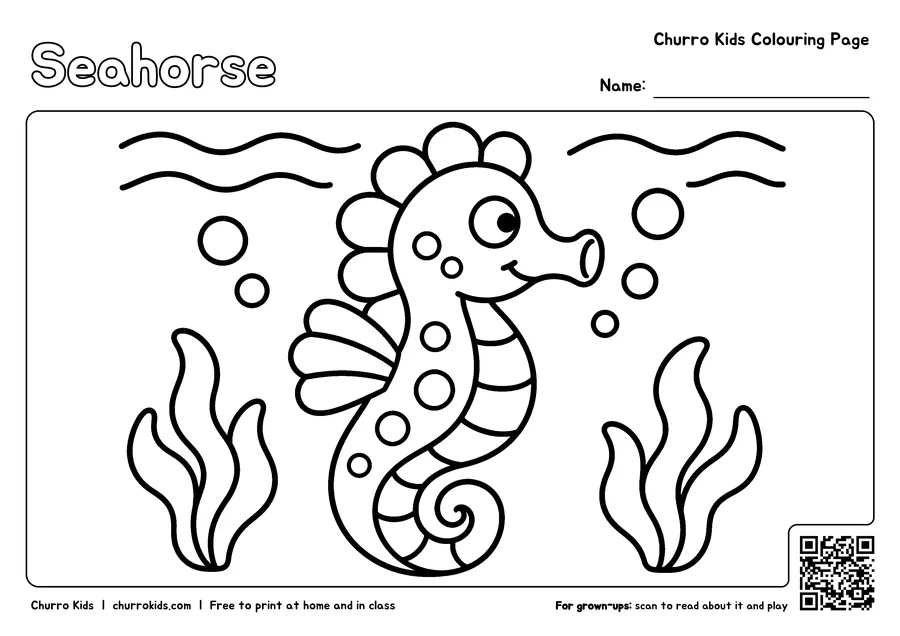
One A4 page, and it is free. Print it freely at home or in class.
Good for parents to know
- Species counts vary between sources (over 45, or 47). Sizes range from about 2 cm to more than 30 cm, and a brood can be as few as about 5 young or more than a thousand.
- "Seahorses mate for life" is not true of all seahorses: many stay with one partner at least through a breeding season, but some switch partners, and sources describe it differently. In 2017 a seahorse from Korea's south coast was described as a new species, Hippocampus haema.
- So many seahorses are taken for traditional medicine and souvenirs that seahorses were added to the international trade-control list (CITES Appendix II) in 2002, with the rules in force since 2004. If you meet one at the shore, enjoy it with your eyes and leave it in the water.
Things to try together
- Play seahorse family: a parent cuddles the child and says "Now I'm the seahorse daddy carrying the baby." It makes the fact easy to remember.
- Wind a piece of yarn or a straw around a pencil to copy how a seahorse wraps its tail around seagrass.
- Cover one eye with a hand and look around with the other. Talk about what it would be like to have two eyes that look different ways, like a seahorse.
Sources
- nationalgeographic.com/animals/fish/facts/seahorses
- theconversation.com/nine-things-you-dont-know-about-seahorses-165650
- koreascience.or.kr/article/JAKO202217140246616.page?lang=ko
- en.wikipedia.org/wiki/Seahorse
- aquariumofpacific.org/onlinelearningcenter/species/pacific_seahorse
- pmc.ncbi.nlm.nih.gov/articles/PMC5704180/
- projectseahorse.org/new-hope-for-seahorse-conservation-18-years-after-cites-listing/