Stories · Sea Friends · Sea animal
Seal Facts for Kids: What's the Difference Between a Seal and a Sea Lion?
· Churro Kids
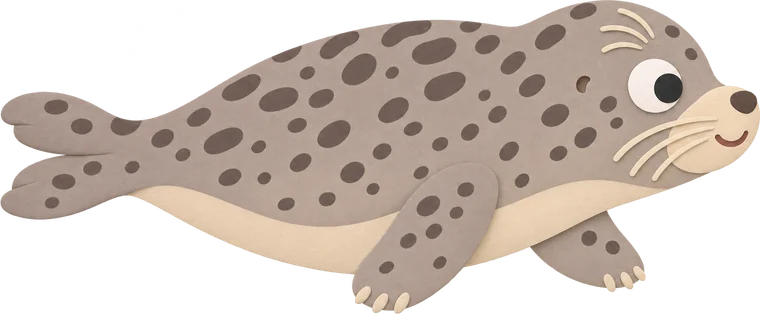
Watching a video of a seal slipping off a rock into the sea, a child asks, "Is that a seal or a sea lion?"
A true seal has no ear flaps and wriggles along on its tummy on land. Blubber keeps it warm, and its sensitive whiskers can feel the trail a fish leaves in the water. Spotted seals visit Baengnyeong Island off Korea's west coast. Below are the questions children ask most, with answers at their level, ready to read aloud.
Fact cardSeal (Spotted Seal) Sea animal · mammal (true seal)
- Length
- about 1.5-1.7 m (5-5.5 ft)
- Weight
- about 70-130 kg (150-290 lb)
- Ears
- no ear flaps, just small holes
- Baby coat
- white and fluffy
- Food
- fish, crustaceans, squid and octopus
- Lifespan
- up to about 30-35 years
- The spotted swimmer with no ear flaps that wriggles on land
Seal (Spotted Seal) in a child's words
- A seal is not a fish but a mammal that feeds its pup milk. It comes up to the surface to breathe.
- Spotted seals visit Baengnyeong Island in Korea's Yellow Sea. They are silvery grey, sprinkled with dark spots.
- A true seal has no ear flaps, just a small ear hole on each side of the head. Sea lions and fur seals have small ear flaps.
- A seal cannot turn its back flippers forwards, so on land it wriggles along on its tummy.
- In the water it swims by sweeping its back flippers and steers with its front flippers.
- Spotted seal pups are born on sea ice in late winter, in a white, fluffy coat that falls out after a few weeks.
Seal (Spotted Seal): measure it with your own height
When your child asks, answer like this
 How is a seal different from a sea lion?

How does a seal move on land?
Doesn't a seal get cold in icy water?
What are a seal's whiskers for?
Why are baby seals white?
What do seals eat?
Do seals live in Korea?
Seal (Spotted Seal) facts that make kids say “Wow!”
- Spotted seals mostly feed in water shallower than about 200 m (650 ft), but dives to 300 m (1,000 ft) have been recorded.
- A seal's whiskers have far more nerve connections than a land mammal's. In one experiment, blindfolded harbour seals, close relatives of the spotted seal, followed a trail in the water with their whiskers alone.
- A newborn spotted seal pup is about 1 m (3 ft) long and weighs about 7-12 kg (15-26 lb).
A quiz to do together
Tap an answer.
What does a true seal NOT have?
How does a seal move on land?
What colour coat is a spotted seal pup born with?
You finished the quiz! Well done.
Colouring page
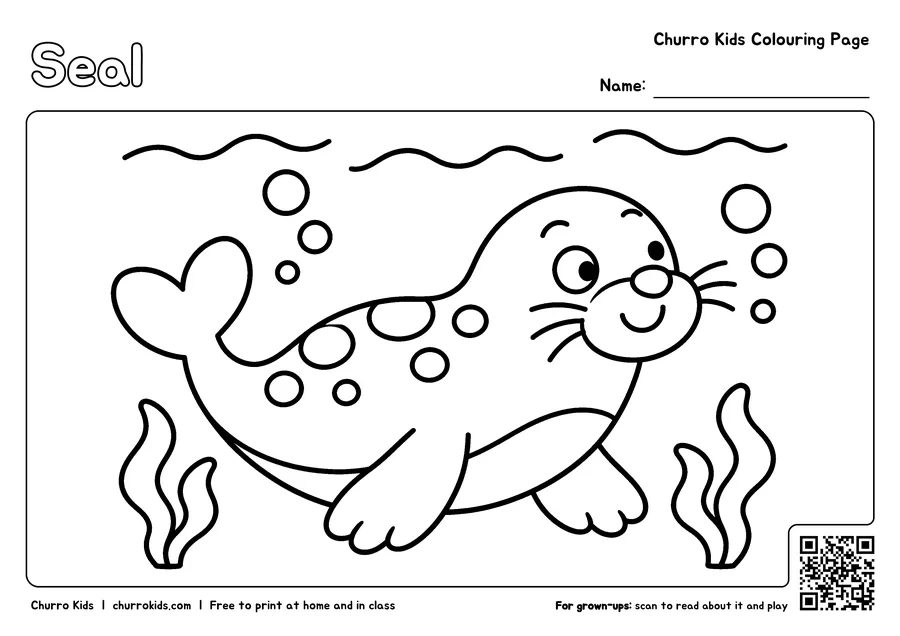
One A4 page, and it is free. Print it freely at home or in class.
Good for parents to know
- This page uses the spotted seal, which visits Korea's Yellow Sea, as its example. It is a Natural Monument in Korea and also protected as an endangered species. About 300 are reported around Baengnyeong Island each year, though counts vary by year and method. In winter they leave to give birth on sea ice off northern China, then return.
- Seals, fur seals and sea lions are easy to confuse: no ear flaps and a tummy wriggle means a true seal; small ear flaps and walking on the back flippers means a sea lion or fur seal.
- If you meet a seal at the coast, keep your distance and don't feed it. A pup that seems alone may have a mother nearby, so don't touch it; report it to the local marine authorities instead.
Things to try together
- Lie on your tummy and try to move forward without using arms or legs. Feel how hard a seal works on land.
- Draw a seal on grey paper and dot it with black fingerprints to make a spotted seal.
- Measure 1.6 m with a tape, mark it on the floor and compare it with your child's height. That is about the length of a grown spotted seal.
Sources
- fisheries.noaa.gov/species/spotted-seal
- en.wikipedia.org/wiki/Spotted_seal
- ko.wikipedia.org/wiki/물범
- oceanservice.noaa.gov/facts/seal-sealion.html
- fisheries.noaa.gov/species/harbor-seal
- en.wikipedia.org/wiki/Earless_seal
- en.wikipedia.org/wiki/Pinniped
- ebi.ac.uk/europepmc/webservices/rest/search?query=DOI:10.1126/science.1060514&resultType=core&format=json
- heraldk.com/article/2026030602400029274