Stories · Sea Friends · Sea animal
Shrimp Facts for Kids: Why Do Shrimp Turn Red When Cooked?
· Churro Kids
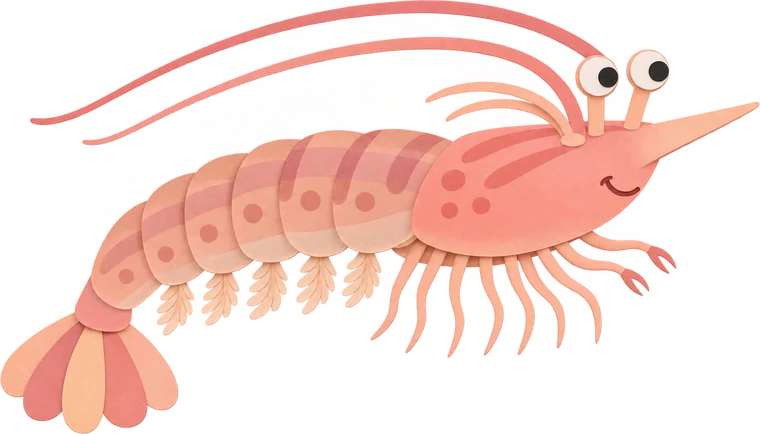
Peeling a shrimp at dinner, a child stops and asks, "Are shrimp red in the sea too?"
A shrimp is a crustacean in a thin, hard shell. It walks on ten legs, paddles with small swimming legs under its tail, and when startled flips its tail to shoot backwards. Most living shrimp are grey or see-through; cooking reveals a red pigment that was hidden in the shell. Below are the questions children ask most, with answers at their level, ready to read aloud.
Fact cardShrimp Sea animal · crustacean (an animal in a hard shell)
- Walking legs
- 10
- Swimming legs
- 5 pairs of small swimmerets under the tail
- Size
- from about 1 cm to around 30 cm (12 in), depending on the kind
- Food
- small animals, algae and bits on the sea floor
- Lifespan
- mostly 1-7 years
- The little swimmer that flips its tail and zooms backwards
Shrimp in a child's words
- A shrimp is not a fish. It is a crustacean, like crabs and lobsters, wrapped in a thin, hard shell.
- It has ten walking legs, and some of the front ones carry tiny claws for picking up food.
- Under its tail are five pairs of small swimming legs, which it paddles like oars to swim forwards.
- When startled, it snaps its tail under its body and shoots backwards. That is its escape trick.
- On its head are feelers longer than its body, used for touching things and smelling food.
- There are thousands of kinds of shrimp, from ones smaller than a fingernail to ones about 30 cm (12 in) long.
When your child asks, answer like this
 Is a shrimp a fish?

How many legs does a shrimp have?
Why do shrimp swim backwards?
Why do shrimp turn red when cooked?
What do shrimp eat?
Why are a shrimp's feelers so long?
Where do baby shrimp come from?
Shrimp facts that make kids say “Wow!”
- The snapping shrimp closes its big claw so fast that it makes a bubble, and when the bubble bursts it makes a crack that is one of the loudest sounds in the sea.
- Like a crab, a shrimp's shell cannot stretch, so it climbs out of the old one and grows a new one each time it gets bigger.
- A shrimp's eyes sit on short stalks. Each is a compound eye made of many tiny eyes, good at spotting movement.
A quiz to do together
Tap an answer.
Which way does a startled shrimp shoot off?
Is a shrimp a fish?
How many walking legs does a shrimp have?
You finished the quiz! Well done.
Colouring page
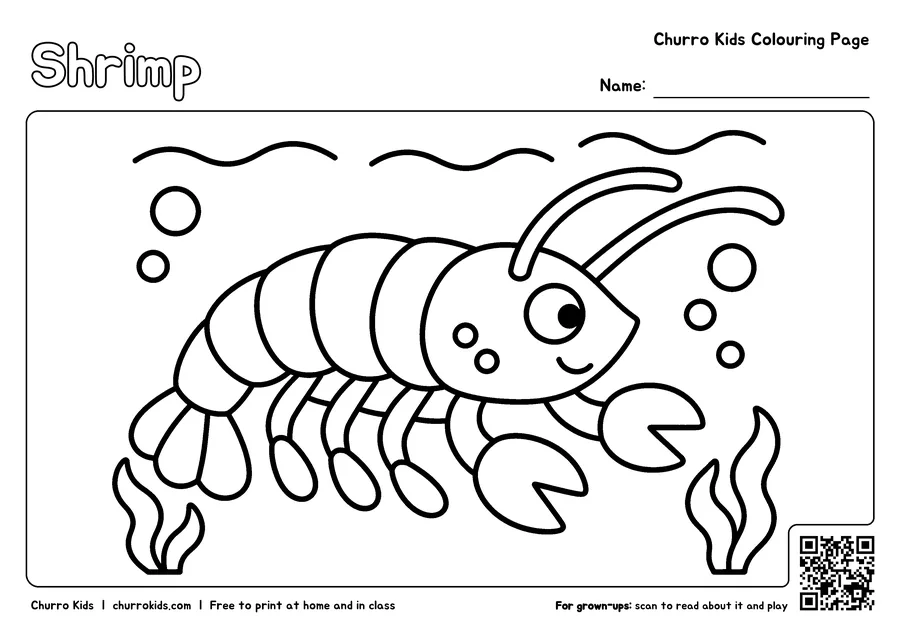
One A4 page, and it is free. Print it freely at home or in class.
Good for parents to know
- With thousands of species, sizes and lifespans vary widely. Many shrimp are around 2 cm long, but some exceed 30 cm, and lifespans run from under a year to about seven years. We give ranges for that reason.
- Carrying eggs on the swimming legs is true of many shrimp (the caridean group). Others, such as the large prawns Koreans call daeha, release their eggs straight into the water.
- Shellfish are a common cause of food allergy. When your child tries shrimp for the first time, offer a small amount and watch for swelling or itching around the mouth. If there is any trouble breathing or a rash spreads over the body, call emergency services (119 in Korea) at once.
Things to try together
- Put a raw and a cooked shrimp side by side and compare the colours. Talk about why the colour changed.
- Count a shrimp's legs together: the walking legs first, then the small swimming legs under the tail.
- Play "shrimp escape": curl up, then hop backwards. The trick is the direction.
Sources
- en.wikipedia.org/wiki/Shrimp
- private-scuba.com/sea-life/marine/invertebrates/crustaceans/shrimps/anatomy.html
- a-z-animals.com/animals/shrimp/
- mentalfloss.com/article/31483/why-do-crabs-and-lobsters-turn-red-when-you-cook-them
- chowhound.com/1930397/why-shrimp-change-color-cooked-science
- sciencedaily.com/releases/2000/09/000922072104.htm
- utmsi.utexas.edu/science-and-the-sea/radio-program/its-a-snap/
- evolution.berkeley.edu/the-basics-of-molting