Stories · Sea Friends · Sea animal
Narwhal Facts for Kids: Why Is the Narwhal's Horn Really a Tooth?
· Churro Kids
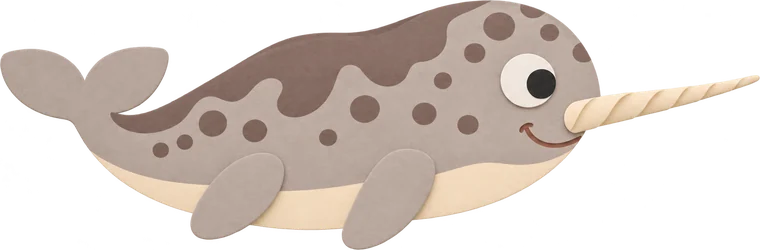
Looking at a picture book, a child spots a whale with a long horn and asks, "Is it a unicorn? Why does it have a horn?"
The narwhal is a whale of the icy Arctic. Its "horn" is really a tusk, a single tooth that grows through the upper lip and can reach about 3 metres. It swims among the Arctic sea ice and dives deeper than 1,000 metres. Below are the questions children ask most, with answers at their level, ready to read aloud.
Fact cardNarwhal Sea animal · mammal (whale)
- Length
- about 4-5.5 m (13-18 ft), not counting the tusk
- Tusk
- up to about 3 m (10 ft)
- Weight
- about 800-1,600 kg (1,800-3,500 lb)
- Home
- the icy Arctic Ocean
- Food
- Arctic fish such as polar cod, squid, shrimp
- Lifespan
- up to about 50 years
- The Arctic whale with a tooth for a horn
Narwhal in a child's words
- The narwhal is a whale that lives in the icy Arctic Ocean.
- What looks like a long horn is really a tooth: one tooth in the upper jaw grows forward through the lip. This kind of long tooth is called a tusk.
- The tusk can grow to about 3 metres (10 ft). The body itself is about 4-5.5 metres (13-18 ft) long.
- Tusks grow mostly on males. Most females have none, though a few do.
- Narwhals have no dorsal fin, just a low ridge along the back.
- They are deep divers, going deeper than 1,000 metres (3,300 ft) and staying down for up to about 25 minutes.
- Young narwhals are greyish; with age they get more white blotches, and very old narwhals look almost white.
Narwhal: measure it with your own height
When your child asks, answer like this
 Is a narwhal's horn a real horn?

How long is the tusk?
What is the tusk for?
Do mother narwhals have tusks too?
Where do narwhals live?
What does a narwhal eat?
Is a narwhal a unicorn?
Narwhal facts that make kids say “Wow!”
- Very rarely, a narwhal grows two tusks.
- A narwhal can dive deeper than 1,000 metres and stay down for about 25 minutes.
- In old Europe, narwhal tusks sold as unicorn horns were worth far more than their weight in gold.
A quiz to do together
Tap an answer.
What is a narwhal's long horn really?
Which sea do narwhals live in?
Who usually has a tusk?
You finished the quiz! Well done.
Colouring page
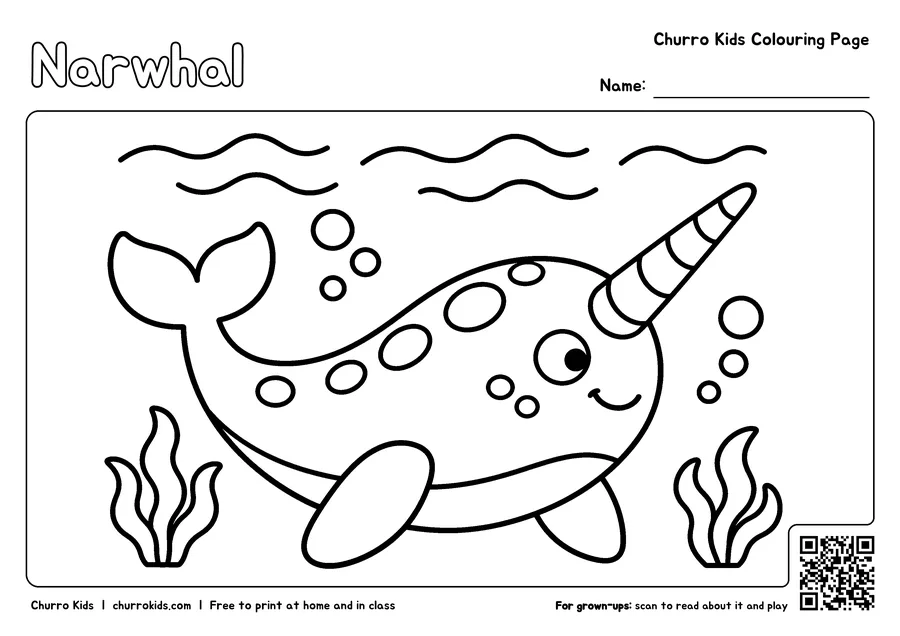
One A4 page, and it is free. Print it freely at home or in class.
Good for parents to know
- What the tusk is for is still debated. In 2005 a Harvard-led team reported tiny nerve channels running to the tusk's surface that could sense temperature and saltiness, but many scientists think it is mainly for males to show off to each other. "Scientists are still finding out" is the accurate answer.
- Sizes and ages vary by source: body length about 4-5.5 m (some say up to 6 m), tusks usually 1.5-3 m. Lifespan is usually given as up to about 50 years, though one eye-lens study suggested some may live past 100.
- Conservation status is listed differently by different organisations and years (Least Concern or Near Threatened). Shrinking Arctic sea ice may affect narwhals, which can be talked about gently.
Things to try together
- Measure 3 metres with a tape measure and mark it on the floor with tape. Lie beside it to compare your height with a narwhal tusk.
- Roll paper into a long, thin cone and draw a spiral stripe on it to make a narwhal tusk. Talk about how it is a tooth that grows through the lip.
- Draw narwhals on grey paper and dab on white paint blotches. Make a 'baby narwhal' and a 'grandpa narwhal' side by side, since narwhals get whiter with age.