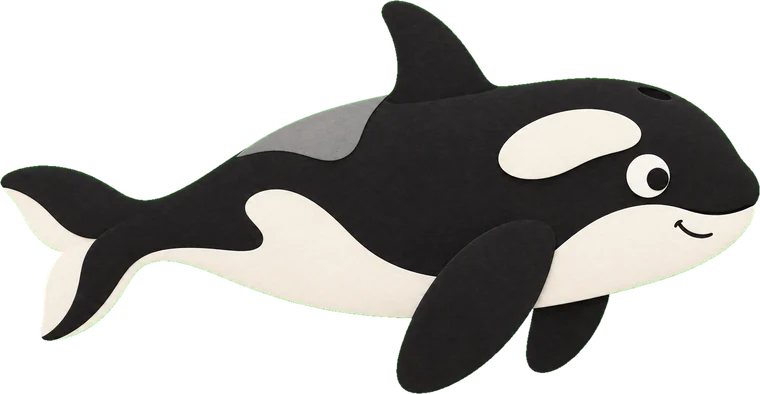
A child hugging a black-and-white soft toy asks, "Is an orca a whale or a dolphin?"
The orca is the largest member of the dolphin family. Males are about 6 to 8 metres (20-26 ft) long with a dorsal fin as tall as a grown-up. Orcas live their whole lives in families led by mothers and grandmothers, and each family has its own set of calls. Below are the questions children ask most, with answers at their level, ready to read aloud.
Fact cardOrca Sea animal · dolphin (mammal)
- Length
- males about 6-8 m (20-26 ft), females about 5-7 m (16-23 ft)
- Weight
- males over 6 tonnes, females about 3-4 tonnes
- Food
- fish, squid, seals (it depends on the family)
- Dorsal fin
- about 1.8 m (6 ft) in males
- Lifespan
- females about 50 years (up to 90), males about 30
- Home
- every ocean in the world
- The ocean family led by grandmothers
Orca in a child's words
- Despite the name "killer whale", the orca is the largest member of the dolphin family.
- Males are about 6 to 8 metres long (20-26 ft) and females about 5 to 7 metres (16-23 ft). A big male weighs more than 6 tonnes.
- The back is black and the belly white, with a white patch behind each eye and a grey "saddle" patch behind the dorsal fin.
- A male's dorsal fin grows to about 1.8 metres (6 ft), as tall as an adult person, and stands straight up.
- Orcas live in families that follow mothers and grandmothers, and each family's calls are a little different.
- Orcas live in every ocean, from icy polar seas to warm tropical ones.
Orca: measure it with your own height
When your child asks, answer like this
 Is an orca a whale or a dolphin?

Why is an orca black and white?
What do orcas eat?
Are orcas dangerous to people?
Why is an orca's back fin so big?
How do orcas talk to each other?
How do orcas find their way in dark water?
Orca facts that make kids say “Wow!”
- Female orcas can live to about 90, so a grandmother, mother and calf may swim together all their lives.
- An orca has 40 to 56 teeth, each about 8 centimetres (3 in) long, the longest about 10 centimetres (4 in).
- At full speed an orca is said to reach about 50 km/h (around 30 mph), among the fastest of all marine mammals.
A quiz to do together
Tap an answer.
Which family does the orca belong to?
Who leads an orca family?
Whose dorsal fin is taller and straighter?
You finished the quiz! Well done.
Colouring page
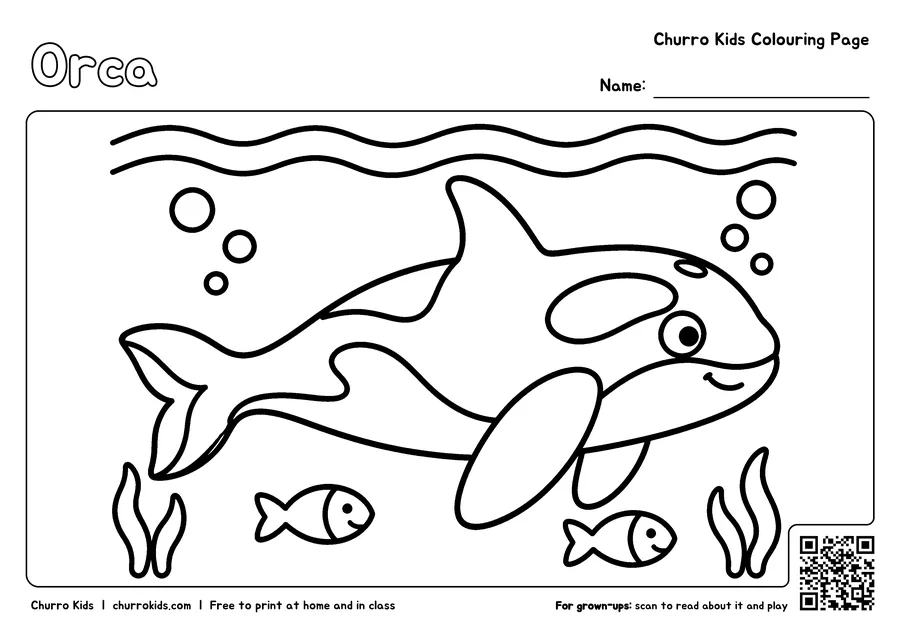
One A4 page, and it is free. Print it freely at home or in class.
Good for parents to know
- The name "killer whale" makes orcas sound frightening, but there is no confirmed record of a wild orca killing a person. "Strong, clever dolphins that look after their families" is a fair description for a child.
- Size and speed differ by source. The largest males recorded were about 10 m and 10 tonnes; top speed is given as 48 to 56 km/h. Average lifespans (about 50 years for females, 30 for males) also vary between populations.
- Orcas form distinct groups that differ in diet, looks and calls; some eat only fish. "Orcas hunt anything" is not accurate.
Things to try together
- Stick a strip of tape on the wall 1.8 metres up. How does a male orca's fin compare with the grown-ups in your family?
- Stand with your eyes closed while someone claps from somewhere in the room, and point to where the sound came from. That is a little like how orcas find things by sound.
- Cut an orca from black and white paper. Don't forget the white patch behind the eye and the grey saddle behind the fin.