Stories · Sea Friends · Sea animal
Jellyfish Facts for Kids: How Does It Live Without a Brain?
· Churro Kids
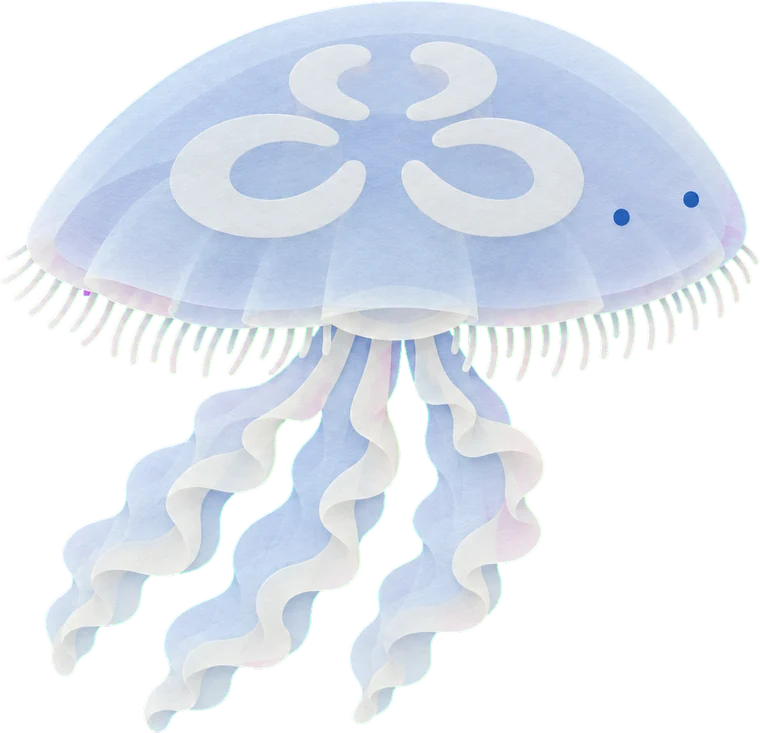
In the darkened room of the aquarium, watching jellyfish drift up and down, a child whispers, "Where are its eyes? Where's its head?"
A jellyfish has no brain, no heart and no bones. About 95% of its body is water, and it senses light and movement through a net of nerves. It is not a fish but a relative of corals and sea anemones, and its kind has lived in the sea for more than 500 million years. Its tentacles carry stinging cells, so we never touch one. Below are the questions children ask most, with answers at their level, ready to read aloud.
Fact cardJellyfish Sea animal · cnidarian (animals with stinging cells)
- Body
- about 95% water
- Does not have
- a brain, a heart, bones or blood
- Size
- from about 1 mm to a bell about 2 m (6.5 ft) across
- Food
- plankton and small fish
- First appeared
- more than 500 million years ago
- The drifting sea umbrella with no brain and no heart
Jellyfish in a child's words
- Despite its English name, a jellyfish is not a fish. It is a relative of corals and sea anemones.
- About 95% of a jellyfish's body is water, which is why it is soft, wobbly and see-through.
- It has no brain, no heart, no bones and no blood. A net of nerves spread through its body senses light and movement.
- It swims by squeezing and opening its umbrella-shaped bell, but mostly it drifts with the current.
- Its long tentacles carry stinging cells, which it uses to catch small prey.
- Jellyfish have lived in the sea for more than 500 million years, long before the dinosaurs.
When your child asks, answer like this
 Is a jellyfish a fish?

How does a jellyfish live without a brain?
Why do jellyfish sting?
What should I do if I see a jellyfish?
What do jellyfish eat?
How big do jellyfish get?
What does a baby jellyfish look like?
Jellyfish facts that make kids say “Wow!”
- An old record gives the lion's mane jellyfish tentacles more than 30 metres (100 ft) long, about the length of a blue whale.
- A box jellyfish has 24 eyes, even though it has no brain.
- A jellyfish has only one body opening: food goes in and waste comes out the same way.
A quiz to do together
Tap an answer.
What does a jellyfish NOT have?
What is a jellyfish mostly made of?
What should you do if you see a jellyfish at the beach?
You finished the quiz! Well done.
Colouring page
One A4 page, and it is free. Print it freely at home or in class.
Good for parents to know
- If someone is stung: leave the water at once, tell the lifeguard, and rinse the area with seawater, not tap water. Do not rub, and do not pull tentacles off with bare hands; ease them off with the edge of a plastic card. Call emergency services (119 in Korea) immediately for breathing difficulty or pain spreading through the body. (This follows Korean public guidance; advice differs in regions with other species.)
- "The immortal jellyfish" is an overstatement. Turritopsis dohrnii reverting to its young form has been observed in the laboratory; in the sea these animals are eaten or die of disease. The famous 36.6 m lion's mane record dates from 1865 and is considered uncertain by some.
- Water content is given as 95% to 98% depending on the source, and the number of species ranges from hundreds to thousands depending on what is counted as a jellyfish. Most stings are mild, but some species are dangerous, so the rule for children is simple: never touch any jellyfish.
Things to try together
- Put a little water in a clear plastic bag, tie it and float it in a bowl of water to see how an animal that is mostly water drifts.
- Slowly open and close an umbrella. That is very like the way a jellyfish pulses its bell to swim.
- Cut a paper plate in half for the bell and stick on wool or paper strips for tentacles.