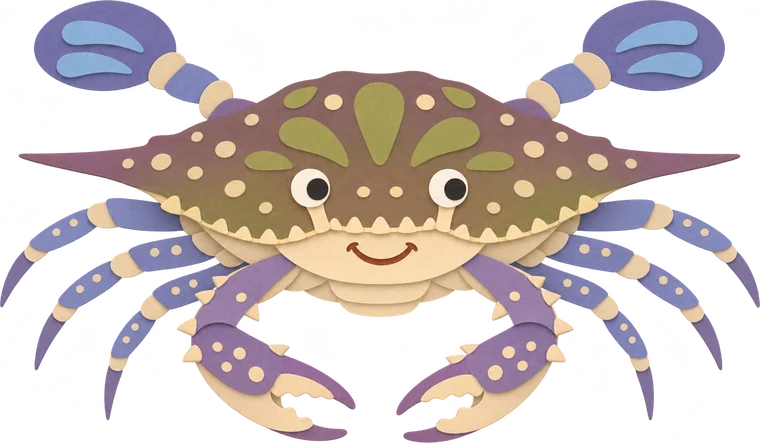
Counting the legs on a crab in the cooking pot, a child tilts their head: "Why do crabs walk sideways instead of forwards?"
The gazami crab, the swimming crab Koreans call kkotge, is a crustacean with a hard shell and ten legs. Its back pair ends in flat paddles, so it swims as well as it walks. Because its shell cannot stretch, it grows by climbing out of the old one, and its leg joints bend sideways, so sideways is the easy way to go. Below are the questions children ask most, with answers at their level, ready to read aloud.
Fact cardSwimming Crab (Gazami Crab) Sea animal · crustacean (an animal in a hard shell)
- Legs
- 10 (including 2 claws)
- Shell width
- up to about 15 cm (6 in)
- Swimming legs
- the last pair, shaped like paddles
- Home
- sandy and muddy sea floors off Korea, China and Japan
- Food
- small fish and shellfish
- The sideways walker that swims with paddle legs
Swimming Crab (Gazami Crab) in a child's words
- A crab is not a fish. It is a crustacean, like shrimp and lobsters, and a hard shell protects its body.
- It has ten legs: two strong claws at the front and eight more for walking and swimming.
- Its back pair of legs ends in flat paddles, which it uses like oars to swim.
- A large gazami crab has a shell about 15 cm (6 in) wide, about the size of a grown-up's open hand.
- Most crabs walk sideways, because their leg joints bend best that way.
- A crab's shell cannot grow, so it sheds the old shell and grows a new one. This is called moulting.
Swimming Crab (Gazami Crab): measure it with your own height
When your child asks, answer like this
 Why do crabs walk sideways?

How many legs does a crab have?
Can crabs swim?
How does a crab grow?
What are the claws for?
How can you tell a mother crab from a father crab?
Where does the Korean name kkotge come from?
Swimming Crab (Gazami Crab) facts that make kids say “Wow!”
- Scientists think sideways walking began with a single ancestor of today's crabs about 200 million years ago, in the early Jurassic, the age of dinosaurs.
- A crab that has just moulted is soft and squishy, so it hides until its new shell hardens.
- A mother crab carries her eggs on the outside of her body, under her tail flap. In Korea it is against the rules to keep a crab carrying eggs.
A quiz to do together
Tap an answer.
How many legs does a crab have in all?
Where are the legs a crab uses for swimming?
Which way do most crabs walk?
You finished the quiz! Well done.
Colouring page
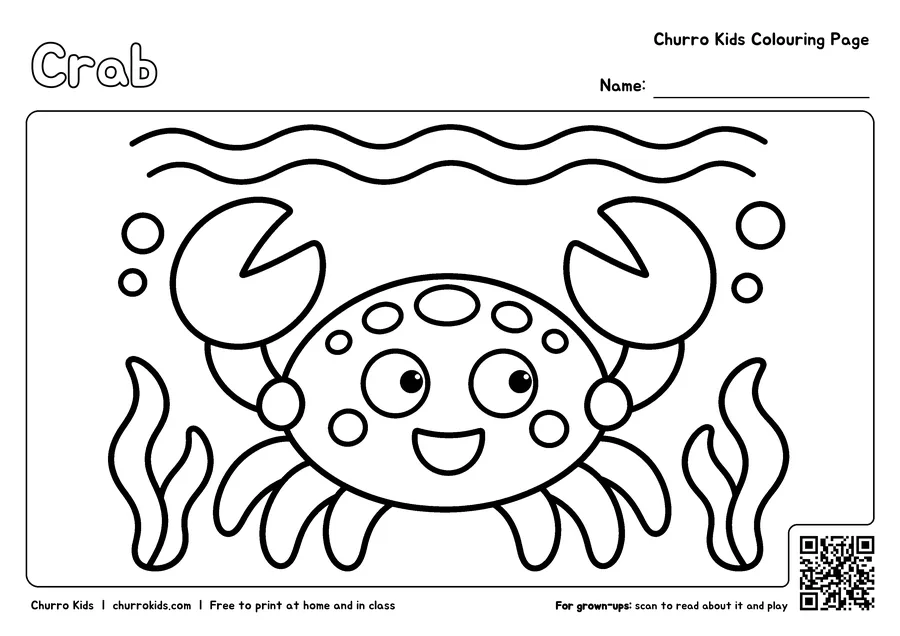
One A4 page, and it is free. Print it freely at home or in class.
Good for parents to know
- Size figures vary a little: encyclopaedias and fisheries sources give a shell about 15 cm wide and 7 cm long, and one study reports larger animals. We say "about 15 cm for a big one".
- To protect breeding crabs, Korea closes the gazami crab fishery every summer (roughly late June to late August), and egg-carrying females may not be kept at any time. If you find crabs at the seaside, you might say: "Let's put the mother crab back so her babies can hatch."
- A live crab can pinch hard. At a fish market or on a mudflat, let a grown-up show how to hold a crab from behind the shell, and let children look, or touch gently with gloves on.
Things to try together
- Crab-walk sideways together. Race: is it faster to go sideways or forwards?
- Paint a paper plate red or blue and stick on ten paper-strip legs. Round off the ends of the back two to make paddles.
- When you see crabs at the market, count their legs together and guess from the tail flap whether each is a mother or a father crab.
Sources
- en.wikipedia.org/wiki/Portunus_trituberculatus
- ko.wikipedia.org/wiki/꽃게
- wikitree.co.kr/articles/1169393
- incheon.go.kr/fish/FI020401/2097010
- nparks.gov.sg/florafaunaweb/fauna/1/2/1208
- utmsi.utexas.edu/science-and-the-sea/print-article/why-crabs-scuttle-sideways/
- sciencedaily.com/releases/2026/05/260501052844.htm
- evolution.berkeley.edu/the-basics-of-molting
- a-z-animals.com/articles/the-amazing-process-of-crab-molting-explained-step-by-step/
- en.wikipedia.org/wiki/Portunidae
- kbmaeil.com/article/202305310363466
- incheon.go.kr/ocean/OC020701
- m.korea.kr/news/policyNewsView.do?newsId=148902229