"This armoured dinosaur has no club on its tail!" Your child has stood a toy Edmontonia next to an Ankylosaurus and spotted the difference.
Edmontonia was an armoured dinosaur that lived in North America in the Late Cretaceous. Its body was wide like a tank and longer than a big car. It had no club on its tail, and big spikes pointed forward and sideways from its shoulders. Below are the questions children ask most, with answers at a child's level. You can read them out loud.
Fact cardEdmontonia
- Name means
- one from Edmonton
- Lived
- Late Cretaceous (about 76.5 to 69 million years ago)
- Length
- about 6 m (20 ft)
- Weight
- about 3 tonnes
- Food
- Plant-eater
- Found in
- North America (Alberta in Canada, and the USA)
- Group
- Armoured and plated dinosaurs
- Big spikes pointing forward from the shoulders
- A wide body like a tank
- A tail with no club
How big was Edmontonia? Measure it with your own height
When your child asks, answer like this
 What does Edmontonia mean?

How big was it?
What did it eat?
What did it do when a scary dinosaur came?
Who lived with it?
- Gorgosaurus predatorsame time and place
Gorgosaurus, a relative of Tyrannosaurus, lived in the same place. Edmontonia probably faced it with its shoulder spikes pointed forward. - Euoplocephalus neighboursame time and place
Euoplocephalus, an armoured dinosaur with a tail club, lived on the same land too. The two armoured dinosaurs probably met in the same feeding grounds. - Other Edmontonia rivalsame time and place
Some scientists think that male Edmontonia pushed their shoulder spikes together to test their strength against each other. There is no firm evidence yet.
When and where did it live?
What was it like as a baby? Did it live with friends?
Are there dinosaurs that look like it?
Who found it first?
Edmontonia facts that make kids say “Wow!”
- Edmontonia probably used the big spikes on its shoulders to protect itself or to test its strength against others.
- Edmontonia fossils are often found with the armour still lying just as it was when the animal was alive.
- They were probably kept so well because the animals fell during a drought and were then quickly buried in mud when the rain came.
- One scientist thought that bigger shoulder spikes meant a male, but the spikes may also have grown bigger with age.
From head to tail
- Its skull was about 50 cm (20 inches) long.
- It had 14 to 17 small teeth in a row on each side of its upper jaw.
- It was about 6 m (20 ft) long and weighed about 3 tonnes, as heavy as an elephant.
- Some of its shoulder spikes split into two points at the tip.
A Edmontonia story to read aloud
Edmontonia walks out onto the warm plain by the river. With its narrow snout it picks the tasty fern leaves it wants and eats them. In the next patch of plants, Euoplocephalus with its tail club is feeding. A Gorgosaurus comes out of the forest. Edmontonia points the big spikes on its shoulders forward and stands firm. Big bony plates go around its neck and shoulders, so it feels safe. When the Gorgosaurus leaves, Edmontonia goes back to eating leaves.
A quiz to do together
Tap an answer.
Where are the big spikes of Edmontonia?
Does Edmontonia have a club at the end of its tail?
Edmontonia got its name from the name of a city in which country?
You finished the quiz! Well done.
Colouring page
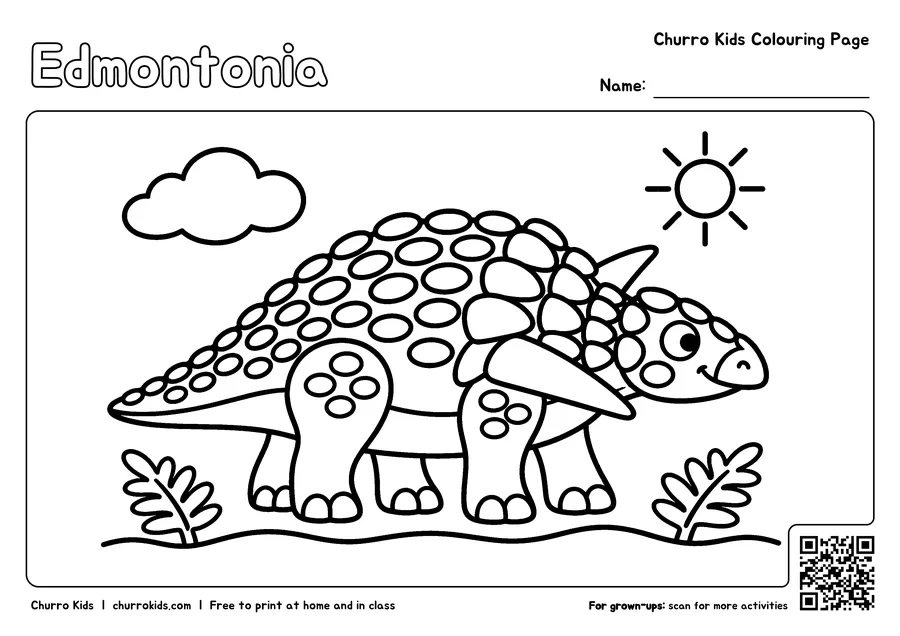
One A4 page, and it is free. Print it freely at home or in class.
Good for parents to know
- Its length differs a lot between sources. Some museum listings give about 4 metres and others give 6 to 7 metres. This guide says about 6 metres.
- What the shoulder spikes were for is still debated. Some scientists think males pushed their spikes together to test their strength, but there is no firm evidence. You can say "it probably used them to protect itself or to test its strength."
- It is easy to mix up with Ankylosaurus or Euoplocephalus. No tail club, big shoulder spikes and a narrow snout mean Edmontonia. Nobody knows yet whether it lived in groups or how it raised its babies.