"This dinosaur has no horns. What does it do when a scary dinosaur comes?" your child asks in a worried voice, looking at a dinosaur book at bedtime.
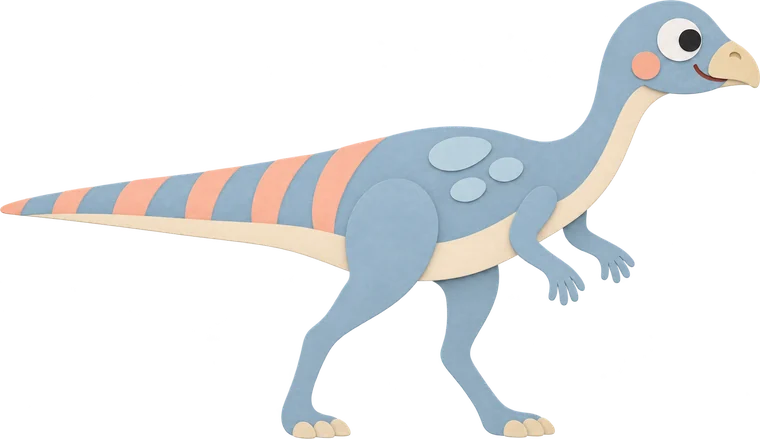
Lesothosaurus was a small dinosaur that lived in the Early Jurassic, in what is now Lesotho and South Africa in the south of Africa. It was about the size of a small dog and had a long tail. It had no armour and no horns, but it probably spotted danger quickly with its big eyes and ran away fast on its long, thin legs. Below are the questions children ask most, with answers at a child's level. You can read them out loud.
Fact cardLesothosaurus
- Name means
- lizard from Lesotho
- Lived
- Early Jurassic (about 200 to 190 million years ago)
- Length
- about 1 m (3 ft)
- Weight
- about 10 kg
- Food
- Plant-eater (it may have eaten small animals too)
- Found in
- Africa (Lesotho, South Africa)
- Group
- Very early dinosaurs (Triassic and Jurassic)
- A small, light body
- Long, thin back legs
- A small mouth with a beak
How big was Lesothosaurus? Measure it with your own height
When your child asks, answer like this
 What does Lesothosaurus mean?

How big was it?
What did it eat?
What did it do when a scary dinosaur came?
Who lived with it?
- Megapnosaurus predatorsame time and place
Megapnosaurus was a quick meat-eating dinosaur that lived in the same land. When Lesothosaurus saw this hunter, it probably ran away quickly. - Heterodontosaurus rivalsame time and place
Heterodontosaurus was a small dinosaur that lived in the same place. The two probably shared the plants that grew low down. - Massospondylus neighboursame time and place
Massospondylus was a long-necked plant-eating dinosaur that lived in the same land. Lesothosaurus probably ran about under the feet of this big neighbour.
When and where did it live?
What was it like as a baby? Did it live with friends?
Are there dinosaurs that look like it?
Who found it first?
Lesothosaurus facts that make kids say “Wow!”
- Lesothosaurus probably ran very fast on its long, thin legs.
- Lesothosaurus is a very early relative of the big dinosaur family that Triceratops and Stegosaurus belong to.
- A dinosaur about 2 m (6.5 ft) long that was given another name, Stormbergia, was probably a fully grown Lesothosaurus.
- The name Lesothosaurus has the name of Lesotho in it, the country where the fossils were found.
From head to tail
- Its eyes were big. Each eye socket was more than a third of the length of its skull.
- At the front of its upper jaw it had thin, curved teeth, six on each side.
- Its shin was about a quarter longer than its thigh, which was just right for running.
- Even the biggest thigh bone was only about 27 cm (11 in), about the length of a ruler.
A Lesothosaurus story to read aloud
In a dry field in the Early Jurassic, little Lesothosaurus greets the morning with its friends. It snips off soft leaves with its small beak and swallows them. It looks this way and that with its big eyes. Long-necked Massospondylus walks slowly by. Far away, it can see the meat-eating dinosaur Megapnosaurus. Lesothosaurus zooms away on its long, thin legs.
A quiz to do together
Tap an answer.
What did Lesothosaurus do when it was in danger?
Where does the name Lesothosaurus come from?
What were the eyes of Lesothosaurus like?
You finished the quiz! Well done.
Colouring page
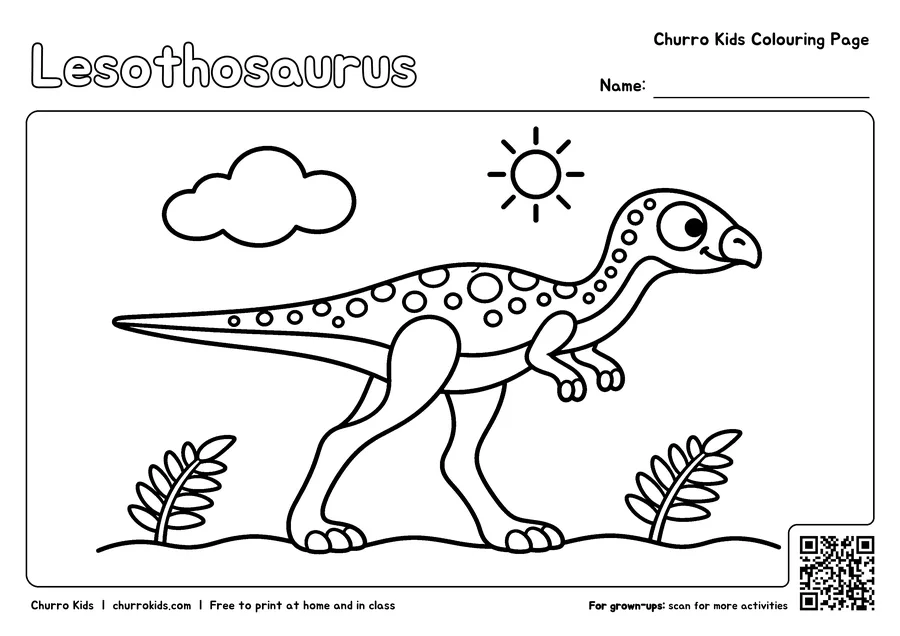
One A4 page, and it is free. Print it freely at home or in class.
Good for parents to know
- Sources give its length as anything from 1 to 2 metres (3 to 6.5 feet). That is because a dinosaur about 2 metres long that was once named Stormbergia may have been a fully grown Lesothosaurus.
- It mostly ate plants, but a study of how its teeth wore down suggests it may have eaten small animals too. You can say "it mostly ate plants, and scientists think it may have eaten small animals now and then."
- Living in groups is a guess from the bones of three animals found in one place. Running fast is also a guess from its long legs.