Stories · Sea Friends · Sea animal
Walrus Facts for Kids: What Does a Walrus Use Its Tusks For?
· Churro Kids
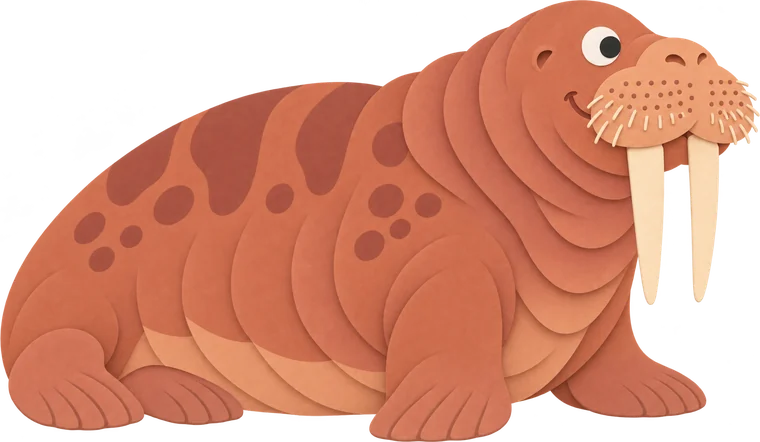
At the zoo, a walrus bobs up with its whiskery face and a child asks, "Why are its teeth so long? Is it an elephant's friend?"
The walrus is an Arctic mammal, a cousin of seals and sea lions. It hauls itself onto the ice with tusks up to about a metre long and feels for clams with 400 to 700 sensitive whiskers. Below are the questions children ask most, with answers at their level, ready to read aloud.
Fact cardWalrus Sea animal · mammal (pinniped)
- Length
- about 2.3-3.6 m (7.5-12 ft)
- Weight
- females about 400-1,250 kg, males about 800-1,700 kg
- Tusks
- up to about 1 m (3 ft), on both males and females
- Whiskers
- about 400-700
- Food
- clams and other sea-floor animals
- Home
- cold Arctic seas and sea ice
- The Arctic friend with long tusks and lots of whiskers
Walrus in a child's words
- A walrus is a mammal closely related to seals and sea lions. Its Korean name means sea elephant, but it is not an elephant at all.
- Its long tusks are teeth. Both males and females have them, and they can grow to about 1 metre (3 ft).
- A walrus hooks its tusks onto the ice to pull itself out of the water; its scientific name means tooth-walker.
- Its snout carries about 400-700 stiff, sensitive whiskers that it uses to feel for food on the dark sea floor.
- When it finds a clam, it sucks out the soft part to eat.
- Walruses are huge: a big male can weigh more than 1,500 kg (3,300 lb).
- Their skin changes colour: pale, almost white, after a long time in icy water, and pink when basking on a warm day.
Walrus: measure it with your own height
When your child asks, answer like this
 Is a walrus related to the elephant?

What are the tusks for?
Why does a walrus have so many whiskers?
What does a walrus eat?
Do female walruses have tusks too?
Why does a walrus change colour?
Where do walruses live?
Walrus facts that make kids say “Wow!”
- The walrus's scientific name means tooth-walker, because it uses its tusks to haul itself onto the ice.
- Walrus skin is about 2-4 cm (0.8-1.6 in) thick, and together with its fat it keeps out the cold.
- Walrus whiskers can grow up to about 30 cm (1 ft) long, but scraping along sand and rocks usually keeps them shorter.
A quiz to do together
Tap an answer.
What does a walrus use to find clams on the sea floor?
Which walruses have tusks?
Is the walrus a relative of the elephant?
You finished the quiz! Well done.
Colouring page
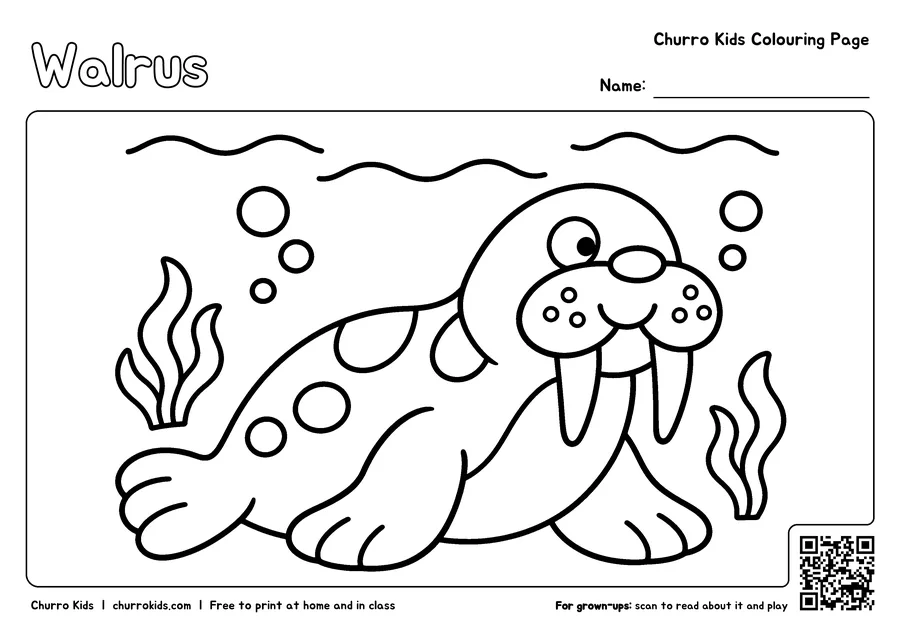
One A4 page, and it is free. Print it freely at home or in class.
Good for parents to know
- The numbers here are mostly for the Pacific walrus; Atlantic walruses are a little smaller. Weights differ between sources ("up to 1.5 tonnes", "males 800-1,700 kg").
- The Korean name 바다코끼리 (sea elephant) comes from the tusks; walruses are not related to elephants, and are not the same as elephant seals either. It is a nice example of a name that does not tell you who the real relatives are.
- Walruses rest and raise their young on sea ice, so shrinking Arctic ice affects them. This can be talked about gently at your child's level.
Things to try together
- Brush the bristles of a soft toothbrush or paintbrush across a palm. With eyes closed, try finding a small object using only the bristle tips, the way walrus whiskers work.
- Hold two white straws under your top lip (held by hand, not in the mouth) and pretend to be a walrus. Throw the straws away afterwards.
- Measure 1 metre with a tape measure: that is how long a male walrus's tusks can grow. Compare it with your child's height.