Stories · Animal Friends · Land animal
Zebra Facts for Kids: Why the Stripes, and Is a Zebra White or Black? Answers to Your Child's Questions
· Churro Kids
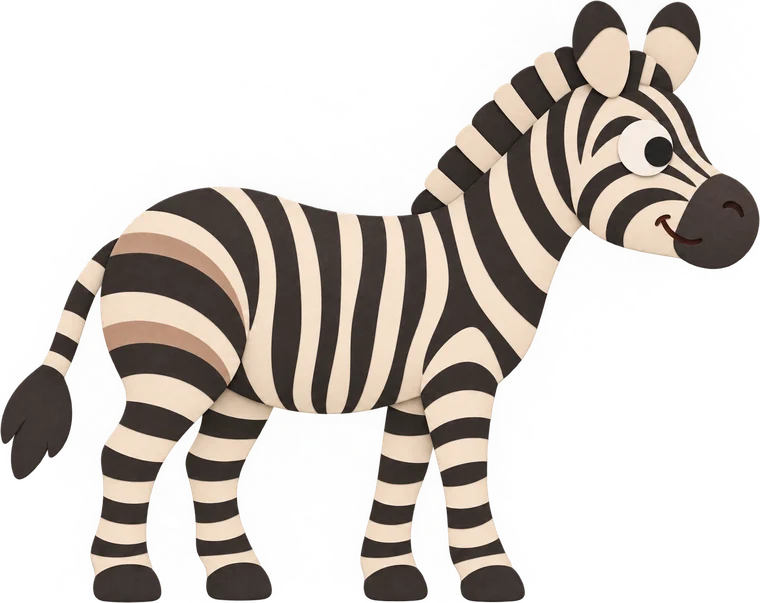
Stopping at the zebra page of a picture book, your child asks, "Is a zebra a white horse with black lines painted on?"
Zebras are close relatives of horses, and every zebra's stripes are as individual as a fingerprint. Under the coat the skin is black, so most scientists call them black with white stripes. Why they have stripes is still being studied, but keeping biting flies away is the leading idea. Below are the questions children ask most, with answers you can read aloud as they are.
Fact cardZebra Land animal · horse family
- Shoulder height
- about 1.3-1.4 m (4.2-4.6 ft)
- Weight
- about 175-320 kg (390-710 lb)
- Home
- African grasslands
- Food
- mostly grass
- Speed
- over 60 km/h (37 mph)
- Kinds
- 3 species
- Stripes as individual as a fingerprint
Zebra in a child's words
- Zebras belong to the horse family. There are three species; this page uses the commonest, the plains zebra.
- A plains zebra stands about 1.3 to 1.4 m (4.2 to 4.6 ft) at the shoulder and weighs about 175 to 320 kg (390 to 710 lb).
- Every zebra's stripes are different. Just like fingerprints, no two patterns are the same.
- Under the fur, a zebra's skin is black, which is why many scientists describe zebras as black with white stripes.
- Zebras live in families of one stallion, several mares and their young. Families often join up into very large herds.
- A newborn foal is up on its feet very soon. One zoo says foals walk at about 20 minutes old and run after about an hour.
- Zebras can run at more than 60 km/h (37 mph), about as fast as a car on a busy town road.
Zebra: measure it with your own height
When your child asks, answer like this
 Why do zebras have stripes?

Is a zebra white with black stripes or black with white stripes?
Do all zebras have the same stripes?
How fast can a zebra run?
How do zebras sleep?
What do zebras eat?
Is a zebra a kind of horse?
Zebra facts that make kids say “Wow!”
- Biting horseflies struggle to land on stripes. When horses were dressed in striped coats, far fewer flies landed on them.
- When many plains zebra families gather, thousands may travel together.
- Shave a zebra and its skin is black all over.
A quiz to do together
Tap an answer.
Do all zebras have the same stripes?
What colour is a zebra's skin under its fur?
What do zebras mostly eat?
You finished the quiz! Well done.
Colouring page
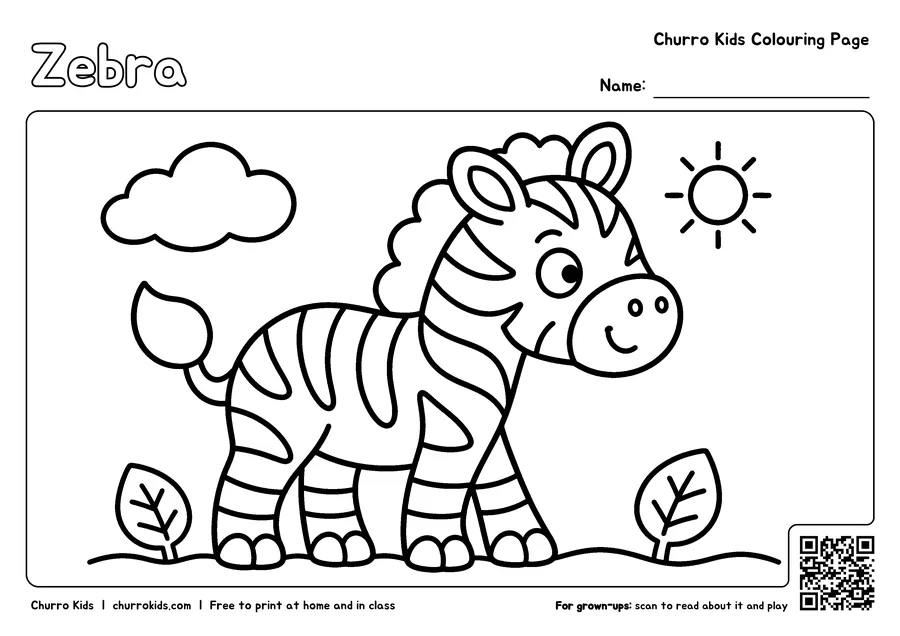
One A4 page, and it is free. Print it freely at home or in class.
Good for parents to know
- There is no settled answer to why zebras have stripes. Ideas include keeping biting flies off, making it hard to pick out one animal in a running herd, recognising each other and keeping cool; recent experiments most strongly support the fly idea. "Scientists are still finding out" is the honest answer.
- Weights differ by source: plains zebra males 220 to 322 kg and females 175 to 250 kg in one, 200 to 450 kg in another. The largest kind, Grevy's zebra, reaches about 450 kg.
- Plains zebras are still numerous (an estimated 500,000), but numbers are falling in many of the countries where they live, and the IUCN lists them as Near Threatened. At the zoo, read the sign together.
Things to try together
- Each of you draws stripes on a zebra outline, then compare: are they different? That is how real zebras are.
- Make fingerprints with paint and compare them. Everyone's are different, just like zebra stripes.
- Mark 1.3 m (4.3 ft) on a wall and compare it with your child's height. That is a zebra's shoulder.
Sources
- animals.sandiegozoo.org/animals/zebra
- nationalgeographic.com/animals/mammals/facts/zebras
- sciencefocus.com/nature/are-zebras-black-with-white-stripes-or-white-with-black-stripes
- newswise.com/articles/experts-have-discovered-how-zebra-stripes-work
- animaldiversity.org/accounts/Equus_quagga/
- en.wikipedia.org/wiki/Plains_zebra