Stories · Animal Friends · Riverside animal
Otter Facts for Kids: How Long Can an Otter Hold Its Breath, and Is It a Sea Otter? Answers to Your Child's Questions
· Churro Kids
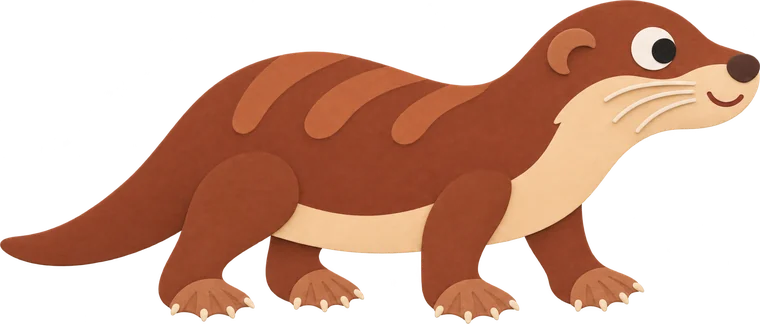
Looking at an otter photo on a riverside sign, your child asks, "How does an otter breathe underwater?"
The Eurasian otter lives along rivers and streams and belongs to the weasel family. Underwater it closes its ears and nose, swims with webbed feet and a long tail, and finds food in muddy water with its sensitive whiskers. In Korea it is a protected Natural Monument and an endangered species. Below are the questions children ask most, with answers you can read aloud as they are.
Fact cardEurasian Otter Riverside animal · weasel family
- Length
- about 60-90 cm (2-3 ft), plus tail
- Tail
- about 35-45 cm (14-18 in)
- Weight
- about 7-12 kg (15-26 lb)
- Home
- rivers, streams and coasts
- Food
- fish, crabs, frogs
- In Korea
- Natural Monument, Endangered Class I
- The swimmer that shuts its ears and nose underwater
Eurasian Otter in a child's words
- The otter is a mammal that lives both in water and on land. It belongs to the weasel family.
- Its body is about 60 to 90 cm (2 to 3 ft) long, with a tail of about 35 to 45 cm (14 to 18 in) on top. It weighs about 7 to 12 kg (15 to 26 lb).
- Webbed toes make the otter a superb swimmer, and its long, strong tail helps too.
- When it dives, an otter closes its ears and nostrils to keep the water out.
- Its long whiskers are very sensitive. Even in muddy water where it cannot see, it finds food by feel.
- Otters are mostly out at night, dawn and dusk, and rest in riverside dens during the day.
- In Korea the otter is a Natural Monument and a Class I endangered species, specially protected by law.
Eurasian Otter: measure it with your own height
When your child asks, answer like this
 How long can an otter hold its breath?

Where does an otter sleep?
Why doesn't an otter get cold in the water?
Can baby otters swim as soon as they are born?
What do otters eat?
Is an otter the same as a sea otter?
Do otters live in Korea?
Eurasian Otter facts that make kids say “Wow!”
- An otter's eyes sit high on its head, so it can keep its body underwater and still look around above the surface.
- Each foot has five webbed toes, and otters leave five-toed footprints in riverside mud.
- Underwater, an otter's heart slows down, which saves oxygen and lets it dive for longer.
A quiz to do together
Tap an answer.
What does an otter close underwater?
What helps an otter find food in muddy water?
What is between an otter's toes?
You finished the quiz! Well done.
Colouring page
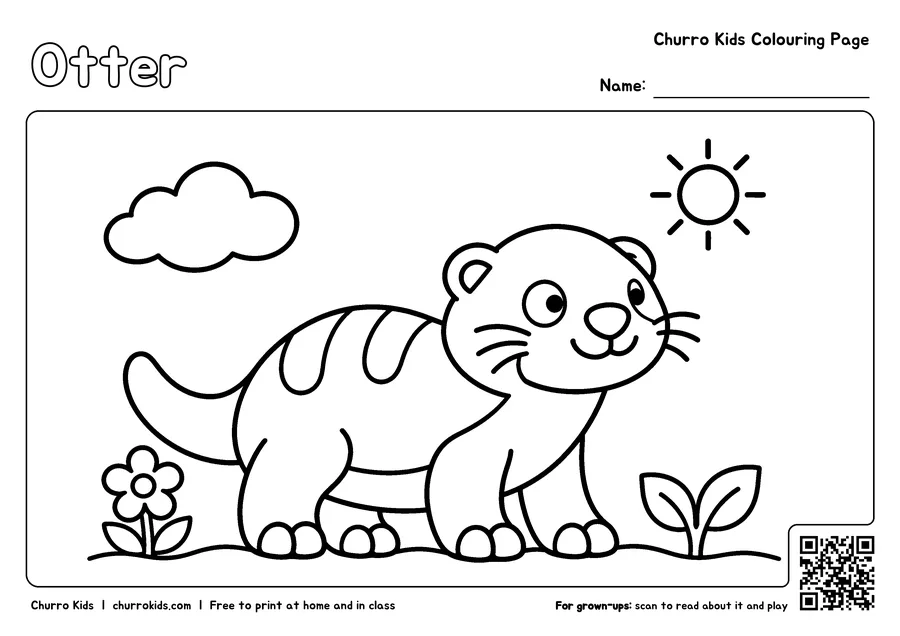
One A4 page, and it is free. Print it freely at home or in class.
Good for parents to know
- Breath-holding figures vary, from 'about 30 seconds' to 'several minutes'. Otters make many short dives and can stay under longer when needed.
- News articles often say 'Natural Monument No. 330'. Since November 2021 Korea no longer uses numbers for designated national heritage, so this page just says Natural Monument. Otters are also Class I endangered wildlife and must not be caught or kept.
- If you see an otter by a stream, watch quietly from a distance. Do not go close or feed it.
Things to try together
- Lie on your tummy with a blanket pulled up to your nose and peek out with just your eyes. That is how an otter watches from the water.
- Sweep your spread fingers through water, then try again wearing a plastic glove. Webbing lets you push more water.
- Measure 1.1 m (3.6 ft) with a tape measure: an otter from nose to tail tip. Compare it with your child's height.
Sources
- wildlifetrusts.org/wildlife-explorer/mammals/otter
- woodlandtrust.org.uk/trees-woods-and-wildlife/animals/mammals/otter/
- treesforlife.org.uk/forest/european-otter/
- wwt.org.uk/news-and-stories/news/spotlight-on-the-european-otter-and-how-to-see-them-in-the-wild
- news.seoul.go.kr/env/?p=515931
- newsis.com/view/NISX20211119_0001657691
- en.wikipedia.org/wiki/Eurasian_otter
- ko.wikipedia.org/wiki/수달
- ko.wikipedia.org/wiki/국가유산청