Stories · Animal Friends · Land animal
Rhino Facts for Kids: What Is a Horn Made of, and Is a White Rhino Really White? Answers to Your Child's Questions
· Churro Kids
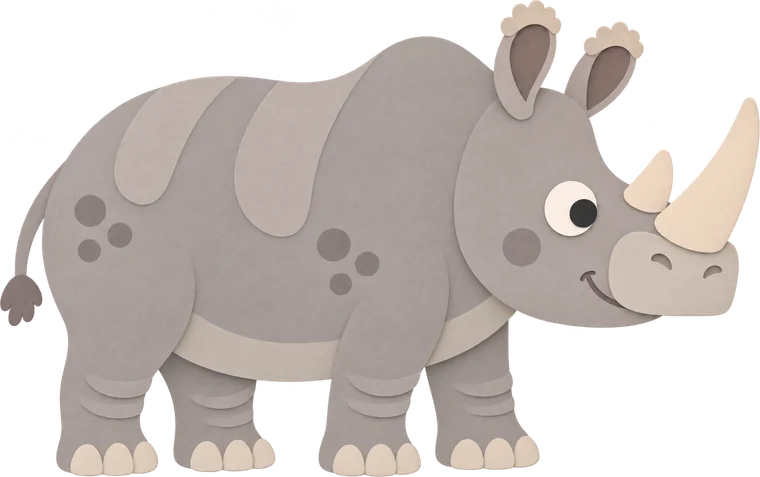
After staring at the rhino enclosure for a long time, your child frowns and asks, "If it's a white rhino, why is it grey?"
The white rhino is the biggest of the five rhino species and, after the elephants, one of the heaviest animals on land. Its two horns are not bone but keratin, like your fingernails, and its wide, square lips crop grass like a lawnmower. Despite the name, it is grey. Below are the questions children ask most, with answers you can read aloud as they are.
Fact cardWhite Rhino Land animal · rhinoceros
- Body length
- about 3.4-4 m (11-13 ft), tail not included
- Shoulder height
- about 1.5-1.8 m (5-6 ft)
- Weight
- about 1,600-2,500 kg (3,500-5,500 lb)
- Horns
- 2 (the front one is longer)
- Home
- African grasslands
- Food
- grass
- A grassland giant with two horns on its nose
White Rhino in a child's words
- There are five kinds of rhino in the world. This page is about the biggest of them, the white rhino.
- A white rhino weighs about 1,600 to 2,500 kg (3,500 to 5,500 lb). After the elephants, it is counted among the heaviest animals on land.
- It has two horns on its nose: a longer one in front and a smaller one behind.
- The horns are not bone. They are made of keratin, the same material as your fingernails and hair, and a broken horn slowly grows back.
- White rhinos have wide, square lips and crop short grass like a lawnmower.
- They love mud baths. Mud keeps them cool and protects them from the sun and from insects.
- A baby rhino grows inside its mother for about 16 months and weighs about 40 to 60 kg (90 to 130 lb) at birth.
White Rhino: measure it with your own height
When your child asks, answer like this
 Is a white rhino really white?

What is a rhino's horn made of?
What do rhinos eat?
Why do rhinos roll in mud?
Can rhinos see well?
Can rhinos run?
How many rhinos are there?
White Rhino facts that make kids say “Wow!”
- Some white rhino front horns have grown more than 1.5 m (5 ft) long, though most are much shorter.
- For all its size, a white rhino eats nothing but grass. It never eats meat.
- A newborn calf is said to be on its feet within about an hour, and it stays with its mother for a few years (about three, according to one conservation group).
A quiz to do together
Tap an answer.
A rhino's horn is made of the same stuff as what?
What does a white rhino eat?
What colour is a white rhino really?
You finished the quiz! Well done.
Colouring page
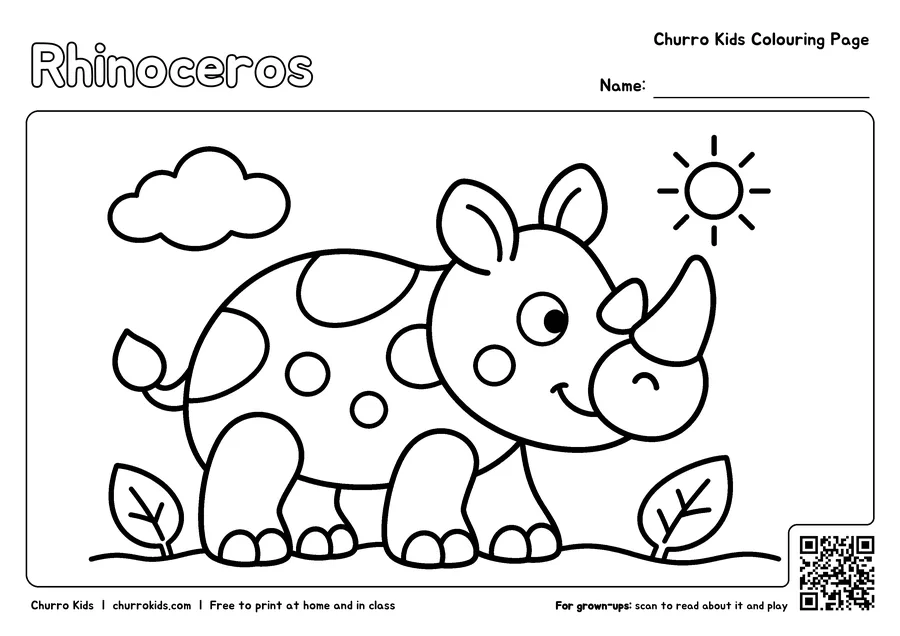
One A4 page, and it is free. Print it freely at home or in class.
Good for parents to know
- The popular story that "white" comes from a Dutch word for "wide" is widely repeated, but many experts doubt it. "Nobody is quite sure where the name came from" is the safe answer.
- Weight, speed and horn length differ between sources. Speed is given as about 40 km/h by one conservation group and over 60 km/h elsewhere.
- Rhinos have declined mainly because people hunt them for their horns. With young children, "the horn belongs to the rhino, and people are working to keep rhinos safe" is enough.
Things to try together
- Look at your child's fingernails together: "A rhino's horn is made of the same stuff." Just as nails grow, horns grow too.
- Measure 3.7 m (12 ft) across the living room: the length of a white rhino. How many children lying head to toe would it take?
- Colour a rhino with a muddy brown crayon. Even a "white" rhino turns the colour of the soil after a mud bath.