Stories · Animal Friends · Land and water animal
Hippo Facts for Kids: Is It True They Can't Swim? Answers to Your Child's Questions
· Churro Kids
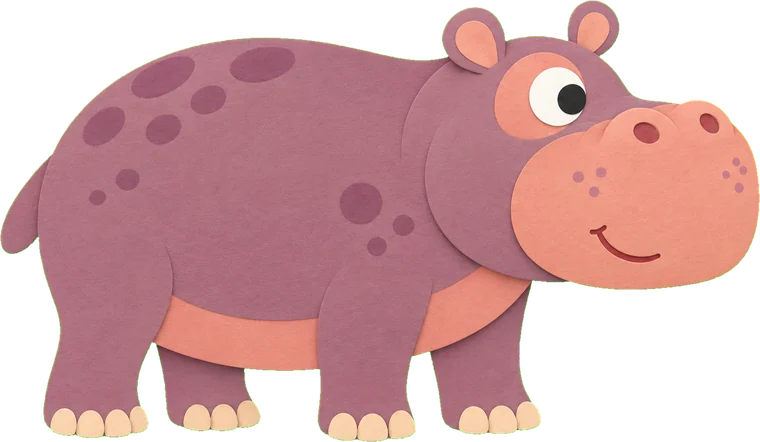
After a long wait by the hippo pool, your child asks, "Why won't it come out? What is it doing down there?"
A hippo spends the day cooling off in the water and comes onto land at night to eat grass. Weighing well over a tonne, it does not float; it walks along the riverbed. Its skin makes a red liquid that works as sunscreen. Below are the questions children ask most, with answers you can read aloud as they are.
Fact cardHippopotamus Land and water animal · hippopotamus
- Body length
- about 3.3-5 m (11-16.5 ft)
- Weight
- about 1,300-3,200 kg (1.3-3.2 tonnes)
- Home
- rivers and lakes of Africa
- Food
- grass
- Food per night
- about 40 kg (88 lb)
- Holding breath
- about 5 minutes
- It can't really swim, but it loves the water most
Hippopotamus in a child's words
- A hippo spends the day in the water and comes onto land after sunset to eat grass.
- It is about 3.3 to 5 m (11 to 16.5 ft) long and weighs about 1,300 to 3,200 kg. It is one of the heaviest land animals after the elephants.
- Hippos live in water but are poor swimmers. They are too heavy to float, so they walk or bounce along the riverbed.
- An adult can hold its breath underwater for about 5 minutes.
- Hippos are plant-eaters. One eats about 40 kg (88 lb) of grass in a night.
- A hippo's skin gives off a sticky reddish liquid that protects it from sunburn.
- Its eyes, ears and nostrils sit on top of its head, so it can see, hear and breathe with its body underwater.
Hippopotamus: measure it with your own height
When your child asks, answer like this
 Why do hippos stay in the water all day?

Are hippos good swimmers?
What do hippos eat?
Do hippos sleep underwater?
Do hippos sweat blood?
Why does a hippo open its mouth so wide?
Are hippos slow?
Hippopotamus facts that make kids say “Wow!”
- Scientists think the hippo's closest living relatives are not pigs but whales and dolphins.
- The name comes from ancient Greek for "river horse". The Korean name, hama, means the same thing.
- A newborn calf already weighs about 25 to 50 kg (55 to 110 lb), as much as a primary-school child.
A quiz to do together
Tap an answer.
What does a hippo eat?
How does a hippo get around in the water?
What does the red liquid on a hippo's skin do?
You finished the quiz! Well done.
Colouring page
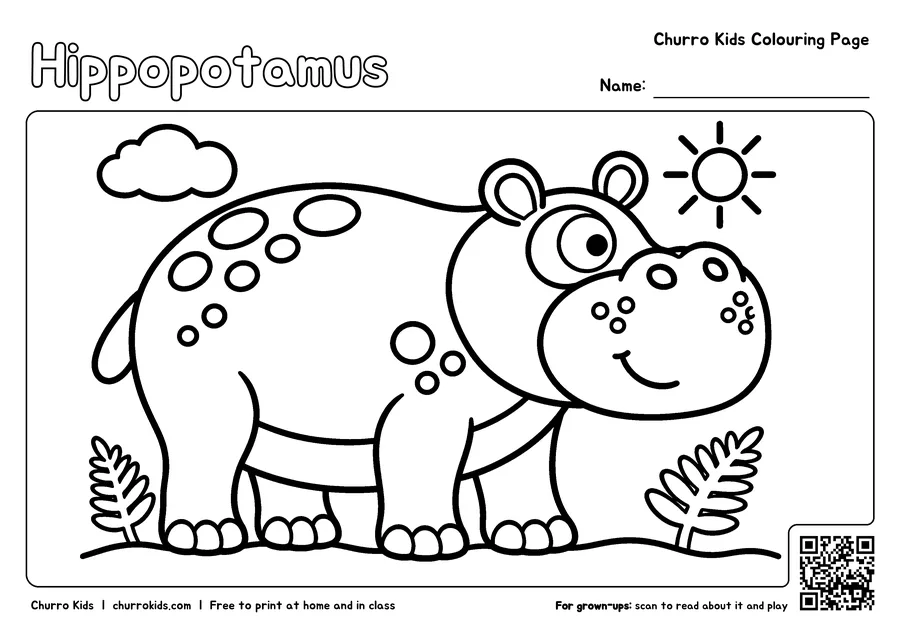
One A4 page, and it is free. Print it freely at home or in class.
Good for parents to know
- Weights vary a lot by source: some give a wild average of about 1,400 to 1,500 kg, others say large males pass 3,000 kg. The gape is given as about 100 degrees in some sources and 150 in others.
- Hippos look cuddly but are strongly territorial. Rather than making them scary, try: "We watch wild animals from far away."
- The often-quoted running speed of 30 km/h (19 mph) is widely used but, according to some, has never been properly measured.
Things to try together
- In a bath or pool with a grown-up, try moving without swimming, pushing off the bottom in little bounces. That is how a hippo travels underwater.
- Open your mouth as wide as you can in front of a mirror. A hippo can open much wider.
- Measure 3.5 m (11.5 ft) on the floor: one hippo. How many family members lying head to toe does it take?